- WAFT
- 1) A term, now obsolete, for a flag tied in a knot and displayed at sea as a
signal of some emergency – a wheft or weft (see also
flag of distress) and its following note).
2) (adv) The term may also be used to describe a flag that is tangled or is otherwise
disordered.
- WALKING STAFF
- See baton(s) 3) and pilgrim's staff.
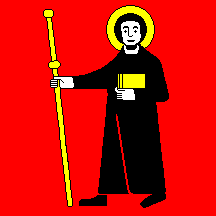
Flag of Glarus canton, Switzerland
- WANDERFAHNE
- See touring flag).
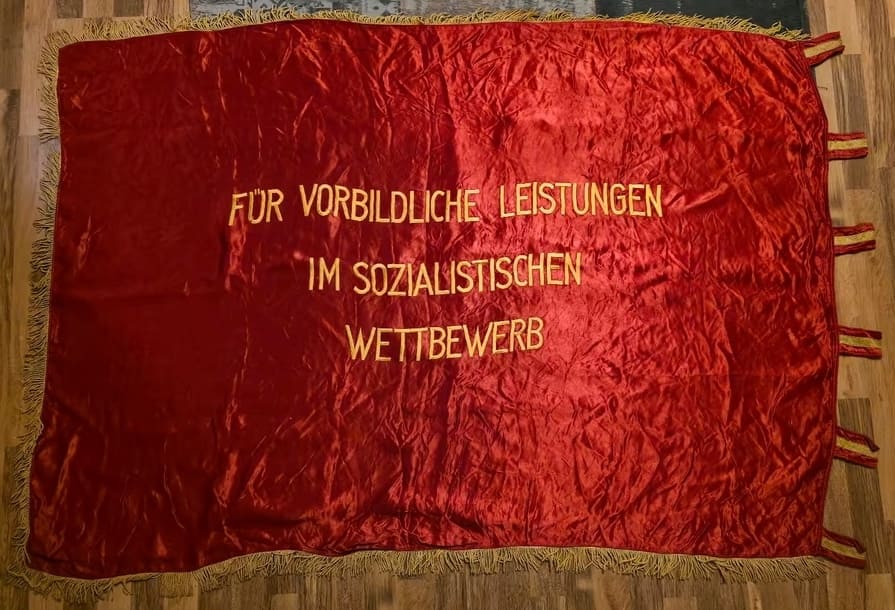
Wanderfahne/Touring Flag (kleinanzeigen.de)
- WAND OF HERMES (or MERCURY)
- Alternative heraldic terms for caduceus.
![[staff of Hermes example]](../images/v/vx-nl-fr_hw.gif)
![[staff of Hermes example]](../images/v/vx-nl-fr)hw.gif)
Flag and Arms of Holwerd, Netherlands
- WANING or WAXING MOON
- Two terms that, whilst potentially contradictory, are sometimes used to describe
the orientation of a crescent moon in place of the more accurate vexillological
phrases “with points towards the hoist or towards the fly”, or of their heraldic
equivalents “increscent/increment” or “decrescent/decrement” – see
crescent 1),
moon 1),
moon 2).
![[waning/waxing moon example]](../images/v/vx-goleniow).gif)
![[waning/waxing moon example]](../images/v/vx-pl-zp-gl.gif)
Arms and Flag of Goleniów, Poland (Wikimedia)
Notes
a) A “waxing moon” in the southern hemisphere looks like a “waning moon” in the
northern (or vice-versa), and its orientation depends upon whether the flag is dexter-hoisted in the
western tradition or sinister-hoisted as in the Arabic. Therefore, the Editors recommend use of either
the vexillological or heraldic terms noted above
b) These terms, whilst not used in modern English heraldry, do occasionally appear in medieval
heraldic blazoning.
- WAR BANNER
- In UK usage a term, last used in 1853 and now obsolete, for a small white
triangular flag seen on military drums at a proclamation of war (see also
bannerette).
- WAR ENSIGN/FLAG
- 1) An alternative term for the naval ensign.
- 2) Alternative terms – and translations of the German Kriegsflagge or Spanish bandera de Guerra
– for that flag (different from the national flag) flown by a country’s armed
services, which is usually (but not invariably) the same design as the naval ensign
and/or state flag – a flag of war (see also battle flag 3)
and ‘naval ensign/war ensign’ under ensign).
3) A variant of the national flag that is used while the country is in a state of war.
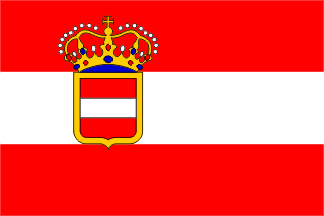
![[Singapore War ensign]](../images/v/vx-sg~n.gif)
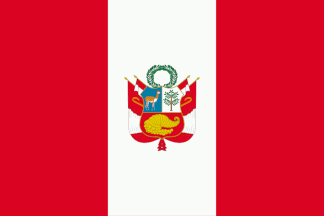
War/Naval Ensign 1880–1915,
Austria/Hungary;
War/Naval Ensign of Singapore;
War Flag of Peru
Please note with regard to 3) that in time of war The Philippines fly their National Flag (which also
acts as a Naval and Civil Ensign) with the red stripe uppermost thus creating a war flag.
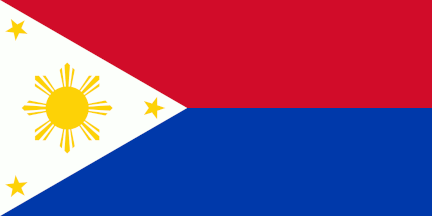
National Flag of The Philippines in War Flag format (red over blue instead
of blue over red)
- WAR (or WARSHIP) PENNANT
- See masthead pennant 1).
![[War pennant]](../images/v/vx-ve_26wp.gif)
Warship/Masthead Pennant of Venezuela c1920
- WAR WAGON
- See carrocerum.
- WARNING FLAG
- 1) See red flag 1)
- 2) The term, and a direct translation of the German warnflagge, that is also used to
describe the red and white flag flown by (slow-moving) snow clearance vehicles (see also
beach flag,
fire alert flag,
range flag,
storm warning flags).
![[Warning flag]](../images/v/vx-es~bch_r.gif)
![[Warning flag]](../images/v/vxt-d2000.gif)
Warning/Red Flag; Warnflagge (James Dignan)
- WARRANT
- In UK usage and in some others, the legal instrument by which
display/augmentation of a territorial coat of arms or of a flag – usually (but not invariably) in
this latter case a defaced version of an established design
is authorized (see also
blue ensign 1) with its following note,
flag law,
red ensign 1) with its following note,
royal order in council 1),
royal proclamation and
yacht ensign under ensign
with its following note).
![[Royal Naval Reserve, The Netherlands]](../images/v/vx-nl~res.gif)
![[The British Antarctic Territories arms]](../images/v/vx-gb_ll.gif)
![[Royal Lymington Yacht Club]](../images/v/vx-gb~lym.gif)
Ensign of the Royal Naval Reserve, The Netherlands;
Flag of a Lord-Lieutenant, UK;
Ensign of The Royal Lymington Yacht Club, UK
Notes
a) Illustrations 1) and 2) above were authorized by Royal Warrant, and 3) by a Warrant of the Admiralty. In addition, such Warrants may be issued by a Governor General or by the UK Minister of Defence (see note b) below).
b) The Board of Admiralty ceased to exist in 1964, and its power to issue (or to withdraw) warrants was
transferred to the Minister of Defence – see
anchor flag.
- WARRANT OF THE MINISTER OF DEFENCE (or OF THE GOVERNOR GENERAL)
- See warrant.
![[Government Ensign of Guernsey]](../images/v/vx-gg~gov.gif)
![[Lt Governor of Saskatchewan]](../images/v/vx-ca-sk_lg.gif)
Government Ensign of Guernsey established by Warrant of the Minister of
Defence, UK;
Flag of the Lt Governor of Saskatchewan Canada authorized by Warrant of the
Governor General
- WASHFASTNESS
- See fastness.
- WATER-POURING (WATER-GUSHING or WATERSPOUT) FOUNTAIN
- See
fountain 2).
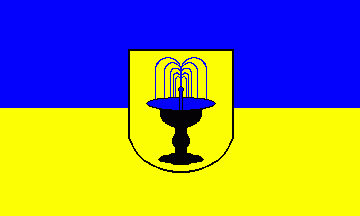
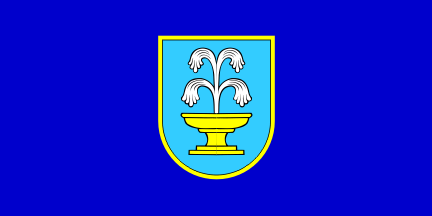
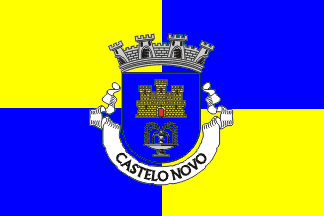
Flag of Borne, Germany;
Flag of Funtana, Croatia;
Flag of Castelo Novo, Portugal
- WATERWHEEL (WATER-WHEEL or WATER-MILL WHEEL)
- Alternative terms for a representation of a wheel that usually (but not invariably) provides the
motive power for the grinding of wheat or other cereal – a riverwheel, water-wheel, water mill
wheel or millwheel – see millstone
(also cog-wheel,
scoop wheel, windmill).

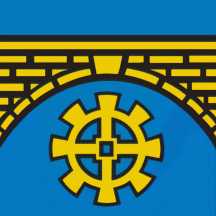

Flag of Sorfold, Norway;
Flag of Bromolla, Sweden;
Flag of Mississauga, Canada
- WATTLE(D)
- 1) On flags, a plaque, frame or ornament consisting of two or more interlaced
branches, and typically used on Croatian flags (see also
cartouche and ring).
- 2) In heraldry, the term refers to the fleshy lobe that grows under the throat
of a domestic fowl and in the adjective form is used when the wattle is of a different
tincture to the body of the bird concerned – but see jelloped
and comb(ed).
![[Wattle example]](../images/v/vx-hr-du-bl.gif)
![[Wattle example]](../images/v/vxt-d349.gif)
![[Wattle example]](../images/v/vx-es-co-gj.gif)
Flag of Blato, Croatia;
Example (Željko Heimer);
Flag of La Granjuela, Spain
- WAVY
- (adj) A basically heraldic term used when the edges of an
ordinary/charge, or the division line of the field on a shield,
banner of arms or a flag are shown with wavy lines, and often
(but by no means invariably) symbolic of running water – unde or undy (see also
active,
barry wavy,
engrailed,
invected,
nebuly,
serrated).
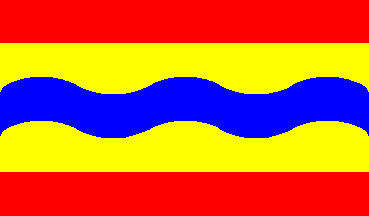
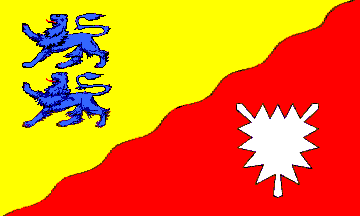
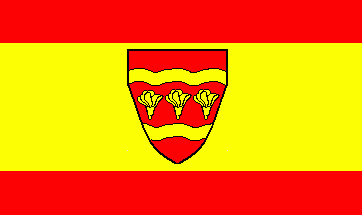
Flag of Overijssel, Netherlands;
Flag of Rendsburg-Eckernförde, Germany;
Flag of Saerbeck, Germany
- WAVY FLAME
- In English then British usage, now obsolete, the term used to describe a
pile wavy as it appeared on military colours (see also
flammes,
pile 2), stand 1),
venn,
wavy).
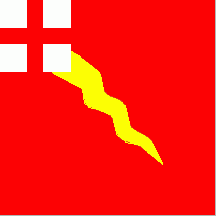
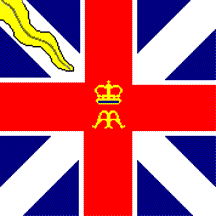
Major’s Colour in Venn A, England c1643;
Major’s Colour, UK c1710
- WAXING or WANING MOON
- See waning or waxing moon (above).
- WAYSIDE CROSS
- In often (but not exclusively) South European usage, the term for a cross set upon a (variously
designed) plinth, and intended as a focus for the spiritual comfort of travellers – but see
cross of calvary 1).
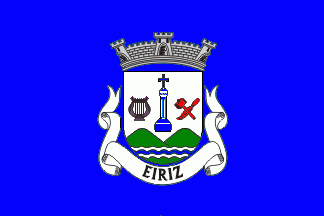
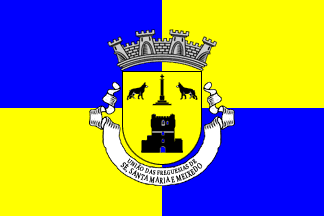
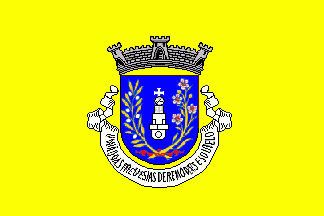
Flag of Eiriz, Portugal;
Flag of Santa Maria e Meixedo, Portugal;
Flag of Remondes e Soutelo, Portugal
- WEAR A FLAG
- (v) To display a flag – said of a ship or any vessel (see also
ensign 1) and
fly 2)).
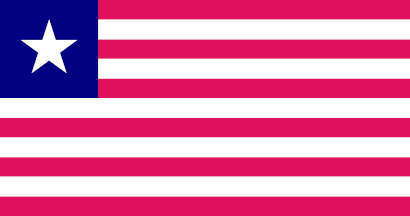
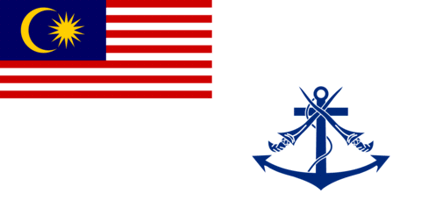
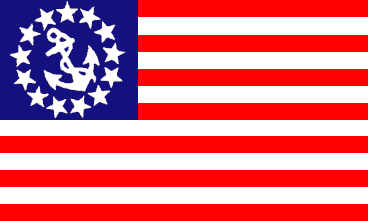
National Ensign/Flag of Liberia;
Naval Ensign of Malaysia;
Yacht Ensign of the USA
- WEATHER (or WEATHER-WARNING) FLAG (or PENNANT)
- 1) See storm warning flag (also
beach flag).
2) In Japanese usage now obsolete, flags or pennants flown prominently in urban areas to advise of
anticipated weather conditions (see also safety flag).
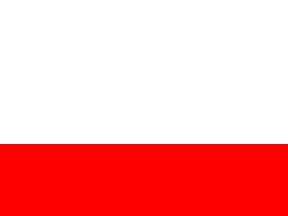
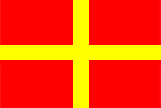
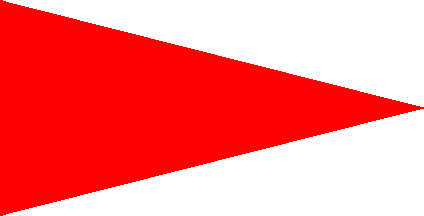
Clear sky, Japan; Loading/Unloading of Cargo Suspended, Chile;
Small Wind Craft Warning, US
- WEATHER VANE
- See vane 4).
- WEAVER'S (or WEAVING) SHUTTLE
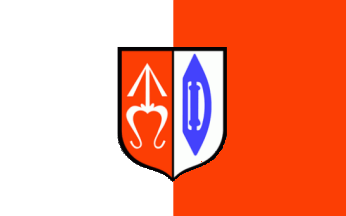
- The representation of a wood and metal device used in the (hand or mechanical)
weaving process – a shuttle or weaving shuttle, or (incorrectly) a spinning shuttle (see also
spinning wheel).
.gif)
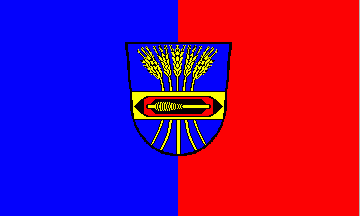
Flag of Ozorków, Poland;
Arms of Carção, Portugal;
Flag of Zetel, Germany
- WEDGE
- See pile 3).
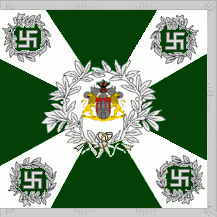
Colour of the Hamburg State Police c1936–1945, Germany
- WEDGE WAVY
- See piles(s) wavy 1).
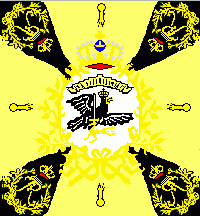
Colour of the
46th Regiment of Foot c1750, Prussia
- WEFT
- 1) See waft.
2) The term used in weaving to describe those yarns attached to a movable shuttle, and
which run alternately above and below those fixed to the loom (the warp).
- WEIGHTED FLY
- A term which may be used when a metal rod (or similar)
is inserted into a sleeve placed at the fly of a conventional/hoisted flag
(intended to he hung from a horizontal pole) in order to weight it for vertical hanging and to
prevent the flag becoming entangled with its pole (see also
flagpole,
outrigger pole,
tangle rod).
Please note that this term has been introduced by the
Editors as no existing established term could be found.
- WELSH (or WALES) PENNANT
- In UK usage, the terms employed to describe a white over green trapezoidal
(bicolour) pennant with a Welsh dragon set towards the hoist, which
may be flown where a flagpole would otherwise be unused – a Pennant of Wales (see also
bicolour 2),
dragon,
english pennant,
hoist 1),
offset towards,
scottish pennant,
trapezoid 2),
union pennant,
wimpel 1)).
- WEST-EAST DIAGONAL
- A diagonal stripe that runs from the upper hoist to the lower fly whose corners
generally touch the corners of the flag but whose width is entirely contained
within the width of that flag – a reduced bend – see bend
and
Appendix IX (also
ascending diagonal,
descending diagonal,
east-west diagonal,
north-east diagonal,
north-south diagonal,
south-east diagonal,
south-north diagonal,
west-north diagonal,
west-south diagonal).
![[Brunei]](../images/v/vx-bn.gif)
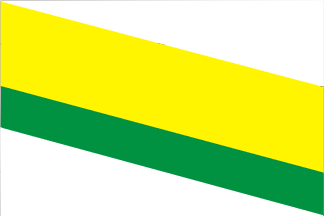
National Flag of Brunei;
Flag of Prosatín, Czechia
- WEST-NORTH DIAGONAL
- A diagonal stripe running from the lower hoist to the upper fly, whose corners may (or may not)
touch the corners of the flag but whose width is contained within the length of the flag at the
fly and the width of the flag at its hoist (see also
Appendix IX,
ascending diagonal,
descending diagonal,
east-west diagonal,
north-east diagonal,
north-south diagonal,
south-east diagonal,
south-north diagonal,
west-north diagonal,
west-east diagonal,
west-south diagonal).
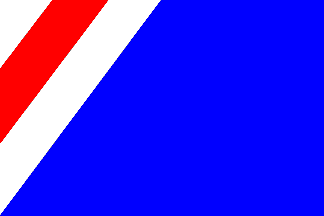
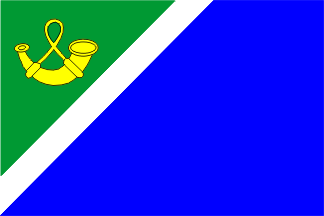
Flag of Dešná, Czechia;
Flag of Lovcice, Czechia
Please note that this term, whilst an extension
of those existing and established, has been introduced by the editors.
- WEST-SOUTH DIAGONAL
- A diagonal stripe running from the upper hoist corner to the lower fly corner, whose corners may
(or may not) touch the corners of the flag but whose width is contained within the width of the flag
at the hoist and the length of the flag at its fly (see also
Appendix IX,
ascending diagonal,
descending diagonal,
east-west diagonal,
north-east diagonal,
north-south diagonal,
south-east diagonal,
south-north diagonal,
west-north diagonal).
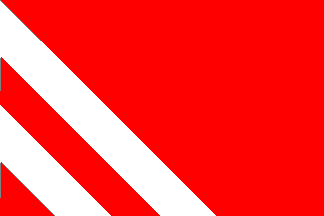
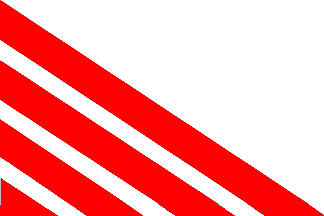
Flag of Žákava, Czechia; Flag of
Makov, Czechia
Please note that this term, whilst an extension of those existing and established,
has been introduced by the editors.

