- LABARUM
- 1) A flag based on the vexillum and combining Christian symbols with those of the
Roman military, introduced by the Emperor Constantine in the early 4th Century AD, and
later used as an imperial standard – but see cantabrian labarum
(also vexillum).
2) The term sometimes used to describe a simple religious banner used in the Roman Catholic Church
or the depiction of such a banner on flags – see banner 3).
3) A term also used to describe an elaborate (gonfalon-like) banner
of the Eastern Orthodox Church.
![[labarum]](../images/v/vx-it_labcn.gif)
![[labarum]](../images/v/vx-at-8.gif)
![[labarum]](../images/v/vx-it_leg13.gif)
The Labarum of Constantine;
State Flag of Vorarlberg, Austria;
Vexillum of the Roman Legio XIII Gemina
Please note – not to be confused with a
Cantabrian labarum.
- LABEL
- 1) See cadency, mark of.
- 2) In heraldry a term sometimes also used to describe the tapes which hang below a prelate’s
mitre – but see stringed.
- 3) In British usage, the (varyingly detailed) marks of cadency employed on the standards of particular
Royal Family members (see also royal standard(s) 2), plus
cadency, mark of and its following note
difference 1) and
variant 1)).
![[label example]](../images/v/vx-gb-pow.gif)
![[label example]](../images/v/vx-gb_rspsa.gif)
![[label example]](../images/v/vx-gb_rsphw.gif)
British Royal Standards Showing the Labels of HRH The Prince of Wales,
HRH Princess Anne,
and of HRH Prince Henry
- LAMBEAU
- An alternative heraldic term to dovetailed.
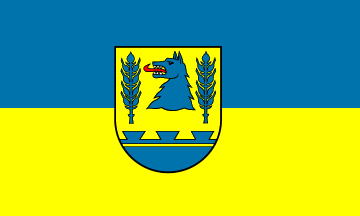
Flag of Wendeburg, Germany
- LAMB OF GOD
- See agnus dei.
![[lamb of God]](../images/v/vx-nl-fr_be.gif)
Flag of Berlikum, The Netherlands
- LANCE
- A long light-weight spear with which some cavalry regiments were formerly
armed, and upon which the standard or guidon was also carried – now restricted
to historical or ceremonial use (see also
guidon 1) & 2),
lance flag, lance pennon 1),
staff 2)
and standard 2)).
![[lancer]](../images/v/vx-lancer1812.jpg)
Lancer, France 1812 (Wikipedia)
- LANCE FLAG (or PENNANT)
- A small flag or pennant, usually swallow-tailed or triangular and of
generally simple (bicolour) design, formerly carried below the lance head by
those cavalry regiments so armed, or currently by some mounted police units in
parade dress, and now restricted to historical/ceremonial use – a lance
pennant or pennon (see
also banneret 2),
pennant 2),
lance and lance pennon 1)).
![[lance flag]](../images/v/vx-d193.gif)
![[lance flag]](../images/v/vx-lb^pennt.gif)
Lance Flag, British c1840;
Lance Pennant, Lebanon
Please note that the use of lance-armed cavalry and the
general design of their flag or pennant derive from Polish practice – Poland having
been the country from which lance-armed light cavalry was adopted in the late 18th
century.
- LANCE PENNON
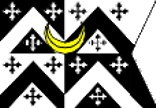
- 1)The term for an armigerous lance flag,
either fork-tailed or square-ended according to rank, and carried by a medieval mounted warrior (see
also banner of arms,
banneret 2), lance,
pennoncier, heraldic standard.
2) See badge pennon.
3) See lance flag.
![[Lance pennon]](../images/v/vx-d1088.gif)
![[Lance pennon]](../images/v/vx-d668.gif)
Lance Pennon of Sir Robert Knolles. Knight Banneret c1360, England;
Lance Pennon of a Pennoncier (or Knight Bachelor), England 1415; Badge Pennon, England c1460
- LANCEOLATE
- (adj) A term that may be used to describe a rounded fly – but
see note below and ogival
(also descate,
guidon 3), standard 4) and
heraldic standard).
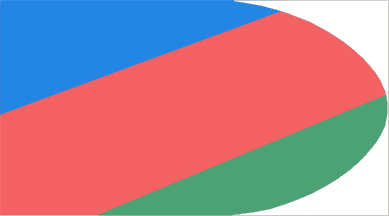
Flag of Leśna, Poland
Please note that the differences between ogival
and “lanceolate” are often very slight, and we suggest that both entries be consulted.
- LANDESFARBEN
- See national colours 2) and
state colours 3) (also
livery colours).
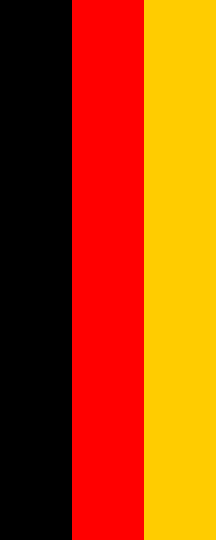
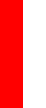
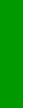
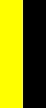
Landesfarben/National Colours, Germany; Landesfarben/State Colours, Brandenburg, Saxony and
Saxony-Anhalt
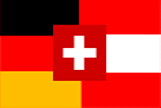
- LANGUAGE FLAGS
- See linguistic flags.
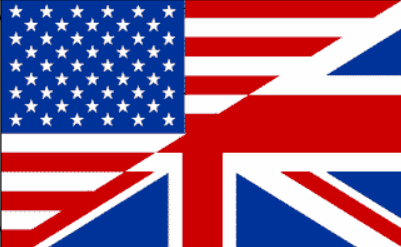
Amalgam/Language Flags for English and German
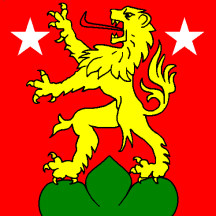
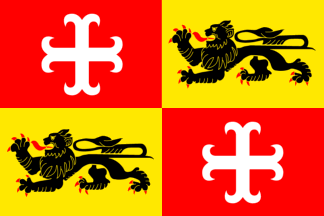
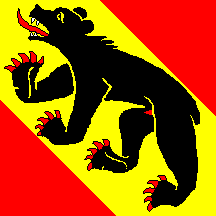
- LANGUED
- The heraldic term used when the tongue of the beast, if shown, is of different
tincture than the rest of the body (see also
armed 2),
armed and langued,
attired,
beaked,
membered).
Flag of Zermatt, Switzerland;
Flag of Aalter, Belgium;
Flag of New Bern, US
- LANYARD
- 1) In French military usage and in some others – and a translation of fourragère
– the term for those cords and tassels that are worn on
military uniforms to signify the award of a unit decoration, and may decorate that unit's military
colour – see cord 1)
and aiguillette
(also colour 2),
cravat 1),
jack of honour,
lanyard pennant).
2) See halyard.
3) See dress knot and its following note.
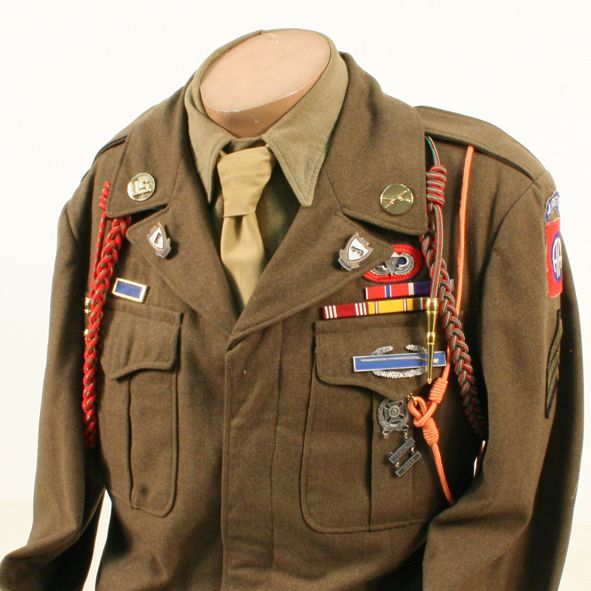
(sofmilitary.co.uk)
- LANYARD PENNANT
- In French Naval usage, the term – and in the language of that country a flamme de
fourragère – for a tapered pennant in various colours, charged with the Croix de Guerre and
having a rounded (or lanceolate) fly, which is flown to indicate that a vessel
has received citations for a certain number of military decorations (see also
cravat 1) and its following note,
fanion 3),
jack of honour,
lanyard 1),
pennant 2)).
![[Lanyard pennant]](../images/v/vx-fr~f146.gif)
![[Lanyard pennant]](../images/v/vx-fr~f394.gif)
Six citations for the Legion d’Honneur, 1914–18; 4–5
Citations for the Médaille Militaire 1939–45
- LAPEL FLAG (or PIN)
- 1) A metal or plastic flag – sometimes showing a badge or coat of arms
below – worn on the dress or coat lapel as a patriotic or political symbol,
originally characteristic of the United States and the former Soviet Union,
but now widely used elsewhere – a flag badge or flag pin.
- 2) A paper flag see flag day 2).
![[flag pin]](../images/v/vx-pingl.png)
![[flag pin]](../images/v/vx-pinua.png)
Flag pins (buyldsproducts.com/fahnenwelt.ch)
- LAPPED
- A term sometimes incorrectly used to describe the leaves of a rose in place
of the heraldic barbed.
- LAPPETS
- The heraldic term sometimes used to describe the tapes which hang below a bishop’s
mitre –
but see stringed.
![[lappets]](../images/v/vx-pt-brgrd-re).gif)
![[lappets]](../images/v/vx-pt-brgrd-re.gif)
Arms and Flag of Real, Braga, Portugal
- LARMES
- An alternative heraldic term to gouttes.
![[gutty / larmes]](../images/v/vx-no)12-42.gif)
![[larmes]](../images/v/vx-no-12-42.gif)
Arms and Flag of Samnanger, Norway
- LATE-GOTHIC (or LATE-GOTHIC-STYLE) SHIELD
- Terms sometimes used (albeit inaccurately) in vexillology to describe a round-bottomed or
spanish-style shield –
but see note below (also rectangular shield,
shield 2)).
Please note that in vexillology the terms Gothic and late-Gothic appear to be used indiscriminately
to describe either a pointed or a round-bottomed shield, and the Editors suggest therefore, that both
these terms, if used at all, should be restricted to those with a pointed base.
- LATE MEDIEVAL SHIELD
- See renaissance shield.
![[Ilok]](../images/v/vx-hr-vu-il.gif)
Flag of Ilok, Croatia
- LATIN CROSS
- The heraldic term for a cross that does not usually extend to the edges of
a shield, flag, panel or flag, but whose horizontal arm is shorter than its
vertical and which is set above the centre line – a long cross – but see the notes below
(also greek cross and cross 2)).
![[Latin cross]](../images/v/vx-pt-mgdva.gif)
![[Latin cross]](../images/v/vx-co-boylu.gif)
![[Latin cross]](../images/v/vx-pt-bnv.gif)
Flag of Vila de Ala, Portugal;
Flag of La Uvita, Colombia;
Flag of Benavente, Portugal
Notes
a) Unless referring to a plain cross, this term should always be accompanied by a further description,
for example a Latin cross fleury fitchy as illustrated above.
b) In vexillological terms
a Latin cross throughout (particularly when in fess /
transversant) becomes an off-centred or Scandinavian-type cross
as illustrated below – see
off-centered cross 2),
off-centered cross 3)
(also throughout).
![[Latin cross]](../images/v/vx-hr-pn-pu.gif)
Flag of Pula, Croatia
- LATIN CROSS BOTTONY
- The heraldic term for a cross of victory.
![[Latin cross bottony]](../images/v/vx-es-o.gif)
Flag of Asturias, Spain
- LATIN CROSS FLEURY FITCHY
- The correct heraldic term for a cross of santiago.
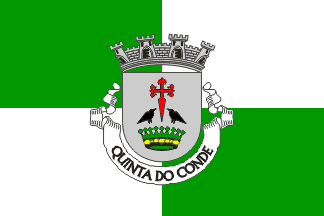
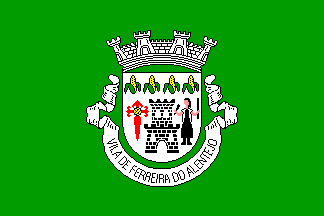
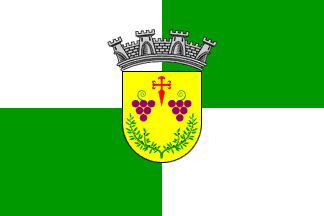
Flag of Quinta do Conde, Portugal;
Flag of Ferreira do Alentejo, Portugal;
Flag of Azeitão, Portugal
- LATIN CROSS REVERSED
- The heraldic term for a cross of st peter.
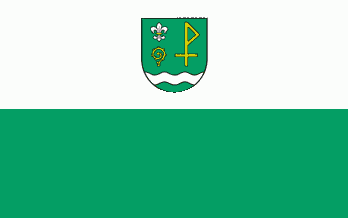
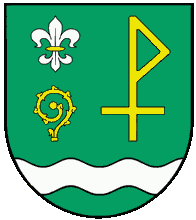
Flag and Arms of Osuchowa, Poland
- LATIN CROSS THROUGHOUT
- See latin cross and
off-centred cross 2) with their following notes.
![[Latin cross throughout]](../images/v/vx-lv-rig2.gif)
Merchant Flag c1650 Riga, Latvia
- LATTICE
- 1) In vexillology a pattern of interlaced bars forming a (usually but not invariably) diagonal trellis.
2) In heraldry see fretty
and latticed.
![[lattice example]](../images/v/vx-cz-pv-pv.gif)
![[lattice example]](../images/v/vx-pt-pnvsa-sf.gif)
![[lattice example]](../images/v/vx-de-od-gl.gif)
Flag of Prostějov, Czechia;
Flag of Sobreira Formosa, Portugal;
Flag of Glinde, Germany
- LATTICED
- The heraldic term used to describe a pattern of interlaced bars resembling
fretty, but with those bars placed vertically and horizontally as in
a portcullis – portcullised (see also gridiron).
![[latticed example]](../images/v/vx-pt-mfreg-gr.gif)
![[latticed example]](../images/v/vx-pt-avvgc-gr.gif)
![[latticed example]](../images/v/vx-de-mk-me.gif)
Flag of Gradil, Portugal;
Flag of Grade, Portugal;
Flag of Menden, Germany
- LAUNCHING FLAGS
- Those flags flown from a vessel that is being launched prior to fitting out,
and which in naval usage are generally (but not invariably) of a prescribed type
and sequence (see also dressing lines and
flag exchange).
![[launching flags]](../images/v/vx-launchflags.jpg)
Launching of HMS St Albans 1747, UK (Wikipedia)
Notes:
a) The flags flown in the above illustration are i) in the bow a Union Jack, ii) at the fore a Flag of
the Lord High Admiral, iii) at the main a Royal Standard and iv) at the mizzen a second Union Jack, with
the suite completed by a pre-1801 Red Ensign at the stern.
b) This combination was usual (in the UK) for the launching of a warship
in this era, and is still flown (but with a White Ensign) when HM The King is
aboard a naval ship – see anchor flag and its
following notes.
- LAY UP (or LAYING UP) COLOURS (or COLORS)
- (v) The ceremonial deposit of regimental, unit, service or national colours
in a church, cathedral or museum when they they are ready for replacement, or when the regiment
or military organisation concerned is disbanded (see also
colour 2) and colours 2)).
- LAYERED CROSS
- A term that may be used to describe a cross whose horizontal arm differs in colour
from its vertical as in the flag of the former Netherlands Antilles – but see the notes below
(also cross 1),
layered saltire,
trinitarian cross,
tripartite).
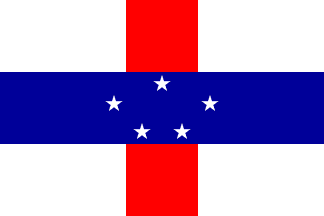
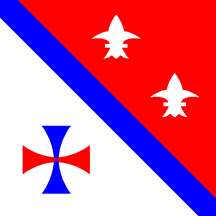
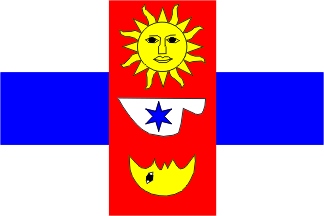
Flag of the Netherlands Antilles 1986–2010;
Flag of Gordevio, Switzerland;
Flag of Bělov, Czechia
Notes
a) This term has been introduced by the
Editors as no established alternative could be found.
b) As can be seen in the illustration above, the term can include a heraldic cross, but:
c) It should only be used in the description of flags as shown above, and does not include crosses
which show two colours because of a fimbriation, or are divided in ways other than those shown.
- LAYERED SALTIRE
- A term that may be used to describe any saltire where an arm of
one colour overlays (or apparently overlays) an arm of a different colour as in the examples given below
(see also
layered cross and tripartite).
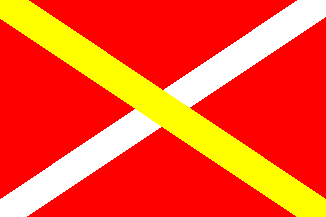
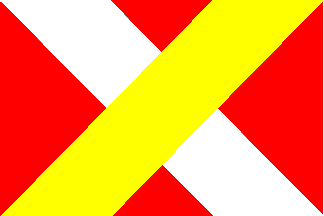
Flag of Rubi, Spain;
Flag of Horní Cerekev, Czechia
Notes
a) This term has been introduced by the Editors as no established alternative could be found.
b) It should only be used in the description of flags as illustrated above, and does not include
saltires which show two colours because of a fimbriation, or are divided in ways other than those shown.
