- JACK
- A flag (generally much smaller than the ensign) flown from a staff at the
bow of a ship, usually when that ship is berthed, at anchor or moored to a buoy,
occasionally when underway but always when dressed overall, and which in current
usage may fall into one of the three main categories listed below – a
bow flag (see also colonial jack,
distinguishing jack,
dress ship,
jack of honour, jack staff,
privateer jack,
union jack) See supplemental note.
Please note that, whilst the origin of this term remains disputed, it is worth recording that
"jack" was a 17th century English (colloquial) diminutive, and so the smallest flag (generally)
displayed by a vessel could become the "jack flag".
- Civil Jack
- Flown at the bow of a merchant ship (see also civil ensign
under ensign).
![[Civil Jack]](../images/v/vx-bs~cjack.gif)
![[Civil Jack]](../images/v/vx-nl-jackc.gif)
Civil Jack of the Bahamas;
Civil Jack of The Netherlands – unofficial
Please note, however, there is only one country which specifically prescribes a special jack for
general use by civilian vessels – the Bahamas – and one whose law permits such vessels to fly a
unique flag in the bows – the UK (see pilot jack).
Sweden, for example, specifies regional flags, whilst the flags of home ports are
sometimes officially used and the regulations of some shipping lines call for a house
or other flag with this, upon occasion, being expressly permitted under national legislation.
- Government Service Jack
- Generally, but not exclusively, limited to the UK and former British colonies,
and flown at the bow by civilian-manned Government vessels – but see
colonial jack 1) with its following note (also
government ensign under ensign
and the notes below).
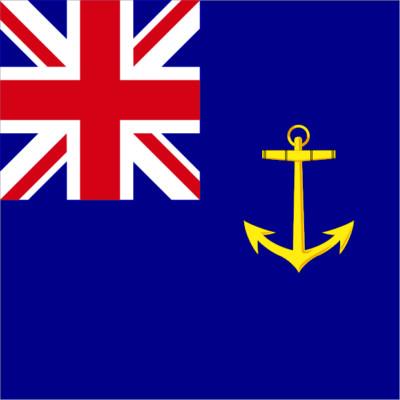
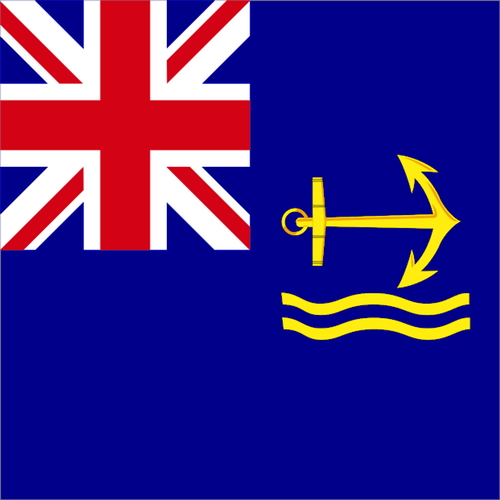
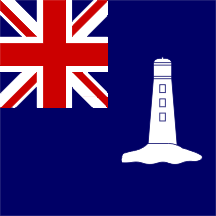
Jacks of The Royal Fleet Auxiliary (ebay.co.uk),
the Royal Maritime Auxiliary (flyingcolours.org) and
Northern Lighthouse Board, UK
Notes
a) In UK usage all Government service vessels wearing defaced blue
ensigns, including those used by the governing authorities of dependent territories, are legally entitled
to fly a blue jack with an appropriate badge in the fly, however, (as far as can be discovered) only the
Royal Fleet Auxiliary, the Royal Maritime Auxiliary and the Northern Lighthouse Board actually do
so at present.
b) In Germany and Austria, Government
(as well as civilian) vessels often fly the flag of the relevant state/province,
and that in some commonwealth countries the appropriate departmental flag is
specified as a jack for government vessels.
- Naval Jack
- Flown at the bow of a warship, often the appropriate national flag (or a variation
of it), occasionally the same as the naval ensign, or sometimes a completely different
design – the jack (see also masthead pennant 1),
naval ensign under ensign,
jack staff, suit of flags).
![[Ukrainian naval jack]](../images/v/vx-ua~2007-02.gif)
![[Slovenian naval jack]](../images/v/vx-si~jack.gif)
![[Uru naval jack]](../images/v/vx-uy~jack.gif)
Naval Jacks of Ukraine,
Slovenia and Uruguay
- JACK OF HONOUR (or HONOR)
- In French naval usage, a jack originally flown in place of le tricolore by ships
that had served in the Free French Navy (the FNFL), and now flown by those ships bearing the same name
(see also
cravat 1) and its following note,
fanion 3),
lanyard 1),
lanyard pennant,
tricolour 3)).
![[Jack of Honour - FNFL Jack]](../images/v/vx-fr~fnfl.gif)
The FNFL Jack, France
- JACK PIN
- See belaying pin.
![[Jack pin]](../images/v/vx-jackpin.jpg)
Jack/Belaying Pin (Wikipedia)
- JACK STAFF (or JACKSTAFF)
- The short staff in the bows of a ship upon which the jack is hoisted (see
also ensign staff, staff 1)).
![[Jack staff]](../images/v/vx-jackstaff.jpg)
![[Jack staff]](../images/v/vx-msbasilea.jpg)
HMS Iron Duke 1912–1946, UK (Wikimedia);
MS Basilea (1952 | swiss-ships.ch)
- JACK, THE
- In UK usage and some others, an increasingly obsolete term for the naval jack – see
‘naval jack’ under jack,
his majesty’s jack.
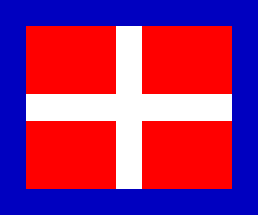
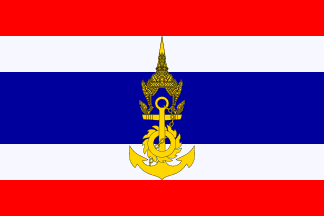
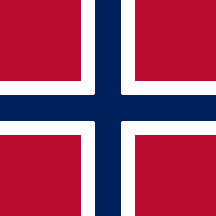
The Jack/Naval Jack 1879–1946, Italy;
The Jack/Naval Jack, Thailand;
The Jack/Naval Jack, Norway
- JAGIELLONIAN
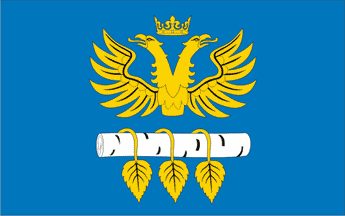
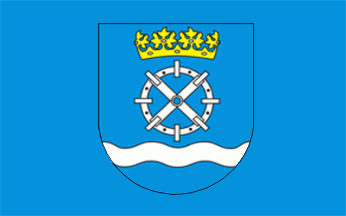
- In East European usage a term often used to describe historic or traditional symbols, and taken from
the dynasty which ruled Poland, Lithuania, Hungary, and Bohemia from the 14th century until the 16th
century – as examples the Jagiellonian cross or Jagiellonian crown.
br.gif)
Flag and Arms of Brzozów, Poland;
Flag of Łubnice, Poland
- JAGIELLONIAN CROSS
- See cross of lorraine
and jagiellonian.

ww.gif)
Flag and Arms of Wschowa, Poland
- JAMES UNION
- An unofficial name for the 1606 pattern British union flag (see also
british flag,
his majesty's jack,
interlaced
conjoined,
union jack).
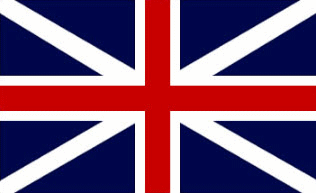
Union Flag 1606–1801, England/UK
Please note that this term appears to have been a 19th century invention,
and that there is no firm evidence of it being used during flag’s lifetime (1606–1801).
- JEHOVAH SUN
- The term – and a direct translation of the German Jehova-Sonne – which may be
used to describe a sun in splendour, surmounted by a
cartouche bearing the name of God in Hebrew lettering – a
charge sometimes to be seen on (exclusively Protestant) German military flags of the
16th and 17th centuries (see also sun-in-splendour).
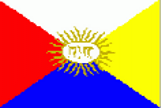
Flag of an Infantry Company c1675, Electorate of Saxony (Klaus-Michael Schneider)
- JELLOPED (or JOWLAPPED)
- The alternative heraldic terms used to describe the wattles of a domestic fowl when they of a
different tincture from its body – jowlapped – but see
wattle(d) 2),
comb(ed) (also
armed 2),
attired,
beaked,
gorged,
hardi,
langued,
membered).
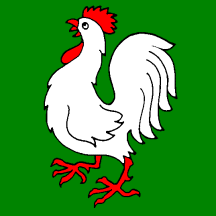
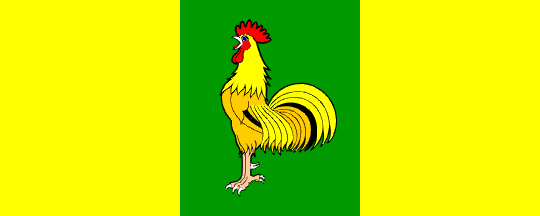
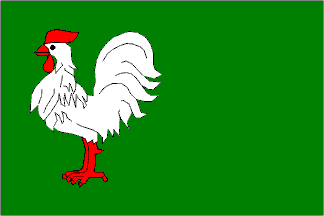
Flag of Lavey-Morcles, Switzerland;
Flag of Šentjernej, Slovenia;
Flag of Líšná, Czechia
- JERUSALEM CROSS
- A symbol of the Medieval Kingdom of Jerusalem – in heraldry a
cross-potent cantonée –
see cross-cantonée and its following note
(also cross potent
and cross of jerusalem 1)).

Flag of the Kingdom of Jerusalem 1162–1191
- JIGGLING JONNY
- See tugh 1) and its following note.
![[Jingling Jonny]](../images/v/vx-schellenbaum.jpg)
(National Music Museum)
- JOINANT
- An alternative heraldic term for conjoined.
10-21.gif)
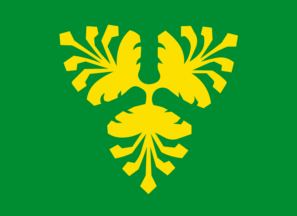
Arms and Flag of Marnardal, Norway
- JOINED (or JOINED TOGETHER)
- In heraldry see conjoined.
17-51.gif)

Arms and Flag of Nærøy, Norway
- JOLLY ROGER
- 1) Generically, any black (or occasionally red) flag often (but not invariably) bearing white
symbols and associated with piracy, but usually shown in its modern form as a flag with black field and
stylised white skull above two white crossed bones – a skull and cross-bones (see also
privateer ensign).
- 2) A flag of the latter description given above, but defaced by a
number of varying symbols dependent upon the type of action and used unofficially by the submarine
service of the British Royal Navy and some others to signify that the boat flying it had successfully
engaged an enemy – but see battle flag 3).
![[pirate flags - Jolly Roger]](../images/v/vx-pir_eeng.gif)
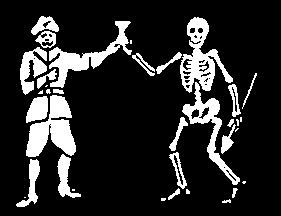
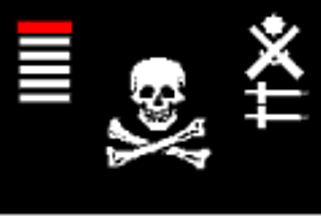
Flag as described above;
Flag of Bartholomew Roberts, early 18th c.;
Submarine Service, UK
Notes
a) With regard to 1), vessels of the US Navy often fly a Jolly Roger at the
yardarm during line-crossing ceremonies (as the signal that King
Neptune is aboard), however, of all known pirates only Blackbeard is thought to have actually
used this design.
b) With regard to 2), it should be emphasised that these symbols were
(and are) entirely unofficial, and that a several variations are known.

