
Last modified: 2026-08-01 by martin karner
Keywords: scheibbs |
Links: FOTW homepage |
search |
disclaimer and copyright |
write us |
mirrors
 image by Martin Karner
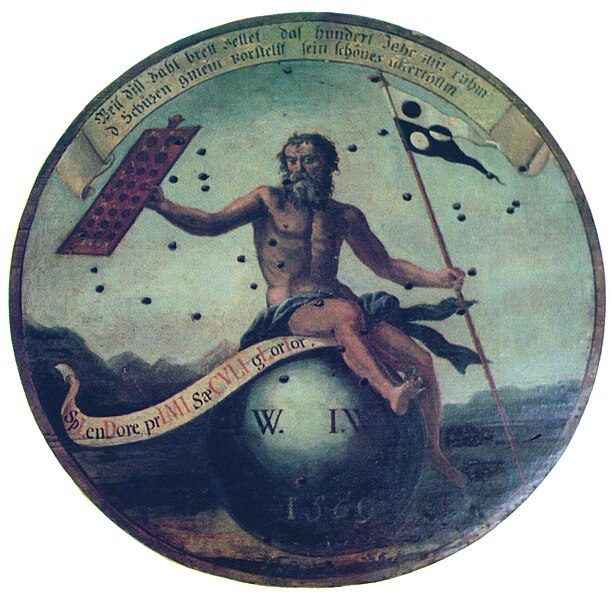
The flag on this painted target
(source, located by
António Martins) is a banner of arms (or armorial banner or heraldic
banner) of the city of Scheibbs (image by
António Martins, 10 Jan 2024). The letters of the chronogram are LDIMICVLILI, in the right
order MDCLLLVIIII (1759), which is very probably the year when this target was made. The inscription 1569
is the year when the shooters' guild (Schützengmein) of Scheibbs was founded (The shooting
tradition of Scheibbs is even older). Scheibbs has one of the biggest museums of shooting targets in
Europe (website). It presents over 240 historic
targets, the oldest from 1680. The tradition of painted targets has been continued until today.
Scheibbs got its coat of arms in 1537 from King Ferdinand I in honor of the defence of the citizens
against the Turkish attacks in 1529 and 1532. Because the citizens were very skilled in the use of their
guns, the Turks weren't able to conquer Scheibbs. That was because of the duty for every citizen to get
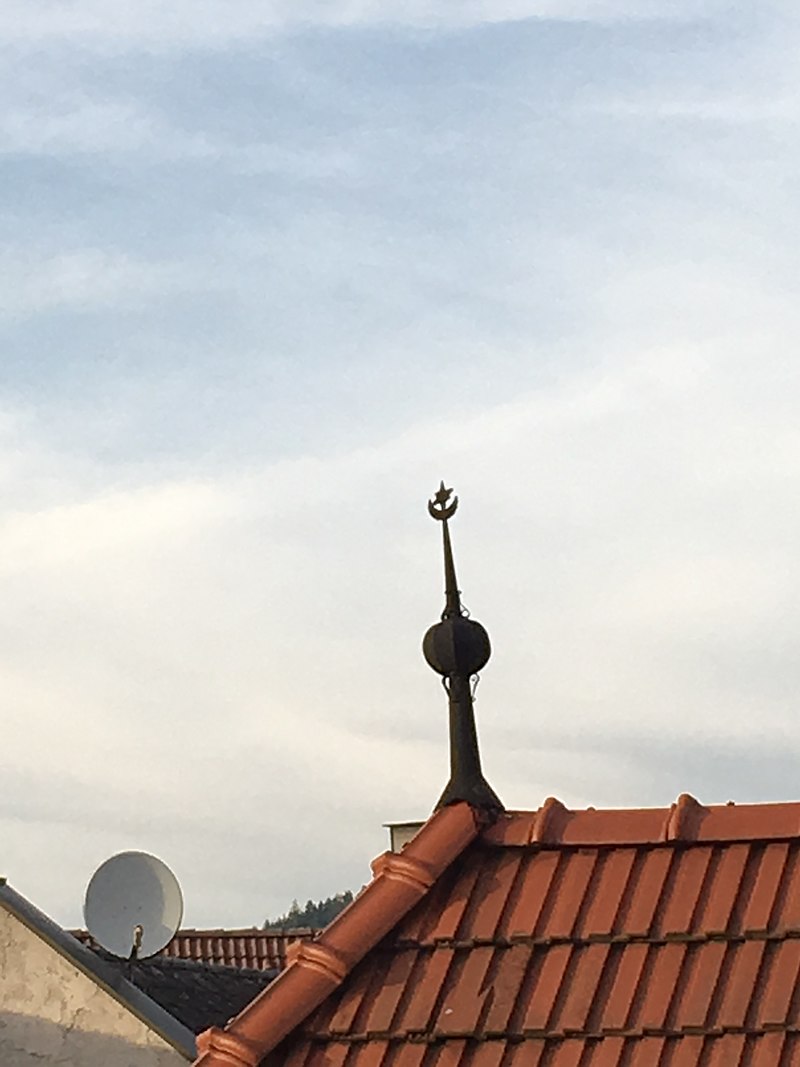
educated in the use of his rifle (See roof sculpture in
Scheibbs with heraldic devices crescent and star, remembering the successful defense against the Turkish
attacks of 1529/32
[source]).
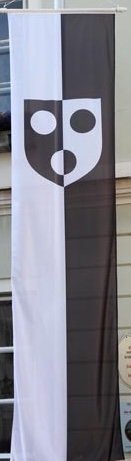
Obviously because of the city's name, Scheibbs' arms show three discs (Scheibe = disc). It's an
ironic coincidence that Scheibbs became famous for its shooting tradition and target museum. The German
word Scheibe (disc) is also used in Zielscheibe (target, lit.: target disc) or
Schiessscheibe (target, lit.: shooting disc). Today we know that the name Scheibbs doesn't come
from "discs", but from the Slavic Ščipéčje (wild dog rose) from the
local Slavic Pannonian population in the 6th century. After the Slavic language faded away, it became
Scibes around 1160, Schibes around 1200, Schibsa in 1367, Scheybs in 1537,
Scheibs in 1700 and Scheibbs in 1800.
Communal website: https://www.scheibbs.gv.at (timeline, German [retrieved])
Martin Karner, 16 January 2024
.gif)
(source)
Per pale Sable and Argent in chief dexter a roundel Argent and in
chief sinister the same but Sable whilst in base a roundel of the Second and First counterchanged.
Christopher Southworth

Per pale Sable and Argent in dexter chief a plate surmounted by an
annulet of the First in sinister chief an ogress surmounted by an
annulet of the Second in base a roundel of the Second and First and an annulet of the First and Second
both counterchanged.
Christopher Southworth



.jpg)