
Last modified: 2026-11-21 by rob raeside
Keywords: panama | guna yala | kuna yala |
Links: FOTW homepage |
search |
disclaimer and copyright |
write us |
mirrors
See also:
 image by Jaume Ollé, 25 August 2004
 image by Jaume Ollé, 25 August 2004
 image by Jaume Ollé, 25 August 2004
The images of the Kuna Yala flag above is quite a bit
different from the flag I just received
from Gilberto Almancia, a Kuna Indian when I visited Panama this July 2004. The
flag can be seen at couture.no-ip.info/travel2004.
Professor John J. Couture, 12 August 2004
According the article in the newspaper "El
Universal" of Panamá, by Anelio Merry: beside
that the Kuna nation flag of red, white (not
yellow) and red, with swastika in center, today exists also
another flag that is only recognized by the Aligandi community.
This flag is not shown but described: as follow: "It has
within two crossed hands, an arrow, a bow and nine
stars. The upper stripe is green, the central one is white (with
the hands) and the lower one is red". There is no doubt that
Merry refers to a flag that was reported by Professor John J.
Couture, describing it with reversed upper and lower stripe
and quoting the central one as white instead of
yellow. I don't know if the differences are dues to a
change, a manufactured variant, or a mistake. Merry
added: The Congreso General Kuna, main authority of the
nation, in one of their sessions adopted the agreement that the
Kuna red, white, red flag created by Maria Colman will be hoisted
in all the communities of the region of Kuna Yala. Maria
Colman, that created the flag, was born precisely in the Aligandi
Community and was the daughter of Olo Kiankipe and her
great father was the chief Olokindipilele (Simral
Colman) that adopted the flag in 1924 and established its meaning
Note that near the sea, the white color is yellowized
faster, and sometimes can seems that the central stripe is
yellow, but official color is now white. Also there's mention that
the flag with central white stripe was in use in 1924-25, but
later was changed to a yellow until the agreement of the
Congreso General Kuna in late 90s. The chief Simral Colman
established the meaning of the colors: red (blood); white (peace
and purity), black (symbol of Kunas oppressed in their own land).
Then white was changed to yellow and this color was attributed to
the "gold people" (The Kunas or Tule) and the symbol
mean North, South, East and West. The swaistica is an ancestral
Kuna symbol called Naa Ukuryaa.
Jaume Ollé, 25 August 2004
 image by António Martins-Tuválkin, 29 November 2005
 image by Fred Drews, 05 August 2014
Valentin Poposki located photo at
www.bildungsservice.at.
This seems to be the Aligandi flag.
António Martins-Tuválkin, 29 November 2005
I was in contact with the provincial authorities of Panama in
2003. Ailigandi, unrecognized community that is oppose San Blas
province and don't recognize its flag.
Ailigandi flag is red, yellow, green horizontal and in center two
crossed arms, bearing arc and arrow, surrounded by 9 blue stars.
Jaume Ollé, 15 September 2009
In the regular meeting of the Kuna General Congress that was held 28-31
October in Mammidub the Kuna flag was officially adopted or should I say
formalized?http://www.congresogeneralkuna.com/3139.jpg
and http://www.congresogeneralkuna.com/kika.htm
from the site of Comarca Kuna Yala http://www.congresogeneralkuna.com/
From what I understand this flag will be flown on the public buildings alongside
the Panama flag. The old swastika flag will be flown only during the
celebrations for the Kuna Revolution of 1925. This info comes from Kuna Yala
Digital blog http://www.titoperezquintero.blogspot.com/.
I leave the details for Spanish speakers!
Paraskevas Renesis, 8 December 2010
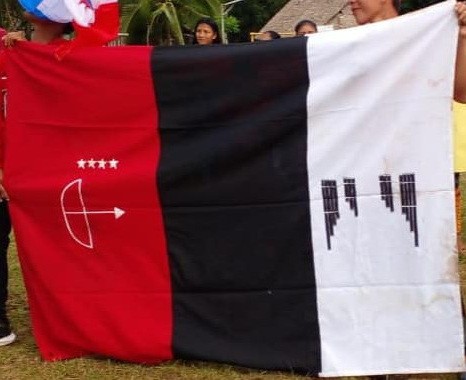 image located by
Paraskevas Renesis, 16 May 2026
Territorio Ancestral Tule de Tagarkunyala is one of the four Guna (Kuna)
territories (the 3 others are Guna Yala, Guna de Madungandi and Guna de
Wargandi).
A flag is displayed in:
https://www.facebook.com/photo/,
https://www.facebook.com/photo
The same flag is displayed inside their
Congreso General:
https://www.facebook.com/photo and also here:
https://www.instagram.com/p/DMq0vnqR9Ak/
Could it be their official flag?
Paraskevas Renesis, 16 May 2026
Official or not, the photos show a squarish (~3:4) vertical triband of red,
black, and white, with charges on both side panels: on the red area, at the
hoist, a stylized bow and arrow under a row of four upright five-pointed stars,
all in white, and at the fly, on the white area, four pan flutes – two smaller,
with only 3 tubes each, and two larger, with 4 tubes each, arrayed to have
the longest tubes outwards, aligned with the mouth parts on the same
horizontal line; all drawn in black with contoured white details. Both
emblems are relatively small for the area they are set on. And while I'm not
an archery expert in any way, I'm surprised to see the tip of the arrow on
what seems to be the wrong side of the bow, presuming it's shown as about to
shoot.
António Martins-Tuválkin, 8 August 2026
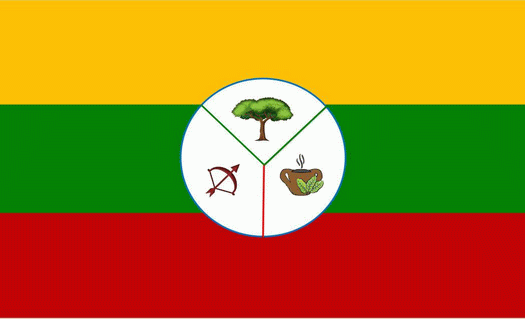 image located by
Paraskevas Renesis, 16 May 2026
The Comarca Guna de Wargandí may have adopted a flag.
In at least 4
different occasions:
https://www.facebook.com/photo/?fbid=1001251712118520&set=pcb.1001251835451841
https://www.facebook.com/reel/1130448232269154
https://www.facebook.com/reel/2322740141477675
https://www.facebook.com/photo?fbid=1072220465021644&set=pcb.1072220481688309
https://www.facebook.com/photo?fbid=864947966277705&set=pcb.864948089611026
a horizontal triband yellow/green/red with a large white disk in the middle
containing 3 symbols
was displayed.
And after finding all the above here's
is the confirmation:
https://www.facebook.com/photo presented in the Comarca's 24th anniversary:
https://elsiglo.com.pa/panama/nacionales/la-comarca-kuna-de-wargandi-celebra-su-24-aniversario-FD8126986
Paraskevas Renesis, 16 May 2026


