
Last modified: 2024-09-14 by martin karner
Keywords: israel | tribes | mandrake | gate | ephod | lion | scales of justice | gazelle | camp | olive tree | corn | sun | stars | donkey | camel | ship | sheaf | wolf | barton's |
Links: FOTW homepage |
search |
disclaimer and copyright |
write us |
mirrors
See also:
 image located by William Garrison
Bonus item of a bonbonnière of Barton's Bonbonnieres (later Barton's Candy Corporation), imprinted year: 1951.
Sheet of paper with a flag chart of the 12 (13) tribes of ancient Israel, and an Israeli couple
holding the national flag.
Title: "Banners of the Tribes of Israel".
This list of emblems shows some differences of items to the stamps we present above:
Martin Karner, 6 August 2024
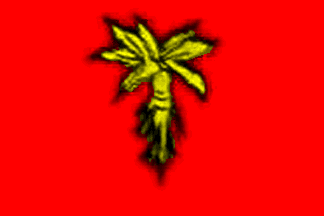 image by António Martins
The caption for this flag is "Reuben – Mandrake".
On page 1 the mandrake is referred as the usual Reuben token,
with no support for the sunrise scene shown in [alv96a]. As for the flag
itself, there are two conflicting reports, according to Nathan Lamm's
long contribution of 5 June 2003 [on page 1]: The Midrash Rabbah describes a red
flag with mandrake imagery, while the Pseudo-Jonathan gives a flag
with "three stripes, each like three of the stones of the breastplate
nofekh, sapir, yahalom", with additional writing. As for the tribe's
gem, Nathan quotes "Odem [carnelian? ruby?]" which would mean red, but
the 1955 Israeli stamp [b(-il.html#00821] is green on transparent /
paper monochrome.
António Martins, 13 November 2026
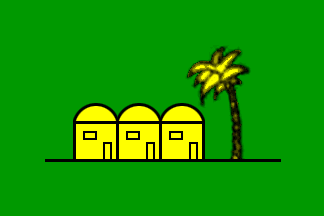 image by António Martins
The caption for this flag is "Simeon – Shechem". As
explained on page 1: "Simeon's stone was Pitedah [Topaz],
and the color of his flag was green, and [a picture of the city of]
Shechem was drawn on it" (Nathan Lamm, 5 June 2003). However both the
stamp issued by the Israeli Post in 1956 [b(-il.html#00822], and
the article [alv96a] symbolize Shechem as a fortified citywalls gate,
not as a row of houses under a palmtree. Furthermore, the latter has
the caption for this image accidentally swapped as that of Asher (but
not the color key "Y/N"?), while the former shows, instead of the
expected green, a burgundy color.
António Martins, 4 November 2026
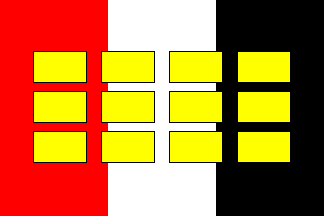 image by António Martins
The caption for this flag is "Levi – Urim and Tumim". The tricolor background [seems to
allude to the] flags with three stripes [see page 1], described in Pseudo-Jonathan; they are not the 12
tribe flags but the four camp flags, with three tribes per camp*. The 3×4 design matches the explanation
given on page 1 for the Levi banner as interpreted for the stamp issued by the
Israeli Post in 1955 [b(-il.html#00823]: "the ephod of the High
Priest on which were engraved, upon precious stones, the names of all tribes."
António Martins, 1/14 November 2026
* This flag's design underlines the special role of the Levites, so to speak as the "fifth camp". – A.M./Ed.
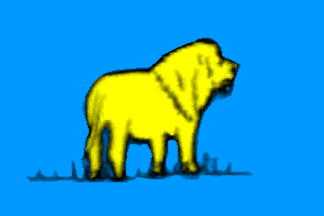 image by António Martins
The caption for this flag is "Judah – Lion". Page 1
shows the lion as the this tribe's symbol, well
known and none other; its reuse in later emblematics is mentioned for
the municipal arms and flag of Jerusalem and for for the
Central Command of the I.D.F.; many more can be added,
namely Ethiopian and Rastafarian flags.
The basic flag design of yellow lion on (light) blue is used both on Barton's
and in [alv96a]; Nathan Lamm, 5 June 2003, quotes from the
Midrash Rabbah: "Judah's [stone] was Nofekh [unknown], and the color of
his flag was sky blue, and [a picture of] a lion was drawn on it." The
the 1956 Israeli stamp [b(-il.html#00824] shows also a lion, but
it's ochre/brown on transparent/paper monochrome, a color that can be
exihibited by some carbuncle and topaz, but is certainly not similar to
light blue. A more complex flag design is found in the Pseudo-Jonathan
as quoted also by Nathan Lamm, 5 June 2003: Again "three stripes, each
like three of the stones of the breastplate" (same basic design as Dan,
Reuben, and Ephraim), with writing and also the image of a lion cub.
António Martins, 14 November 2026
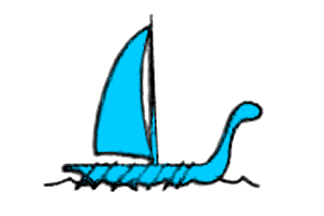 image by António Martins
The caption for this flag is "Zebulun – Ship". Page 1
refers a ship, however depicted, is the token
of this tribe: e.g. the 1956 Israeli stamp [b(-il.html#00830]
and the article [alv96a]. As for colors and flag pattern, [alv96a] has
white on yellow (or so seems at [il_12trib-1.gif]); this
matches Nathan Lamm's 5 June 2003 long contribution. Zebulun totem gem
is said to have been beryl, a mineral/ore that can be associated with several different colors
(https://en.wikipedia.org/wiki/Beryl).
The stamp is magenta and paper/transparent monochrome.
António Martins, 13 November 2026
 image by António Martins
The caption for this flag is "Issachar – Sun & Moon". This design is explained on page 1 by Nathan Lamm's 5 June 2003 quoting from the Midrash Rabbah:
Issachar's [stone was] Sapir [sapphire], and the color of his flag was like azure [some: black], and [a picture of] a sun and a moon was drawn on it, because [as it says in I Chronicles 12:32] "And from the sons of Issachar were those who knew the wisdom of the times [i.e., astronomy and calendars –> but read the next few words of the verse! – Ed.]". [Jacob's blessing calls Issachar a "laden donkey", and sometimes the symbol is shown as that or as a laden man.]A different take on this same symbolism can be seen in the 1956 Israeli stamp [b(-il.html#00829], which shows for Issachar a 16-ray sun with flaming rays (alternating long and short) in a ring of eight six-pointed stars, all in dark olive monochrome. The donkey symbolism explains in turn the Issachar tribe flag given in [alv96a].
António Martins, 16 November 2026
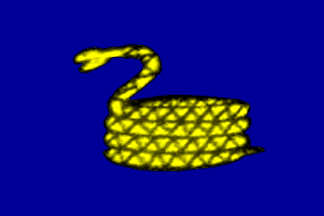 image by António Martins
The caption for this flag is "Dan – Serpent". Page 1
refers that both a snake and a set of scales (the
wheighting device, not a reptile's hide element) are taken as the token
of this tribe: e.g. the 1956 Israeli stamp [b(-il.html#00825]
has the scales of justice, while [alv96a] shows a snake. As for colors
and flag pattern, [alv96a] has the snake overall on a horizontal bicolor
of red over something [il_12trib-1.gif], while the stamp is
teal (these stamps are monochrome, presenting for each tribe a color,
often associated with its gemstone, not necessarily a flag pattern).
António Martins, 11 November 2026
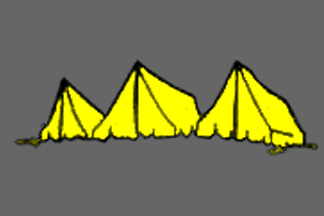 image by António Martins
The caption for this flag is "Gad – Camp". On page 1
is quoted the Bible passage ["Gad, a troop shall overcome him: but he shall overcome at the last."],
thus most depictions of the the tribe's flag go for a military encampment – e.g.
[alv96a] and [b(-il.html#00827], some
depict actual troops. The color is said to be grey ("a mixture of black and white"). Nonetheless,
the stamp issued by the Israeli Post in 1956 is purple; the article
[alv96a] indicates colors but [il_12trib-1.gif] is too tiny and
pixelated to discern.
António Martins, 8 November 2026
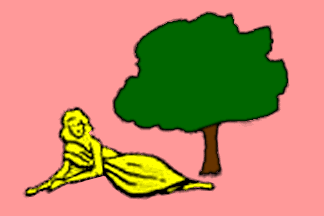 image by António Martins
The caption for this flag is "Asher – Woman & olive tree".
On page 1 losely matching symbolism is quoted
with the tree being a token of farming fertility (some times along with
or instead of "corn or fruit" or "cornucopia"); the addition of a woman
("symbol for human fertility?", 6 Aug 2024) seems to be original to
this source. The stamp [b(-il.html#00828] issued by the Israeli Post in
1955 is red; this is not too far from the rosy pink on Barton's, but
mismatches the yellow/olive/green hues of what is known as chrysolite
(see https://en.wikipedia.org/wiki/Chrysolite),
as tarshish is tentatively translated by Nathan Lamm, 5 June 2003.
António Martins, 10 November 2026
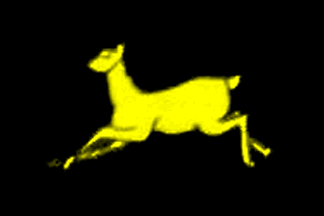 image by António Martins
The caption for this flag is "Naphtali – Hind". On page 1
the spelling "Naftali" is also used; it explains this
totem/metaphore can be a gazelle, a stag, or a hind, and that the
"color of his flag was like diluted wine (whose red [color] was no
longer strong)" – which seems to be pink. The (ochre) stamp issued by
the Israeli Post in 1955 [b(-il.html#00826] shows a gazelle. The
article [alv96a] shows an ibex or oryx of undisclosed color overall on
an ascending diagonal background of red over white.
António Martins, 8 November 2026
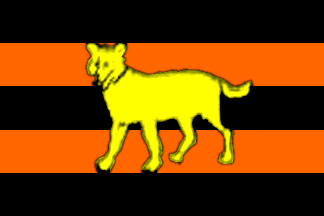 image by António Martins
The caption for this flag is "Benjamin – Wolf". As
explained on page 1: "The symbol of the tribe was the wolf"
(Nahum Shereshevsky, 5 May 1998), which matches the (green) stamp
issued by the Israeli Post in 1956 [b(-il.html#00832]; the article
[alv96a] shows also a wolf overall on a background of five horizontal
stripes, but very differently colored: from the top, red-violet-blue-ochre-yellow.
António Martins, 6 November 2026
 image by António Martins
The caption for this flag is "Ephraim – Bullock".
The cattle motif explained in [il_tribe.html]: "The color of his flag[s]
was very black" (...) "on the flag of Ephraim was drawn an ox" (Nathan
Lamm, 5 June 2003), but the Egyptian token (a pyramid?) is absent. The
plain black design contradicts Numbers 2:18,
where it says* that "[Ephraim's]
flag had three stripes"*; the mentioned "picture of a young boy" (...) "on
it"* is also absent (again, quoting from Nathan Lamm, 5 June 2003). The
stamp issued by the Israeli Post in 1956 [b(-il.html#00831] shows
the emblem of the parent Joseph tribe, a sheaf of grain ears on green background.
António Martins, 3 November 2026
* N. Lamm is quoting here Pseudo-Jonathan, but it is not clear how the latter arrived at this
interpretations of the verse in question. – Ed.
 image by António Martins
The caption for this flag is "Menasseh* – Unicorn".
On page 1, Nahum Shereshevsky, 5 May 1998, explains
why neither the article [alv96a] nor the twelve 1955/1956 Israeli stamps
cover neither Menasseh nor Ephraim. The Midrash Rabbah, as quoted and
commented by Nathan Lamm, 5 June 2003, says: "on the flag of Menasseh
was drawn a re'em [a sort of wild ox]", interpreted as a classic Greek
unicorn (a horse with a narwhal horn) on Barton's (not, say, a unicorn
as a rhinoceros from the Book of Job).
António Martins, 15 November 2026
* This tribe's and its founding patriarch's names are spelled varyingly on
our pages: "Menasseh", "Manasseh", and "Menasshe" – all
of which are romanizations of "מְנַשֶּׁה". – A.M.
Barton's flag chart displays the number of tribes after the division of Joseph into Ephraim and Menasseh, thus omitting the flag of the parent tribe. António Martins provides it here as a bonus item to the bonus item.
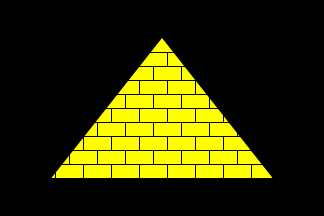 image by António Martins
On the 1956 Israeli stamp [b(-il.html#00831] Joseph's token is a
sheaf of grain, on green on transparent / paper monochrome, a shade of
green darker than Reuben's.
On the same page, Nathan Lamm's 5 June 2003 translation and commentary
of the Midrash Rabbah states:
"Joseph's [stone was] Shoham [onyx], and the color of his flag[s] was very black, and the [picture] drawn on it for the two princes [of] Ephraim and Menasseh was Egypt [a pyramid?], because they were born in Egypt."To illustrate this conjecture, here's a 2:3 black flag with a yellow stylized Egyptian pyramid centered on it, matching the style of Barton's flag chart (It's the Great Pyramid, drawn to scale: 1px = 2 cubits; the brickwork might be oversized, though).
António Martins, 18 November 2026
