Last modified: 2018-12-15 by rob raeside
Keywords: tel aviv-jaffa | tel aviv-yafo | iriyat tel aviv-yafo | tel-aviv | jaffa | yafo | crown: mural (white) | coat of arms (stars: red) | coat of arms (stars: 6) |
Links: FOTW homepage |
search |
disclaimer and copyright |
write us |
mirrors
 8:11   image by Dov Gutterman and Željko Heimer Coat-of-arms adopted 13th November 1958 |
 (source) |
See also:
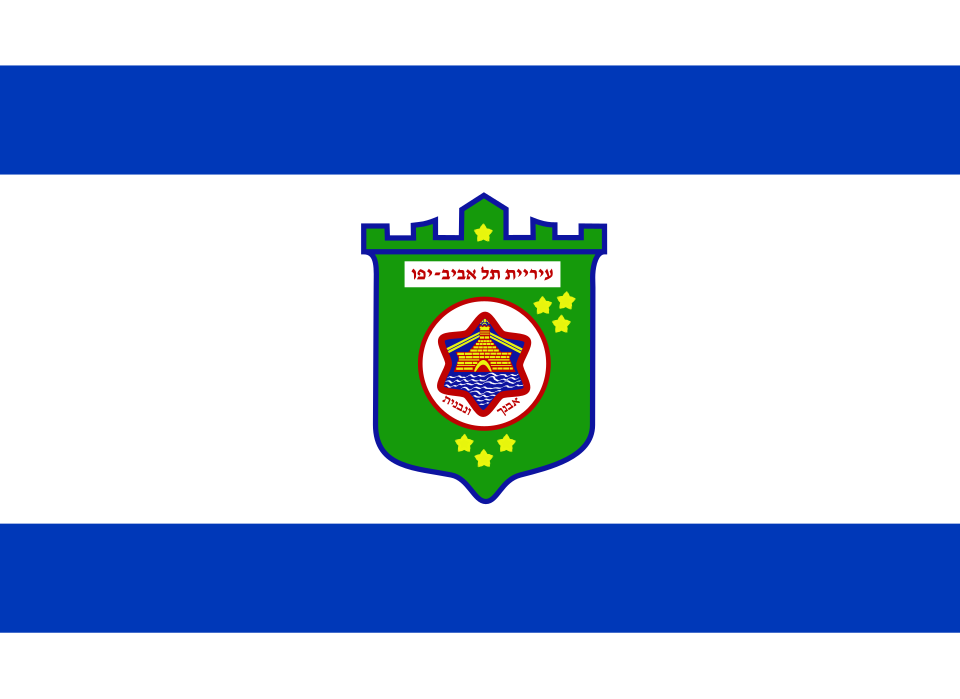
The city emblem instead of the Magen David on the Israeli national flag makes the municipal flag.
There is also a vertical variant.
The Tel
Aviv website [retrieved] says (my translation):
When Tel Aviv celebrated its 25th anniversary, the heads of the city decided that the first Hebrew city also needed its own symbol. The municipality published a contest, and some propasals were submitted. The one who won and was chosen to design the symbol was the painter Nahum Gutman, whose father, the writer S. Ben-Zion was one of the settlers in Akhuzat Bait later to become Tel-Aviv. On the emblem there are some motives symbolizing Tel Aviv and B.Z. Herzel who was kind of spiritual forefather of the city. Beside the name Tel-Aviv, there are seven stars symbolizing Herzl's vision of seven daily hours work, as it was costumary at the past in the town hall. In the center, Gutman painted a lighthouse to symbolize Tel-Aviv port [closed many years ago], then a safe refuge to tenths of thousands of new immigrants. The name Tel Aviv is taken from the Bible [Ezekiel 3:15 – "Telabib" = "mound of green growth"] and in the bottom Gutman added a phrase from Jeremiah 31:4: I will build you and you shall be built.
Dov Gutterman, 13/14 April 2000
Tel Aviv (Spring Mound) was initiated in 1906 by organizing an
association for establishing an "Hebrew urban center"
near Jaffa. Land was bought in 1908 and on 11 April 1909 there
was a lottery of the parcels between the member of the
association and the establishment of A'huzat Bayit (Home
Estate) was officially declared. This date is considered as the
day of the establishment of the city.
In 1910, by suggestion of Menahem Sheinkin, it was renamed to
Tel-Aviv following the Hebrew title of a translation by Nahum
Sokolov of Herzl book Altneueland (Old New Land).
Tel Aviv was developed rapidly and the community that was
initiated as suburb of Jaffa became a local council in 1921 and a
municipality in 1934, and therefore considered as the "first
Hebrew city". In 1935 it became the biggest city in
Palestine (Israel-land). The declaration of Independence was held
in Tel Aviv on 14th May 1948.
In 1950 Jaffa (Yafo) was annexed to Tel Aviv and it officialy
renamed Tel Aviv-Yafo. Even though it is not the biggest city of
Israel (Jerusalem is bigger), it is the commercial and cultural
center. Pop. 363'000 (2003).
Jaffa (Yafo) is one of the most ancient communities in Israel and
first mentioned in the 15th century B.C. and probably always was
a port town.
It was ruined and rebuilt numerous times. In the 19th century it
became the major port of the country and the second largest city.
The building on nearby Tel Aviv and the riots of 1921 and 1929
brought to the mass abandonment of its Jewish population.
The construction of Hebrew communities around it made it isolated
from other Arab strongholds and as hostilities started in the
area (April 1948), most of its Arab population evacuated it and
it was taken over by the IDF on 13 May 1948.
Sources: municipal
website [retrieved], www.mapa.co.il [retrieved].
Information in English at www.tel-aviv.gov.il [retrieved]
and www.white-city.co.il [partly retrievable].
The emblem appeared on a stamp
issued on 15 December 1965.
Dov Gutterman, 8 May 2005
♦ Birth of the city (tel-aviv.gov.il, Hebrew [retrieved] | English translation)
♦ How the name Tel Aviv came to be (tel-aviv.gov.il, Hebrew [retrieved] | English translation)
.png)
(source)
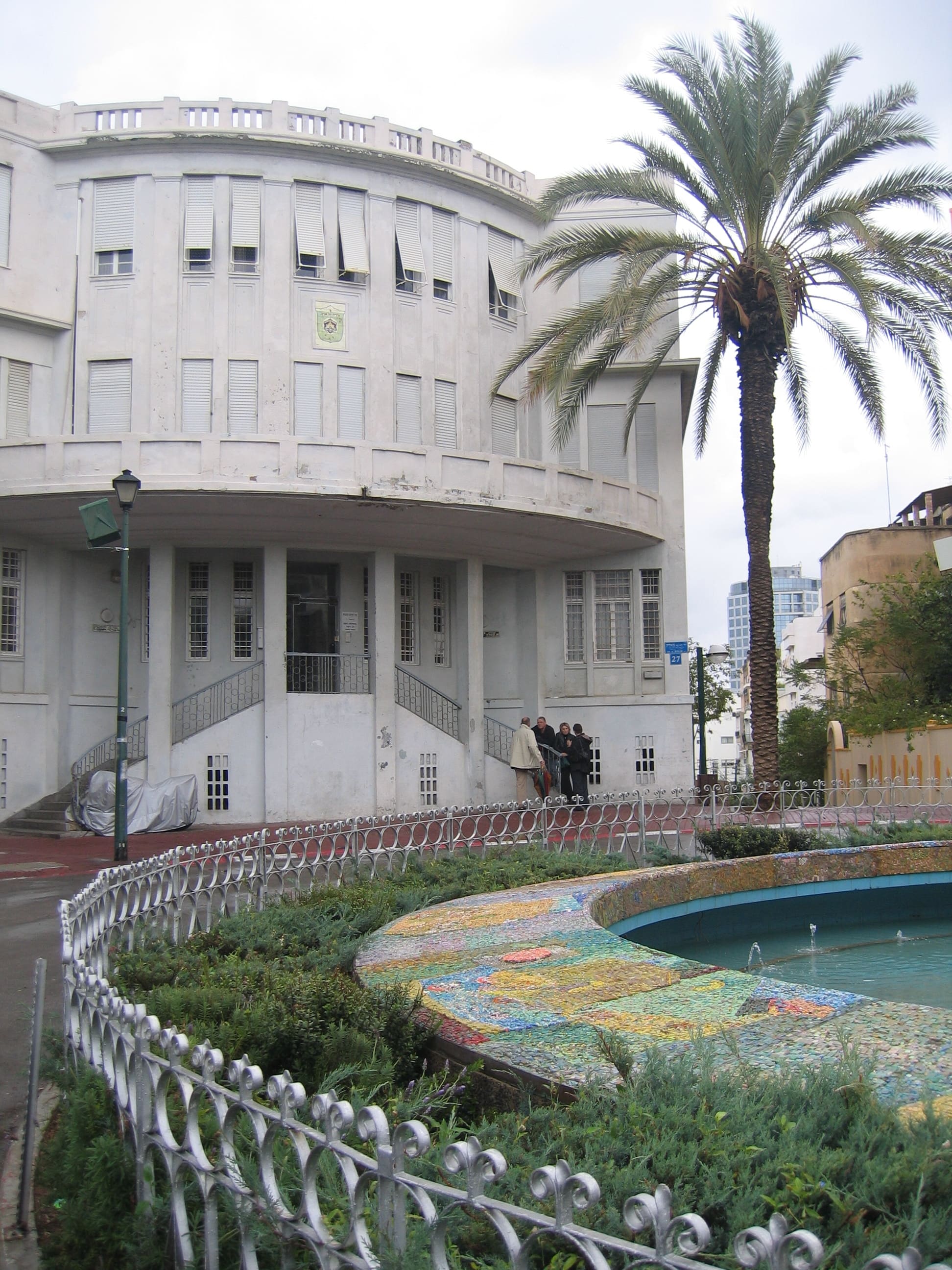
♦ photo source (old city hall | detail)
The municipal emblem was published in the official gazette (Rashumot),
YP 631, 13 November 1958.
Dov Gutterman, 4 September 2001
From Hebrew Wikipedia:
For the design, the 27-year-old Gutman consulted with his father, S. Ben-Zion, a writer of that era, as well as with Meir Dizengoff and the writer and poet Chaim Nachman Bialik. According to one theory, it was Ben-Zion who suggested the inscription "Abencha ve-nivnita". The journal "At-Mol" put forward a different theory, suggesting that Shimon Rokach, founder of the Neve Tzedek neighbourhood and one of Tel Aviv's leading figures at the time, was the one who proposed the motto, as he used to sign his letters with the phrase "Avnecha v'nivnita".
This inscription, which became the city's motto, is taken from the verse in the Bible:"You shall yet be built up, O virgin of Israel; you shall yet play the tambourine and go forth in the dance of those who rejoice" (Jeremiah 31:4).This verse has many meanings and interpretations. Metzudat Zion interpreted the phrase "I will build you again, and you shall be built":"'Again' means 'Behold, the First and Second Temples were built by human hands and were destroyed; I will build you – I myself – as the third, and you shall remain built for ever'; or it means: 'Behold, in the exile you are scattered amongst the nations like a ruined building whose stones are scattered, and I will gather you together like stones in the walls of a building, and you shall be built for ever and shall never again be exiled'."Rashi, however, interpreted it as follows:"You had two buildings erected by human hands; that is why they were destroyed. 'I will build you again – I Myself will build the third, and you shall be built up for ever; you shall be adorned.' Metzudat David interpreted the words 'the Virgin of Israel' as 'the congregation of Israel, who is dear to Me like a virgin who has known no man, yet is beloved by her husband'".Furthermore, it is possible that the symbol was influenced by a work of art depicting a similar "the Virgin of Israel" is replaced by "the Virgin of Zion".
In addition, the seven stars were added, symbolising a seven-hour working day as part of Benjamin Ze'ev Herzl's vision (this was the number of working hours at Tel Aviv City Council before the switch to a five-day working week). The seven stars also feature in Herzl's original proposal for the Israeli flag:We have no flag. We need a flag. When one wishes to lead a large number of people, it is essential to raise a symbol above their heads. I envisage a white flag with seven golden stars. The white cloth symbolises a new, pure life; the stars represent the seven golden hours of our working day, for it is through the symbol of labour that the Jews are making their way to the new land.In the mid-1950s, Gutman wrote to the town clerk, Yehuda Nadivi, who wished to know about the process of designing the emblem: "As is customary with us when it comes to emblems, too many demands were placed on the small space occupied by the emblem; they wanted to give expression to many intentions held in the heart, regarding both the past and the future. At the same time, the emblem must be simple, uncluttered and understandable ... For the reasons I mentioned above, I actually chose one that has several meanings: a gateway and a tower of light. So I incorporated a few more ideas into it (the seven stars) and endeavoured to keep the emblem simple." In Gutman's view, the excessive demands were one of the reasons for the failure of the emblem design competition. In his letter, Gutman argues that the emblem was distorted over time by the various artists who drew it; the lines were altered and the colour contrast diminished. He complained about the distortions made to the emblem and the fact that the stamp format he had designed was not used, and subsequently wrote to Yehuda Nadivi: "When I see the emblem in the Tel Aviv Municipality newspaper, whether on the front page or inside, it does not give me any satisfaction." He even offered to redraw the emblem. According to Dora Gutman, the widow of Nahum Gutman, the emblem has also changed significantly since it was first designed by her husband [picture of Gutman's first version source].
– The Jewish State
An official decision to adopt the coat of arms was taken at a city council meeting in 1925, and from the end of that year the coat of arms appeared on official publications. In 1927, the coat of arms was redesigned, and further changes were made in the late 1930s. In 1950, following the establishment of the State of Israel and the merger of Tel Aviv and Jaffa, the inscription "Tel Aviv-Jaffa" replaced the inscription "Tel Aviv Municipality" on the original coat of arms.
Additions to the emblem from the late 20th century – contour line and skyline
For many years, the municipality used a contour line (taken from the upper part of the shield in Nahum Gutman's original coat of arms, in its revised version) on its official stationery and in its publications as a graphic element alongside the original coat of arms:

In the 2000s, the city council replaced the original emblem and outline with a new logo, drawing inspiration from the New York City skyline as a model. The logo depicted the Tel Aviv-Jaffa skyline as seen from the sea. The Jerusalem City Council, and later Haifa and Eilat, followed Tel Aviv's lead and began using a similar skyline emblem for their own cities.

In light of the outcry raised by city councillors over the neglect of the original emblem, and following a debate on the matter, a decision was taken to reinstate Gutman's emblem in the council's publications, alongside the new skyline logo. This decision sparked a trend among other cities, such as Haifa, Herzliya and Rehovot, to retain their historic emblems alongside the branded logos they had adopted.
(Translated with DeepL.com)
From Hebrew Wikipedia:
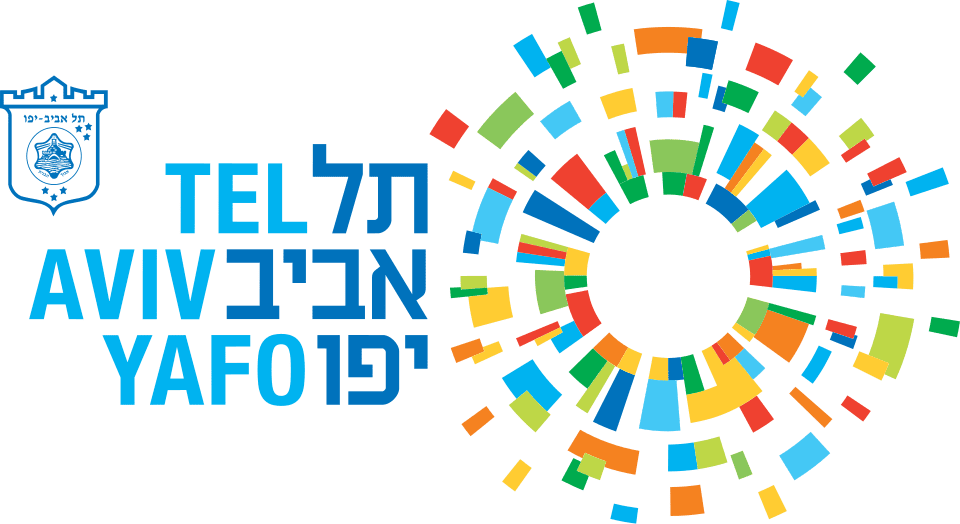
The design for the circular logo consists of a graphic illustration of a circle containing dozens of different graphic shapes in various colours, symbolising the city's diverse population coming together to form a single circle [...] The dynamism of the chosen logo, as well as its colourfulness and graphic elements reminiscent of the sun, influenced the spokesperson's decision. [...] The logo featured the city's name in Hebrew and English, reflecting the city's international character. [...] Following a council debate, it was decided to keep Gutman's original emblem alongside the newly selected logo.
(Translated with DeepL.com)
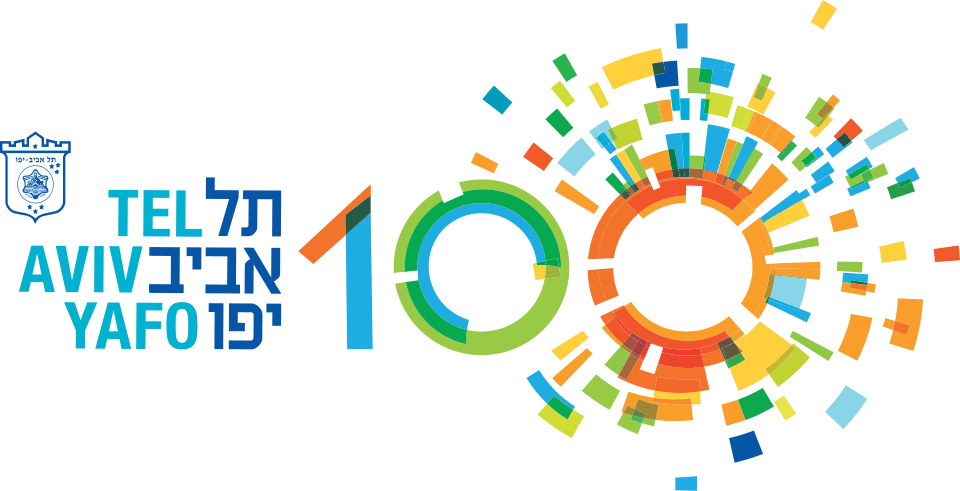
From Hebrew Wikipedia:
In order to adapt the city's logo for the centenary celebrations [in 2009], it was decided to add the coloured circle to the number 100, with the intention of removing the number 100 after the celebrations and retaining only the logo. The logo appeared in all the municipality's publications during the centenary year, and the skyline logo was discontinued. At the end of the centenary year, it was decided to retain the coloured circle as a separate graphic element; this, alongside the original emblem, constitutes the city's current emblem.
(Translated with DeepL.com)
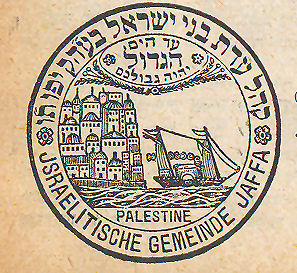
Printed in: Ze'ev Vilnai, Guide to the Land of Israel – Tel Aviv, The Sharon, Hashpela and the Negev, "Tor" Jerusalem, 1941 (third edition 1950). Inscriptions in Hebrew and German. The seal was probably created in the 19th century.
State of Tel Aviv (or State of Dan Block) – this idea was
initiated by Eli Zevuluni, Dudu Geva (comics writer) and Rinat
Nerkowitz (editor of Archisex fanzin) with a left wing agenda and
as protest against the size of the defense budget.
A similar idea was suggested by Uri Fink at Zbeng comics. After the
1996 elections, a few left wing activists founded this
"state" in a shelter situated in Tel-Aviv center, where
it "existed" for a few weeks. No flag reported.
Dov Gutterman, 27 July 2007