Last modified: 2026-01-02 by daniel rentería
Keywords: bogota | colombia | santafe de bogota | distrito capital |
Links: FOTW homepage |
search |
disclaimer and copyright |
write us |
mirrors

by Carlos Thompson, 22 March 2003
See also:
20 Localities (Localidades):


Other Sites:
Adopted: 1952, colours based on the flag of the revolt of
1810. See: Cundinamarca Independent State
(1813-1814).
Jaume Olle, 8 September 1996
At <www.udistrital.edu.co>
there is more info about the flag. The image is plain yellow over red bicolor.
Dov Gutterman, 27 December 1998
According to the official site the flag is plain yellow over red without the Coat of Arms. The site says (translated):
The Flag of Bogotá finds its tradition in the same movement of the Insurgency against the colonial authorities, which stalled on 20 July 1810. The rebels commenced with taking that day on their forearm a band [or cockade]with the colors yellow and red, which are of the Flag of Spain, current at the time for the New Kingdom of Granada. After 142 years, through Decree 555 of 9 October 1952, the patriotic band stayed official and definitively was adopted as the Flag of Bogotá.
Elevated and exemplar is the significant attribute of the colors of the Flag. Yellow is taken for representing justice, clemency, virtue, and benignity; while the red is as a symbol of liberty, health, and nurturing. They are treated as qualities which are wished to be reflected in personal and collective behavior of all of the inhabitants of Santa Fe de Bogotá.
Source: <www.alcaldiabogota.gov.co>.
Dov Gutterman, 12 May 2002
The flag is officially adopted by Decree No. 555 of 9 October 1952. As the Decree reads (translated):
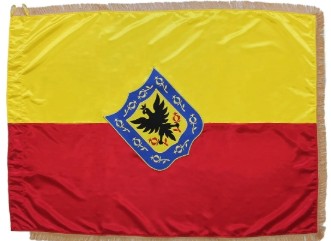
Article 1º.- Adopt officially as Pennant, Flag, or Standard one composed of the colors yellow and red, distributed in two equal stripes, horizontal, of which yellow shall be placed in the upper part. It shall carry in the center the Coat of Arms of the City, crested with the title of "Muy Noble y muy Leal" [Very Noble and very Loyal]. The dimensions of the flag shall be the same as those of the National Banner. When it is used as a pennant, it shall be two times as long as its height, cut in reduction to its point. When it is employed as a Standard, it shall be two and a half times as long as it is wide.
Text: alcaldia.bogota.gov.co
I am not sure if the Decree of 1952 was actually followed, as that would mean the flag would have had a ribbon above the arms.
Later, through Decree 001 of 19 April 1988, it replaces the 1952 decree and describes the flag a bit better:
Adopt as the flag of the city of Bogotá, Special District, the one established by Decree 555 of October 1952, consisting of two horizontal stripes, one of yellow color in the upper part and another of red color in the lower part, and in the center carrying, printed or embroidered, the coat of arms of the city in the size of 1/3 the total of the standard.
Text: alcaldia.bogota.gov.co
It is also adopted yet again through Local Agreement No. 088 of 7 June 2003, in effect on 26 June; and with the same text.

by Dov Gutterman, 12 May 2002
This flag is a horizontal bicolor of yellow over red; this is a widely used flag but appears to have not been adopted officially.
Daniel Rentería, 30 November 2025
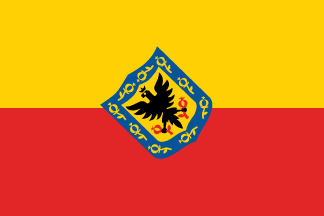
photo from mercadolibre.com
by Daniel Rentería, 30 November 2025
A horizontal bicolor of yellow over red with a diagonally placed coat of arms in the center to appear upright.
*Not official by law; commonly used on indoor flags.
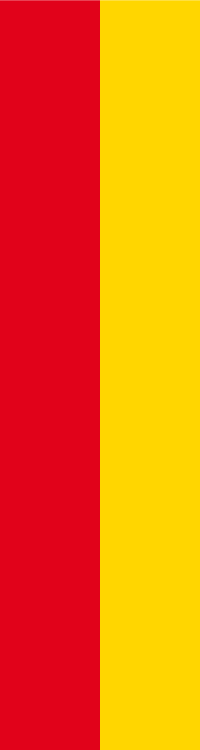
photo from reporterosasociados.com
by Daniel Rentería, 30 November 2025
A long vertical flag of yellow and red.
*Does not conform to law, but still used

image
by Zoltan Horvath, 24 November 2013
On November 15, during a tv news broadcast by
CM& one can see an additional official flag of Bogotá. It is a plain horizontal
white flag with the coat of arms in the middle.
Image (official flag is the first from left to right).
Esteban Rivera, 19 November 2013
This flag seems not to be white, but pale yellow or cream. Please see board
backround, and jackets wearing by guys around the table. They are white. If you
compare the colour shade of flag with these white elements on this picture, we
can state that this flag is definitley not white. This flag may not belong to
Bogotá itself, likely it belongs to a department or other entity of Mayor
administration.
Zoltan Horvath, 24 November 2013
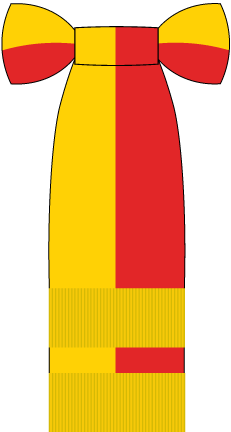
photo from rafaeluribe.gov.co
by Daniel Rentería, 30 November 2025
The cravat is colored yellow and red, the city's colors. It is not official, however, as far as I know; it is used unofficially by the government of the City and its localities.
As typical in Latin American flag tradition, these cravats are used on indoor
flags.
Daniel Rentería, 30 November 2025
dc.gif)
by Carlos Thompson, 22 March 2003
It is possible the crowned eagle represents its status under Spain and that
the colors are red and yellow because it
was a Spanish colony. The pomegranates are seen because the area at the time was in the
province of the Nuevo Reino de Granada (New Kingdom of Granada); the word granada translates to pomegranate.
Originally, the coat of arms was adopted after the councilors thought it was necessary to adopt Municipal Symbols because of its importance in the Kingdom. Pedro de Colmenares as councilor and Alfonso Téllez as the scribe wrote to the King Carlos I asking for his approval of a symbol.
In fact, he granted the usage of the arms to all of the cities and villas of the Kingdom.
As the Royal Decree given in Valladolid reads, 3 December 1548 (where it was
adopted officially, ten years after the foundation of the city):
...henceforth, the aforementioned province of the named New Kingdom of Granada, and its cities and villas shall find and have as their arms to be known as a shield, of which in the middle is a full rampant black eagle crowned in gold, of which in each hand has a pomegranate colored on a golden field, and as border some branches of pomegranate in gold over a blue field as it shall be painted and figured.
The coat of arms was first regulated upon by the Municipality of Bogotá as part of Cundinamarca through Agreement No. 031 of 9 June 1932, in effect on 13 June. This decree prevented its use by private persons and instituted iits use by the mayor. Through Decree 001 of 19 April 1988, the coat of arms is adopted as official. The text of the decree is:
Article 1º.- Adopt the official arms of the city of Bogotá, Special District, the one established by Royal Decree on 3 December 1548, conformed by the Royal rampant Eagle, surrounded by nine pomegranates in red and a crown in the upper part
Indeed, the Decree says red pomegranates (though it could be that the person writing from the document missed something?). It is also adopted yet again through Local Agreeement No. 088 of 7 June 2003, in effect on 26 June; and with the same text.
The correct name of "granada" in English is
"pomegranate". The Latin name of the pomegranate tree
is "Punica granatum". "Punica" recalls that
the tree was brought back from Carthago by the Romans. In French,
the ancient name of the fruit was "pume grenate",
"pume" being an ancient form of "pomme"
(apple) and "grenate" derived from Latin
"granatum", a fruit with grains, via a dialect of
Northern Italia (Grand Robert de la Langue Francaise). The name
of the fruit was later simplified to "grenade", the
same word being later used for the weapon. In the ancient
mythology, the grain of pomegranate was the symbol of the faults
and pleasures which sent you to hell. It was later adopted as the
mystical symbol of divine perfection (op. cit.).
Luis Carrillo, 15 July 2002
Juan Arenas, 31 March 2004
dissertation on pomegranate by Ivan Sache, 1 April 2004
Daniel Rentería, 30 November 2025

photo from img.lalr.co
by Daniel Rentería, 30 November 2025
Today during the inauguration of the Mayor of the City of Bogotá, one can see
the sash, which has the same colors as the flag and also the
Coat of Arms.
The sash can be seen here:
- Picture: [1] and [2].
Esteban Rivera, 02 January 2012
The sash of the mayor is a horizontal bicolor of the flag's colors (yellow and red), with the coat of arms over the center shifted closer to being horizontal on the bands.
[Editor]
dc2.gif)
historical arms from Wikimedia Commons
by Daniel Rentería, 30 November 2025
*potentially used on an original flag of Bogotá (legislated in 1955)?
Yesterday on CM& news, a local news
broadcast, the flag of the Personería de Bogotá is seen.
Personería de Bogotá D.C. is the organization in charge of the defense and
safeguard of the citizens' rights and operates at the local level, that is,
city-wide. It's kind of a mixture between the
Defensoría and the Procuraduría. The
Procuraduría de Bogotá was established more recently by Decree No. 1421 of 1993,
its roots date back to the XVIIIth century.
Source:
http://www.personeriabogota.gov.co/content/historia
The flag of the Personería de Bogotá D.C.is a white horizontal flag with the
logo in the middle.
Images attached:
- Cropped logo from the
official website.
- Flag of the Personería, first flag from left to right.
An image of the flag is seen here:
http://www.bogota.gov.co/sites/default/files/styles/large/public/field/image/salud2.jpg
Source:
http://www.bogota.gov.co/salud/Supersalud%20y%20Personeria%20de%20Bogota%20firman%20convenio%20para%20proteger%20a%20usuarios%20de%20la%20salud
(Bogotá Mayor's Office official website)
For additional information please go to:
Personería de Bogotá (official
website)
Esteban Rivera, 07 September 2013

.gif)
logo from bogota.gov.co
photo located
by Esteban Rivera, 14 December 2015
On March 18 during the main broadcast of tv news
CM&, one can see the flag of the EAAB (Empresa
de Acueducto y Alcantarillado de Bogotá, Aqueduct and Sewer Company of Bogotá).
EAAB was established by
Acuerdo (Law) 105 of the Administrative (City) Council of Bogotá on December
9, 1955.
Sources:
this portal,
http://www.acueducto.com.co/streaming/video02_.asx and
https://es.wikipedia.org/wiki/Empresa_de_Acueducto_de_Bogot%C3%A1
The flag is the
logo on a light blue blackground.
Image iscropped image from tv broadcast
at 21:33.
For additional information please go to: Acueducto (official website)
Esteban Rivera, 14 December 2015
The logo depicts a frog emerging as its mascot, which thrives in water. It also has the name "acueducto" and its full name smaller underneath "AGUA Y ALCANTARILLADO DE BOGOTÁ". The symbol is in blue as a representation of water.
[Editor]