Last modified: 2026-04-11 by  zachary harden
Keywords: díli | dili | dilli | dily | coat of arms (tree: green) | tree | arrow-bag |
Links: FOTW homepage |
search |
disclaimer and copyright |
write us |
mirrors
On the right and the left wall of the East Timor national parliament
are hanging traditional weavings, each with the name of one of the
districts. Each district has such a weaving
on the left and the right, but
there are not exactly the same, just similar.
J. Patrick Fischer, 08 August 2002
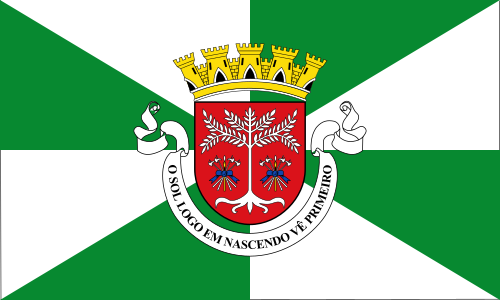
 image by J. Patrick Fischer, 08 August 2002
 image by J. Patrick Fischer, 08 August 2002
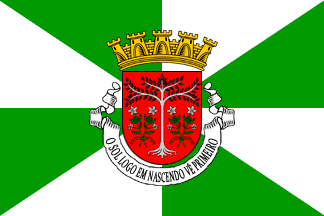 image by Sérgio Horta and António Martins-Tuválkin, 04 March 2026
.gif) image by Sérgio Horta and António Martins-Tuválkin, 04 March 2026
image by Sérgio Horta and António Martins-Tuválkin, 04 March 2026
Some, not all, Portuguese overseas municipalities received arms and
flag in the period 1940-1974, after all metropolitan
municipalities got one. In Portuguese Timor overseas province only
Díli had a flag and a coat of arms, all other 12 municipalities (currently
named districts) being confirmedly flagless.
António Martins, 15 January 2003 and 06 August 2005
The Díli municipal flag was white and green gyronny of eight,
with the municipal coat of arms over all: argent, a tree vert between
two arrow-bags, sable; golden mural crown with five visible towers
(overseas province capital city status), and white scroll with uppercase
sans serif "CIDADE DE DÍLI".
Antonio Martins, 23 October 1999
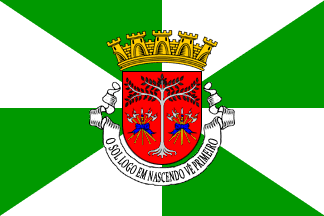 image by Sérgio Horta and António Martins-Tuválkin, 04 March 2026
.gif) image by Sérgio Horta and António Martins-Tuválkin, 04 March 2026
image by Sérgio Horta and António Martins-Tuválkin, 04 March 2026
The decree (Portaria) n.º 19409 / Octobre,1 1962 (http://www.legislacao.org/primeira-serie/portaria-n-o-19409-prata-ouro-azul-listel-6778)
wrote:
Província de Timor
Cidade de Díli - O escudo de armas a que se
refere o artigo único do Diploma Legislativo Ministerial n.º 1, publicado em
Díli em 31 de Maio de 1952, passa a ser descrito nos termos seguintes: em campo
vermelho uma árvore de sândalo de prata, entre dois troféus atados por fita azul,
debruada de prata, e constituídos por quatro alabardas de prata, hasteadas de
ouro, e um venábulo com manga de azul realçada a ouro. Listel branco com os
dizeres «O Sol logo em nascendo vê primeiro».
Sources:
http://www.anmp.pt/anmp/press/bol/1999/bol7099.html#a5
https://upload.wikimedia.org/wikipedia/commons/thumb/2/2d/Bandeira_Dili_1952-1975.svg/500px-Bandeira_Dili_1952-1975.svg.png
http://www.legislacao.org/primeira-serie/portaria-n-o-19409-prata-ouro-azul-listel-67
To differentiate it from the earlier flag, it says "In a red field... and
motto "O Sol logo em nascendo vê primeiro"."
Jens Pattke, 25 March 2016
This law states that scrolls that read merely the settlement’s name may be
omitted (probably means that they be omitted on flags, too), and are mandatory
only when they read a motto. This is interesting and show a difference between
these colonial coats of arms and the Metrópole (metropolis, as opposed
to colonies - it was the contrasting term to Ultramar and included both
the Portuguese mainland and the “adjoining islands” of Azores and Madeira; in
practice, it’s where white people lived), as the latter never had mottos on
their scrolls, at most additional titles to the name of the settlement,
Oporto being the most notable case. This is also due
to the fact that colonial coats of arms were created later, already in the 1940s
(except for a few pre-existing ones), and the heraldists’ sophistication had
improved.
Cidade de Díli - O escudo de armas a que se refere o artigo
único do Diploma Legislativo Ministerial n.º 1, publicado em Díli em 31 de Maio
de 1952, passa a ser descrito nos termos seguintes:
The phrase "passa
a ser descrito" means something like "from now on will be described as",
which indicates that the mentioned previous law, of 1952.05.31, had it described
differently.
My source must have been Durán Rodríguez (1995) and
Langhans (1966) (and
Langhans 1966 was apparently also
the source for Durán Rodríguez, 1995), but why those were showing what’s apparently the 1952-1962
version of the flag and not its replacement I cannot say. The 1999 photo
suggests that the 1962-1975 flag existed, not a case that the 1962 law had been
ignored - or maybe the 1999 event was using a newly created flag according to
the 1962 law, which had however been ignored or forgotten so that the very
official book (Langhans 1966) in 1966 shows the previous version instead?
As for
my interpretation of the additional elements next to the tree as quivers,
instead of war trophies, they come also from Durán’s article (Durán Rodríguez, 1995).
António Martins-Tuválkin, 25 March 2016
The remarkable thing for me is the golden mural crown, which acc. to
decree/law from 1930/1991 is exclusively reserved to Lisboa as the capital of
whole Portugal incl. overseas provinces. I have no idea about the change of
shield background colour.
Klaus-Michael Schneider, 27 March 2016
The 1930 law reserved the golden crown for Lisbon (imperial capital) and for
each of the overseas province capitals, one of which Dili was. It would be
remarkable if it were silver, as the one shown on the 1999 photo [http://www.anmp.pt/anmp/press/bol/1999/image/b7003.jpg]
Jens found at [http://www.anmp.pt/anmp/press/bol/1999/bol7099.html#a5].
The 1991 law updated the state of affairs after the “empire” was gone in
1975 and Lisbon is the only municipality left with a golden crown. (The 1991 law
gives to administrative regions the same crown that the previous law had for the
overseas provinces, which is also golden, but since there’s no regions, the
matter is moot.)
António Martins-Tuválkin, 27 March 2016
[The above re-drawn images refers to] the original image, as usual, and quotes the same official legal sources
as in FotW-ws at [tl-dil.html#pt]: _Boletim Oficial de Timor : I Série_
*22*, of 1952.05.31, and “Portaria n.º 19409” _Diário do Governo : I
Série_ *226*, of 1962.10.01. These two laws prescribe identical flags
but for the elements flanking the central charge of the armorial shield:
The 1952 text prescribes two coffee plants Vert fleury Argent tied at
their proximal ends each pair with a broken off length of chain Argent.
The 1962 text prescribes two trophies, each composed by four halebards
Argent handled Or and one javelin with a sleeve Azure garnished Argent
and all five tied together with a ribbo Azure (the javelin’s colors are
not specified; Sérgio used the same as for the halebards). Both agree on
shield Gules a sandalwood tree eradicated and leaved Argent, mural crown
Or with five visible towers, white scroll with the Camonian quote in
black letters, and white over green 8-triangle gyronny flag.
This differs in some regards from [previous images images we
had here], namely:
1. The general orientation of the flag background pattern is swapped: As
seen before for Portuguese (mainland/metropolitan) municipal flags, this
is/was a common mistake. The 1999 photo showing peace Nobel laureate,
former president and former prime-minister of East Timor, and 1995-1996
coffee break buddy of yours truly Ramos Horta with Portuguese municipal
bigwigs (heh) and a Díli municipal flag confirms the gyrons orientation as interpreted
by Sérgio Horta and illustrated today: See how it is a green, not white,
part of the background that adjoins the scroll next to letters "SCENDO".
2. Shield Argent, not Gules, matching my 23 Oct 1999 report. While I did
peruse a physical (photo)copy of [drn95] (thanks to Jaume Ollé sending
me a lot of PT-related stuff in 1998 — molts gràcies!) and used it in
my own flag website, my image remained incomplete and this detail might
have been a confabulation: Between 1998 and 1999 I had 99% of my stuff
safely stashed in storage, flag books included, and that 1999.10.23 post
was done 5000 km away, from memory and scarce notes. Mine or someone’s copy of [drn95] should come handy to ascertain whose error it is, but an
error it is.
3. Scroll reading the more prosaic and usual municipal seat rank epithet
+ toponym instead of the prescribed motto from a literary work. This
might have been a common variation in actual representations of the coat
of arms, or may be a mistake in [drn95] or other source. This motto, by
the way, comes from "The
Lusiads_’" stanza VIII of canto I: In context, this passage is not about
East Timor, rather to the extent of the whole empire in the 1570s, whom
the Sun would «see first when rising» and last when setting; back then
East Timor was not even part of the Portuguese Empire: its easternmost
reach was in nearby Ternate.
The 1962 legal document,
Ministerial Drecree n.º 19409, issued by the Overseas Ministry, contains
several colonial municipal heraldic and vexillological determinations,
not only about Díli mun.: It covers also the three municipal flags of
Portuguese India, Bissau, S. Tomé,
Lourenço Marques, and nine mun. in Angola. Furthermore its art 4.º allows for the use of prior
flags, arms, and seals temporarily, while updated replacements were
being procured — which, in some of these municipalities, might have
lasted up to the end of the colonial period in 1975. Some of my 27 Mar
2016 post pertains not to Díli mun. specifically but in general to
Portuguese mun. flags, both colonial and otherwise.
António Martins-Tuválkin, 05 March 2026
Two images of monuments from 1962 and 1963 with the CoA of Dili in Remexio and Atauro, which have been part of the conselho of Dili in this time.
https://commons.wikimedia.org/wiki/File:Remexio_296451.jpg
https://commons.wikimedia.org/wiki/File:Monumento_da_Camara_Municipal_de_Dili,_construido_em_1962.jpg
The coffee plants are below the tree.
J. Patrick Fischer, 06 March 2026