- IN ABEYANCE
- The term used when a flag or office is no longer in current use, but which may be re-introduced at
some future date – see the second note following
flag captain (also
broad command pennant 2),
flag of former entity,
rank flag 1)).
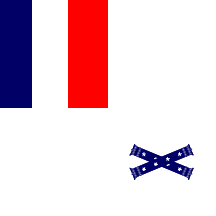
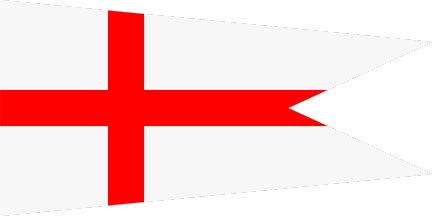
Rank Flag of a Marshal of France;
Former First Class Commodore’s Broad Pennant, UK
Please note that two examples would be the rank flag of Marshal of France (which office has no
extant holder) and the broad pennant of a commodore first class (a rank in abeyance since 1958.
- IN ANNULO
- The heraldic term used when a series of objects are set equidistant around a central point –
see annulet and
conjoined (also
orled 3) and rosette).
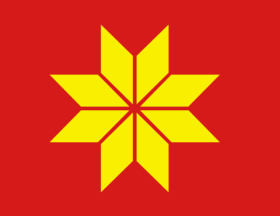
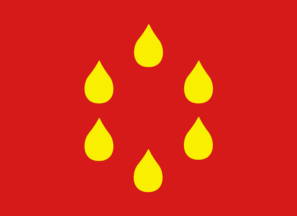
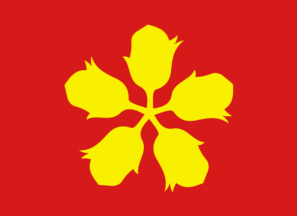
Flag of Ulvik, Norway; Flag of
Samnanger, Norway;
Flag of Hemne, Norway
- IN BASE
- The heraldic term used when a charge or charges appear in the lower part of a
shield, banner of arms or
flag – see base 1) (also abased).
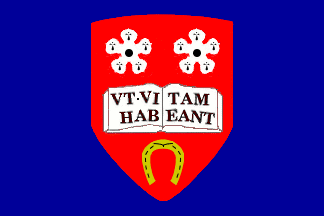
Flag of the University of Leicester, UK
- IN BEND
- The heraldic term used when an object, charge or charges on a shield, a
banner of arms or any quartering thereof are placed diagonally
from top left to bottom right across the field – but see
bendwise 2)
(also bend,
and per bend,
quartering 1)).
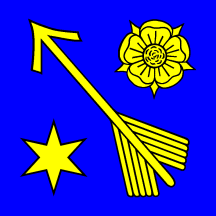
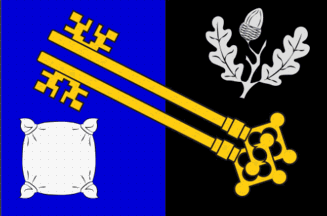
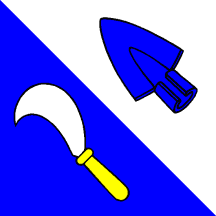
Flag of Nidfurn, Switzerland;
Banner of Arms of Surrey County Council, UK;
Flag of Benken, Switzerland
- IN BEND SINISTER
- The heraldic term used when an object, charge or charges on a shield, a
banner of arms or any quartering thereof are placed diagonally
from bottom left to top left right across the field – but see
bendwise 2)
(also bend sinister,
per bend sinister
and quartering 1)).
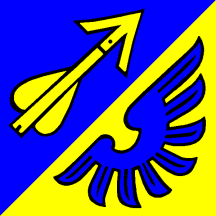
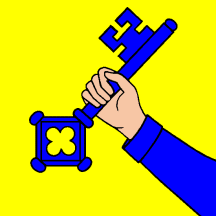
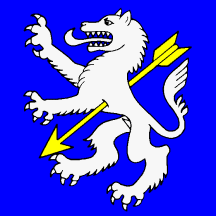
Flag of Luzein, Switzerland;
Flag of Wallisellen, Switzerland;
Flag of Wolfenschiessen, Switzerland
- IN CHIEF
- 1) The heraldic term used when a charge or charges appear in the upper part of a shield,
banner of arms or flag – see
chief
(also enhanced and shield).
2) In English naval usage now obsolete, a term officially employed to describe a charge placed in
the upper hoist canton – see canton 2).


Villiers, Switzerland;
English Red Ensign c1625–1707
- IN COMMISSION
- In British RN, USN and some other usage, the phrase used to describe a warship that is active, manned
and ready for combat – see masthead pennant 1).

Commissioning Pennant of South Africa
- IN FESS
- The heraldic term used when an object, charge or charges on a shield, a
banner of arms or any quartering thereof appear in a horizontal
position – but see fesswise 2) and the note below
(also fess,
per fess and
quartering 1)).
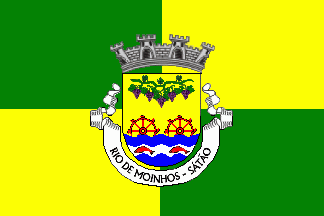
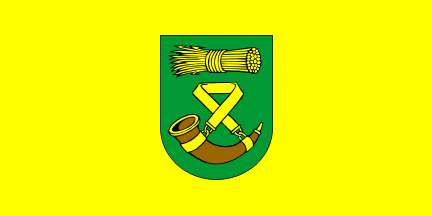
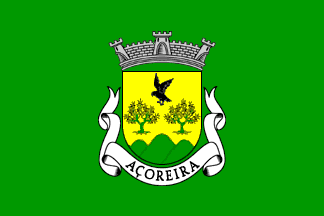
Flag of Rio de Moinhos, Portugal;
Flag of Bilje, Croatia;
Flag of Açoreira, Portugal
Please note charges can be arranged in fess but orientated palewise
as per the examples below, with would be blazoned as ‘three shovels
palewise in fess’.

08-11.gif)
Flag and Arms of Siljan, Norway
- IN HER PIETY
- A heraldic phrase specifically relating to a (sometimes wounded) pelican feeding her chicks, and
symbolizing sacrifice and compassion – a "pelican in her piety" – see
vulned (also birds in heraldry).
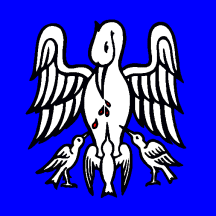
.gif)
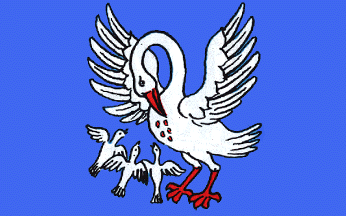
Flag of Lavertezzo, Switzerland;
Arms of Neudorf bei Parndorf, Austria;
Flag of Lučenec, Slovakia
- IN PALE
- A heraldic term used when the charges on a shield, a
banner of arms or any quartering thereof are arranged one above
the other, or when an individual charge is seen in the vertical – but see
palewise 2) (also
pale, per pale and
quartering 1)).
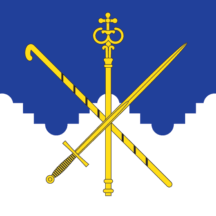
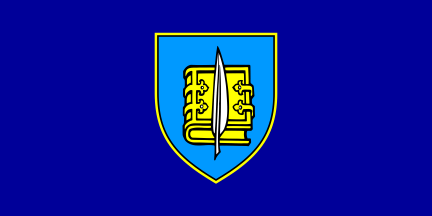

Flag of Stara Pazova, Serbia;
Flag of Stankovci, Croatia;
Flag of Mandal, Norway
- IN PALL
- The heraldic term used when the charges on a shield, a banner of arms or a flag are arranged in the
form of a pall – see
pall 2) and per pall.
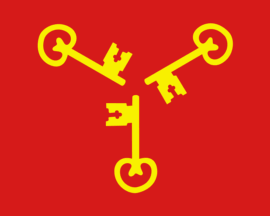
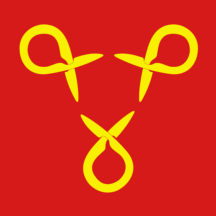
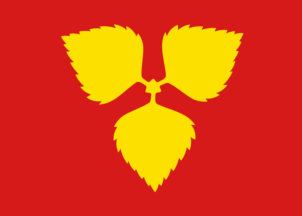
Flag of Sor-Odal, Norway;
Flag of Masfjorden, Norway;
Flag of Lavangen, Norway
- IN SALTIRE
- The heraldic term used when two separate objects or charges are placed across each other diagonally on
a flag, shield or banner of arms – saltirewise
(see also saltire
and per saltire).
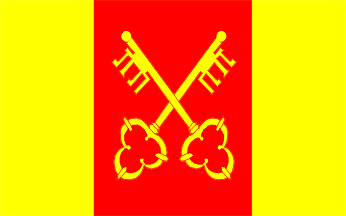
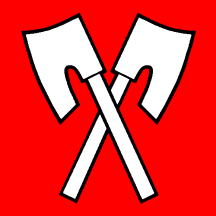
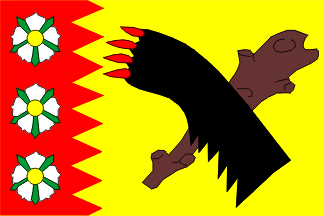
Arms of Babimost, Poland;
Flag of Biel/Bienne, Switzerland;
Flag of Milíkov, Czechia
- INACTIVE
- In vexillology a term that may be used to describe when the rays of a star or sun emblem, or a radiating
stripe, are straight-edged – see active (also
active and inactive,
radiating,
rays 1) and
star and its following note,
sun emblem and
sunburst).
![[inactive example]](../images/v/vx-ag.gif)
![[inactive example]](../images/v/vx-my-saraw.gif)
![[inactive example]](../images/v/vx-no-18-04.gif)
National Flag of Antigua-Barbuda;
Flag of Sarawak, Malaysia;
Flag of Bodø, Norway
- INCENSED
- 1) The heraldic term for when a wild beast has fire issuing from its mouth or eyes.
- 2) A term sometimes incorrectly used in place of ‘inflamed’ – see
inflamed and the note below.
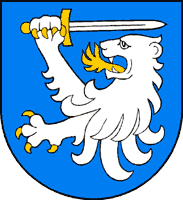
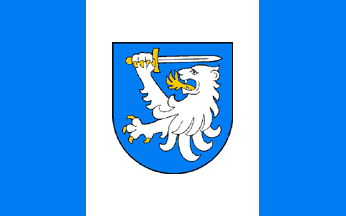
Arms and Flag of Gorlice, Poland
Please note that in English heraldry only a wild beast should be described as “incensed”,
and that other charges are “inflamed”.
- INCLINED FLY
- A term used when the fly of a flag is cut diagonally so that the upper length
of the flag is greater than its lower length – a type largely limited to Central
Europe (see also length 1),
schwenkel,
swallow-tail(ed)).
![[inclined fly flag]](../images/v/vx-pl-wp-ja.gif)
![[inclined fly flag]](../images/v/vx-pl-wp-pl.gif)
Flag of Jarocin County, Poland; Flag of
Pleszew County, Poland
Please note that this is not an established term, but has been introduced by the Editors since no
suitable (or suitably descriptive) alternative could be found.
- INCRESCENT (or INCREMENT)
- In heraldry see moon 2) with following note.

Flag of Oron-la-Ville, Switzerland
- INDENTATION(S)
- A term that may be used to describe the shape remaining at the fly of a flag or pennant where that
fly has been cut into two or more tails – see swallow-tail(ed)
(also
hussar cut,
palm, pennant 2),
swallow-tail and tongue,
tongues).
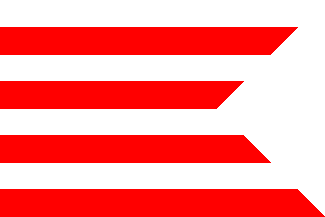
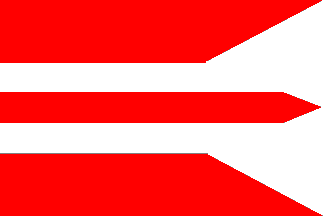
Flag of Banská Bystrica, Slovakia; Flag of
Bojná, Slovakia
- INDENTED
- 1) The heraldic term used when the edge of an ordinary or the partition
line on a shield, banner of arms or flag is notched as in dancetty
but with smaller/narrower teeth – endented.
2) See embattled.
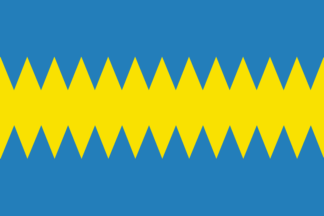
wu.gif)
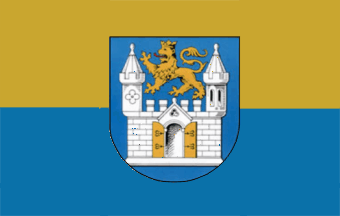
Flag of Ulstein, Norway;
Arms and Flag of Wunstorf, Germany
- INDENTED EDGE
- See scalloped 1).
![[indented edge example]](../images/v/vx-pt~e15.gif)
![[indented edge example]](../images/v/vx-pt~e16.gif)
Two Merchant Flags, Portugal 16th/17th century
- INDEPEDENTIST(S) FLAG
- See
flag of a separatist movement.
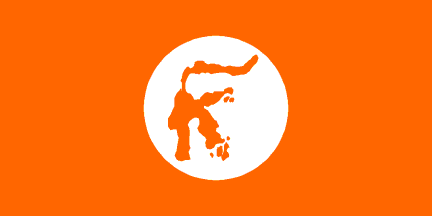
Flag of the Sulawesi Separatist Movement, Indonesia
- INDIVIDUAL FLAG
- In U.S. army usage, the flag denoting an officer's rank – see
rank flag 1)
(also distinguishing flag 3),
flag of command and
personal flag 4)).
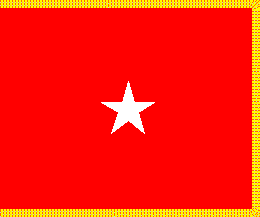
Individual/Rank Flag of a Brigadier General, US Army
- INDOOR FLAG
- A flag made expressly for display inside a building and sometimes fringed.
It is often made from more costly materials, is enhanced by embroidered detail, and is fitted
with a sleeve for attachment to a staff – a dress flag or flag of ceremony (see
also ceremonial flag 1),
cord,
embroider,
flag spreader,
fringe, sleeve 2),
staff 2) and
tassels).
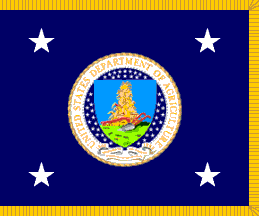


Indoor Flag of The Secretary of Agriculture, US;
Indoor Flag of the Secretary of Health and Human Resources, US;
Indoor Flag of The Secretary of The Interior, US
- INESCUTCHEON
- The heraldic term for one shield appearing within another (usually – but
not invariably – at its centre point) “a heart shield”, but see notes below
(also banner of arms,
coat of arms,
escutcheon,
escutcheon of pretence 1),
escutcheon of pretence 2),
overall
and quartering 1)).
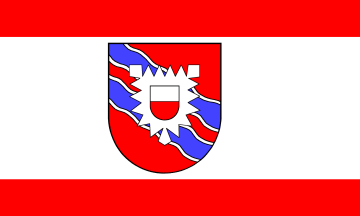
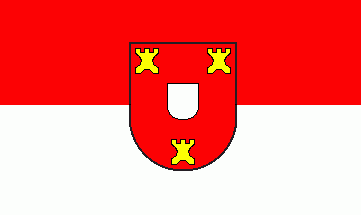
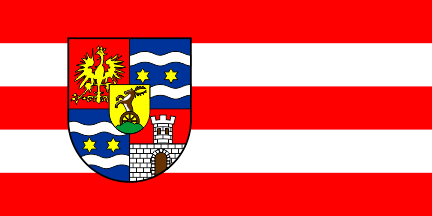
Flag of Friedrichstadt, Germany;
Flag of Kalkar, Germany;
Flag of Varaždin County, Croatia
Notes
a) Please note that some heraldic sources propose that this term should also be used when more than one
shield appears within another, but it is suggested that a suitable glossary or heraldic dictionary should
be consulted for further information.
b) However, one further (authoritative) source states that an inescutcheon should be placed on or near
the fess-point, and that the term “escutcheon” be used for any that are seen in another
position – see honour-point 2).
- INFLAMED
- The heraldic term used when a charge is shown with flames coming from it –
ardent, enflamed or flamed – but see incensed 1)
(also flamant).
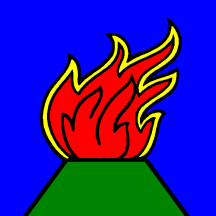
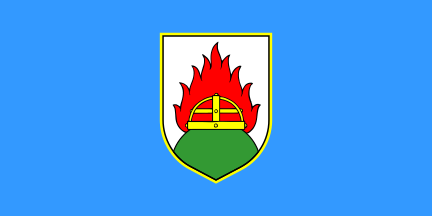
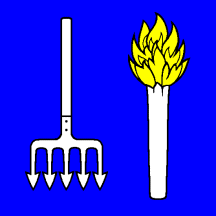
Flag of Lugaggia, Switzerland;
Flag of Gornja Stubica, Croatia;
Flag of Geroldswil, Switzerland
