
Last modified: 2026-02-28 by antónio martins
Keywords: sal | salt | triangles: 2 | triangle (white) | plane | beach | sail ship (red) | chain (green) | chain: 3 links | stars: 10 (yellow) | star: 5 points (yellow on white) | star: 5 points (yellow on blue) |
Links: FOTW homepage |
search |
disclaimer and copyright |
write us |
mirrors

image by Waldir and Jorge Candeias, 10 Mar 2007 |
(source)
See also:
External links:
Concerning the municipality iself, it should be noted that its territory covers fully and exclusively the namesake Salt Island — Ilha do Sal / Dja’r’Sal. The municipal seat is Espargos, on the central/northern part of the island, built around the country’s oldest international airport.
The colonial administration had the same characteristics, down to the name of the municipality — named after the island, not after its seat settlement, but the municipal seat was instead Santa Maria, located at the southern tip of the island. I am not sure when this change occurred — it may or may not have been at the same time as the independence of Cabo Verde in 1975.
António Martins, 14 Dec 2025

image by Waldir and Jorge Candeias, 10 March 2007 |
(source)
This one is a bit strange: the blue is so light it’s practically
indistinguishable from the white. But since banners are ceremonial flags
made to be carried around, it just might work, despite the lack of
contrast.
Jorge Candeias, 10 Mar 2007
The banner of Tarrafal is also blue and
white — differing from that of Sal by the order of the colors of the
banner (blue-white vs. white-blue) and the shade of blue, which is
light in Tarrafal and a very pale light blue, almost white, in Sal.
António Martins, 30 Mar 2016
The arms include one canting element: the two white triangles are two
salt cones, and the name of this place means, exactly, "salt" in Portuguese.
Jorge Candeias, 10 Mar 2007
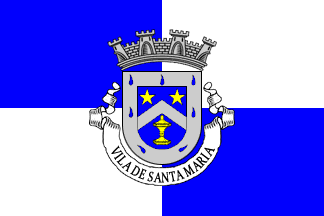
image by Sérgio Horta and António Martins, 14 Dec 2025 |
(source)
A colonial-era flag existed — a typical Portuguese
municipal flag, it consists of a 2:3 blue and white quartered background with
the coat of arms centered on it. Mural crown Argent with four
visible towers (town rank) and white scroll reading in black upper case
serifed letters "Vila de Santa Maria". The banner should
have silvery and blue tassels and cord, and golden staff with a spear finial.
Flag and arms approved by the Overseas Ministry in
Ministerial Decree (Portaria)
n.º 15441 and published in the official journal Diário do
Governo : I Série 144 of 1955.07.01.
António Martins, 14 Dec 2025
At HeraldicaCivica.PT
we can see Sérgio Horta’s account of these arms and flag, drawn in
the same style as contemporary CHAAP artwork;
other sources, such as [lgh66] and postage
stamps, may differ in details.
António Martins, 14 Dec 2025
![[flag]](../images/p/pt-'bw4.gif)
image by António Martins, 29 Feb 2010
Non-monocolored portuguese subnational flags are
allowed to have armless variations.
Jorge Candeias, 18 Jul 1999
While the current law, adopted in 1991,
doesn’t apply to municipal flags in the colonies, independent in 1975, it
however draws most of its content from the 1930 ministerial dispatch, incl.
the regulation of armless variations allowed for non-monocolor municipal flags.
This 1930 ruling affected all future Portuguese municipal flags, including the
colonial ones.
António Martins, Feb 2026
.gif)
image by Sérgio Horta and António Martins, 14 Dec 2025 |
(source)
The arms have on a shield Azure a chevron Argent accompanied by two estoiles Or in chief and a salt cellar Or in base and on a bordure Argent seven teardrops Azure.
Em campo azul, asna de prata acompanhada de duas estrelas de ouro em chefe e de um saleiro do mesmo em contrachefe. Bordadura de prata gotada de sete lágrimas de azul. Coroa mural de quatro torres de prata. Listel branco, com os dizeres "VILA DE SANTA MARIA". Bandeira - Esquartelada de branco e azul. Cordões e borlas de prata e azul. Lança e haste douradas.António Martins, 14 Dec 2025
By my reading, salt shakers were introduced about 115 years ago. Before that,
salt was present on the table in cellars, open or, as depicted here,
lidded vessels, from which diners took salt with a spoon.
John Ayer, 25 Dec 2025
These three colonial-era municipal coats of arms
(Maio, Boa
Vista, and Sal) were issued in 1955 but depict historical
items, not modern free flow salt shakers. (I wrongly presumed that a salt cellar
is something akin to a root cellar or a wine cellar.)
António Martins, 27 Dec 2025
Anything below this line was not added by the editor of this page.

