Last modified: 2026-04-04 by  zachary harden
Keywords: ufe | unidentified flags |
Links: FOTW homepage |
search |
disclaimer and copyright |
write us |
mirrors
Please note our Policy for Submissions and Enquiries.
Below is a series of images of flags that have been provided to FOTW; some we have recognized, and some we have been unable to recognize. If you can help us identify any of these flags, please let us know! Contact the: UFE Editor.
Identification Key:
 = Positive ID (Positive Identification)
 = Tentative ID (Tentative Identification)
 = Some Speculation Some Speculation
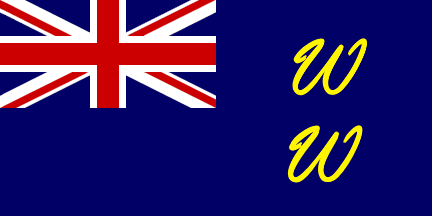 Speculative Image by Rob Raeside, 20 April 2010
Can you tell me the significance of a blue ensign with 2 large yellow Ws on the blue part?
Erica Utsi 20 April 2010
How clearly did you see this flag? I suspect you have the flag of the Training Ship Worcester, or its yacht club descendant, the Old Worcesters Yacht Club. While the lower W is definitely a W, the upper one is actually a naval crown. From a distance it would probably look quite like a W.
Rob Raeside, 20 April 2010
The answer to your question is very clearly indeed. It's being hoisted by a local eccentric in his front garden. This gentleman has taken to referring to himself as a "commodore" although he has no RN experience. He gave a talk to a local society on one of the major naval battles a couple of years back. I believe he does have a small boat of his own. It was flying yesterday and also a few months ago. Very distinctive - blue ensign with 2 large yellow Ws, one above the other taking up the majority of the rhs (as you face it). The Ws are identical. My description is confirmed by one of my work colleagues, the Ws are more flamboyant than that used by TS Worcester. They take up more physical space and there is a short tail to one side, shorter than but reminiscent of the tail on the W used by Wayfarer dinghies. I think the tail is on the opposite side to that of the Wayfarer but my colleague is not sure of this.
Erica Utsi, 20 April 2010
I'm inclined to think this may a personal design, if the two Ws really are both Ws. Could that be his initials? However, now that I have confirmed you had a good clear close-up sighting of it and that it is not the Worcester flag, I will ask further in a group of flag enthusiasts that discuss such matters on the internet. I take it from your message that the W is written in a scripted
form, not a plain uppercase letter W?
Rob Raeside, 20 April 2010
That's absolutely right - it's scripted. The placing is also interesting. Looking through your website and then the material you sent links for, the placing of any additional emblens is very central i.e. the margin to the upper and lower edges of the flag are greater than the gap in the middle e.g. between the crown and the W on TS Worcester's flag. I'd say that these Ws are equally spaced relative to each other and the top and bottom of the flag. I guess that also suggests a private enterprise initiative. Does yesterday's date have an significance? I've seen the flag once before but he doesn't fly it on a daily basis. I didn't see it this morning but a colleague assures me it's still on the flagpole, just not as visible since the wind has dropped.
Erica Utsi 20 April 2010
I am, of course, unable to add anything of substance to the resolving of the WW mystery flag, but I am wandering of legality of display of such flag in his own back yard. From my (casual and lay) understanding of the English flag related legislation, it may indeed be quite legal thing to do. It would be different if used on a ship/boat instead of an ensign/jack (although it may possibly pass off as a private signal/house pennant), where the skipper would have to be able to produce a warrant of other document that may confirm his right to use it on the boat/ship. But on land, if I understand correctly, one can hoist more or less whatever he want in his back yard, providing that he has planning permission for the flagpole. And as I understand, this is much to difference with the legislation regarding the flags in your back yard in the most of the countries on Continent (of Europe, of course), where the laws in general much more strictly prescribe what can be hoisted.
Željko Heimer, 21 April 2010
Since this isn't an official Blue Ensign, the only way you can find out what it is all about, as a friend suggested, is to knock on the door and ask him what the two "w" stand for. If you do please let us know what you find out.
Pete Loeser, 22 April 2010
Some Speculation
 Provided by Andrew Bienhaus, 8 May 2010
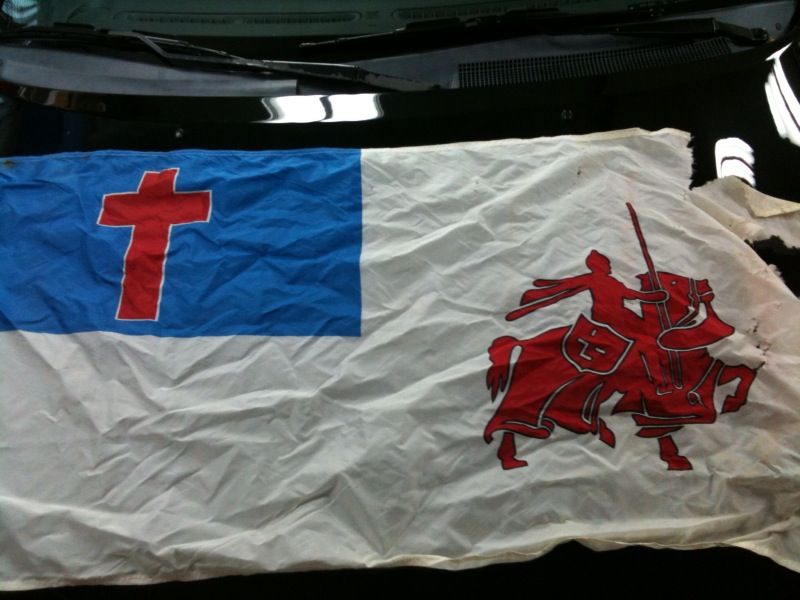
Any idea on what this flag might stand for? The image is from http://www.1stBinbrook.org/photo.jpg, which is on a Canadian Scouting group's website called Binbrook.
Andrew Bienhaus, 8 May 2010
This is a variant of the Christian flag shown on FOTW, and quite widely used across North America, at least in Protestant churches. I have never seen it with the red mounted knight in the fly, and I am not sure if that is a local addition or if it has any other meaning.
Rob Raeside, 9 May 2010
It's only a guess, but the flag might have been made up as a flag for a local Christian school, probably somewhere in the US. I would also guess that the emblem in the fly would be that of a "Crusader" which used to be a popular mascot name among Christian schools. For obvious reasons, the "Crusader" nickname has fallen out of vogue. I found the white fimbriation around the cross interesting as it doesn't exist on any Christian flag that I have ever seen. And, the blue is too "royal blue" compared to most Christian flags which are generally made with a darker US flag blue or UK flag blue. The flag does appear to be printed, meaning that a bunch of them would have been made.
Clay Moss, 9 May 2010
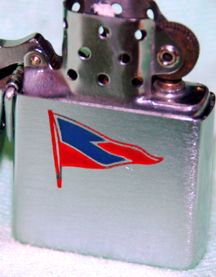 Image From Ron Laubenheimer, 7 May 2010
I was wondering if you can identify the flag on this Zippo lighter?
Ron Laubenheimer, 7 May 2010
[Note: This flag is the same design as UFE16-15, although with the colors reversed]
Positive ID
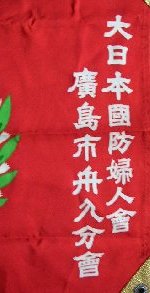

Images From Jim Smith, 16 May 2010
Any help identifying this flag for me would be appreciated. The flag is 20" by 28" long. The flag was purchased in Japan in the mid-1950s.
Jim Smith, 16 May 2010
The flag says: dai nippon kokubou fujinkai (line closest to fly), which means "Great Japan National defense Sisterhood." The second line is: Hiroshimashi Irifune bunkai, which means "Hiroshima Irifune Branch." The characters are the type of character (kanji) used up until the 1950s
Educational reforms began use of simplified characters.
John Udics, 17 May 2010
With this information I now believe the flag was for the women shipyard workers at the huge shipyards near Hiroshima in World War II.
Jim Smith, 18 May 2010
That is a flag of Imperial Japan National Defense Women's Association, Hiroshima City Huneiri Branch.
Nozomi Kariyasu, 18 May 2010
Positive ID
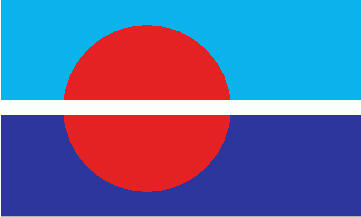

Images from Klaus-Michael Schneider, 18 May 2010
The flag is horizontally divided into celestial blue over dark blue with a red disc in ist centre. The whole is superimposed by a horizontal white fimbriation. I also send an image of the funnel, which is repeating the flag in the middle of a black funnel with white fimbriations. I don't know, whether it is flag of a shipping company or of an association in order to keep museum ships. I spotted this flag in summer 1995 in Roskilde Fjord just opposite to the Viking Ship Hall. Flag and funnel belonged to a very old steamer named SAGAFJORD, which was mooring there.
Klaus-Michael Schneider, 18 May 2010
No help in answering the question, but a picture of the ship in question can be seen on its M/S Sagafjord website.
James Dignan, 18 May 2010
This has been positively identified by James Dignan, it is some kind vintage tourist shipping company, running just one vessel in the Roskilde Fjord. Maybe, they have taken the house flag of a former Danish shipping company, but that doesn't matter. It's simply a club, running a vintage ship.
Klaus-Michael Schneider, 15 July 2019
Some Speculation on #33a / Positive ID on #33b
 #33a
#33a
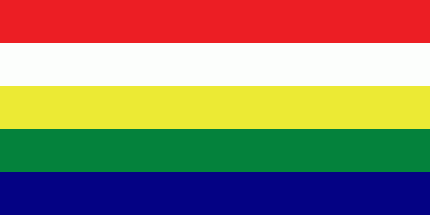 #33b
#33b
Images by Klaus-Michael Schneider
Theses UFEs were spotted in Naashik Naashik is located in the State of Maharashtra, half way between Mumbai and Aurangabad. The location had been the exile of Lord Raama, his wife Siita and his brother LakSHmana. There happened little since then, until in 1818 the Peshwas, the Brahmin Prime Ministers of the Maratha Kings gained control of the place, naming it Naashik since then. The control was lost however in the very same year to the British and the city finally became part of Bombay Presidency. Every 12th year here a Kumbh Mela is celebrated, a Hindu mass pilgrimage. Flag #33a: The ratio is 1:2. It is a red over white over light pale yellow (y--) over green over dark blue(b+) horizontal 5-stripes flag. Flag #33b: The ratio is 1:2. It is a white over red over white over green over dark blue(b+) over light pale yellow (y--) horizontal 5-stripes flag. Source: I spotted these flags in October 2003 in Muktadhaam Temple. Flag #33a, which was bigger was stuck upon the central tower, Flag #33b was stuck upon both side towers. The design is that of a former princely state flag. According to our pages, we have a Nasik, which may be another transliteration of the name or more probable another city, within the former Baroda, Western India and Gujarat Agency. Due to the little information available it seems however, that Naashik never was an independent state. So the context of the flag is doubtful and it might turn out a religious flag in the end, symbolizing the five bhuutaani, the gross elements earth, water, fire, air and ether.
Klaus-Michael Schneider, 28 May 2010
All these multiple-striped flags put me in mind of an unidentified flag from several years ago which was, to the best of my knowledge, never identified. See UFE03-10 Unknown Boxer flag.
James Dignan, 29 May 2010
The second flag (#33b) is that of the Vijaynagar State, known as Pol State before 1934, a princely state under the Mahi Kantha Agency, Bombay Presidency in NE Gujarat during the British Raj. The capital of the state was in Vijaynagar taluka, Sabarkantha district. The state's last ruler signed the accession to the Indian Union on 10 June 1948. (Wikipedia: Vijaynagar State).
Anonymous, 16 July 2021
Tentative ID
 Images from Ann Crone, 7 July 2010
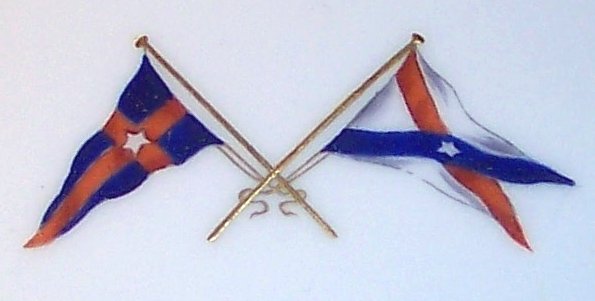
I have a flag I am attempting to identify. It appears on a tureen dish. I know that the pennant at left is the Burgee of the New York Yacht Club. The flag on the right would be the private Signal Flag of the actual Yacht. The tureen dish has china markings indicating it was made between 1895 and 1900. So, if there is a Pictorial List anywhere of the Private Flags of American Yachts that were members of the New York Yacht Club circa 1895 - 1900, then I may be able to figure out which yacht this dish belonged to. Can you help?
Ann Crone, 7 July 2010
The pictorial listings are the "American Yacht List" or "Lloyd's Register of American Yachts." The former stopped publishing somewhere around 1900 while Lloyd's ceased in the late 1980s I think. "American Yacht List" does not show this flag in the 1874-1891 annual issues. Lloyd's for 1903 shows this flag without a star (#202, on plate 21) for the yacht "Muriel" owned by C. Smithers of New York. It is also shown as #266 on plate 13 in the 1906 edition. I have the 1938 edition (flag #500, plate 27) and it is credited to C. F. Smithers of New York whose yacht at that time was named "Typhoon." In none of these publications is this flag shown with a star. Perhaps it belonged to some unregistered yacht, but then why would the New York Yacht Club flag be shown?
Dave Martucci, 16 July 2010
The New York Yacht Club's burgee is shown because Charles F. Smithers was (according to the 1913 edition of Lloyd's Register of American Yachts) a member of the NYYC. It is not unusual for owners of large boats ("Muriel" was 99 feet overall) to justify having a personalized set of china displaying their yacht club's burgee and their private signal. This display may also be found painted on the boat's stern and/or funnel. What is unusual here is that the staff of the (senior) burgee being placed behind that of the private signal's. This china manufacturer's error suggests they are also responsible for incorrectly including the star on the private signal.
Peter Edwards, 2 February 2019
Either several yachts are sailing with erroneous china, or there is a reason for giving the yachts' burgees a more prominent position. As I've mentioned before, the china belongs to the world of the yacht, rather than that of the club. Hence, the owner's flag is more important. Commonly, the owner does respect the club indicated enough to show it dexter, but there is something to say for at least placing the private signal's staff in front.
Peter Hans van den Muijzenberg, 10 February 2019
Some Speculation
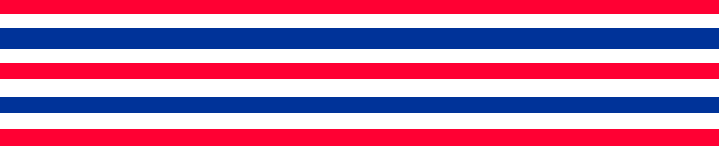
Speculative Image by Pete Loeser, posted 17 August 2010
A friend of mine found a flag similar to what is described as a variant of the Prinvelag flag. It has 9 horizontal stripes with following color pattern: red-white-blue-white-red-white-blue-white-red. It is 144 inches in length by 30 inches in width. It also has brass grommets and a stamp, but I can't make out a lot of detail on the stamp. It was found in southwestern Ohio in the US. Any thoughts on what this could be?
George Krisanda, 15 August 2010
Judging by the dimensions presented here (144 x 30 inches) this sounds to me more like decorative bunting than an actual flag. The colours are obviously in line with US flag colours.
Rob Raeside, 15 August 2010
No, it's definitely a flag. I was thinking with the dimensions maybe a naval flag? I think the stamp says Waverly, NY.
George Krisanda, 17 August 2010
This is another UFE which I'm not sure is a flag. Although it is not bunting per se, the dimensions could be consistent with the related product called a "pulldown." From browsing vendors catalogs it is clear that they often have grommets, so their presnce here doesn't necessarily mean this is a flag. I haven't seen a catalog with this specific design, but repeated red-white-blue stripes would be appropriate for patriotic decorations.
Ned Smith, 6 September 2010
It could be a 12 foot patriotic curtain used to cover a plaque before it's unveiled, or part of a curtain backdrop from the stage of a political convention. I think we need to know more about the hoist for example, does it have standard attachments as you might expect for a flag, or are there other possible clues to its uses (like as a curtain) there?
James Dignan, 30 September 2010
Some Speculation
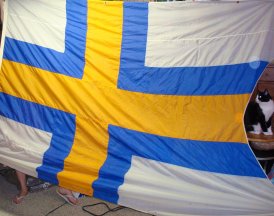 Image from David Prothero, 2 August 2010
This flag looks familiar but I cannot place it. It was found in the sea off New Smyrna Beach, Florida, some years ago. White flag with shallow swallow-tail. Yellow cross with broad pale blue edge. The vertical arm is off-set towards the hoist. Appears to be artificial materials, sewn together, not printed. About 5'6" x 11' (1.7 x 3.4m).
David Prothero, 2 August 2010
Since this posting David has received some off-list speculation, which he shares with us:
1. Possibly a swallowed-tailed variant of a flag proposal for Norrland, Sweden.
2. It has been suggested that the yellow is faded orange and that the flag is the House flag of Safmarine, a South African shipping company.
UFE Editor, 7 August 2010
Since the page on the Norrland proposal says the flag appears to have been in use, that would make the identification likely, however, I sent in an Åland Islands Flag Proposal Chart (see first image) which shows another possibility. Since the two are so similar, maybe the two pages should be cross-linked?
Ned Smith, 8 August 2010
The flag resembles the most common unofficial flag for the northern half of Sweden, Norrland, though this UFE has different proportions and is said to have a swallowtail without tongue. Official Swedish flags normally have a swallowtail with tongue. The Norrland flag I mention above is already listed on this site as the First Proposal for the region, though it really is the third and most recent proposal (1992).
Daniel Lundberg, 11 August 2010
Some Speculation
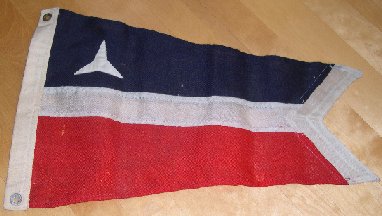 Image from Harvey Rothstein, 7 August 2010
A friend of mine asked for my help in ID´ing this family heirloom. Her forbear was a Pennsylvania Civil War vet (14th Regiment Cavalry Volunteers), but the grommets and machine stitching seem more modern. Also, her ancestor did live into the 1900's. We would appreciate any assistance.
Harvey Rothstein, 7 August 2010
I'm afraid that I cannot identify the pennant in question, but it certainly isn't Civil War vintage since the grommet and Inglefield clip method of attaching flags was not introduced - by Lt (later Admiral) Inglefield RN to speed up flag signalling - until the 1880's. It has the look of a modern (or perhaps comparatively modern) yacht club burgee.
Christopher Southworth, 8 August 2010
Some Speculation
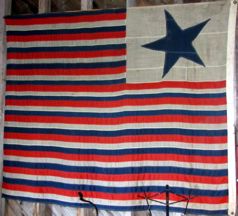 Image from Dr. David J. Clarke, 11 August 2010
The former Loyal Orange Lodge in my hometown (Twillingate, Newfoundland, Canada) has a large flag on display, but no one, including myself, is certain of its origin. Having done my graduate studies in maritime history, the flag suggests the house flag of some shipping line, possibly of American origin. I am attaching a jpeg of the flag, and was wondering if you might have any suggestions about it. Thank you in advance for any help you could give me on this matter.
Dr. David J. Clarke, 11 August 2010
I don't recognize the flag myself, but the multiple blue, red and white stripes suggest a Dutch origin to me, but the blue star is not expected there.
Rob Raeside, 11 August 2010
Looking at the page to which you referred me, the likeness to the Dutch Princevlag is rather obvious, although ours has well over thirty stripes. The flag now hangs in the local Orange Hall, and may have been found there. Our branch was started in the late-1800s, and the hall was built in 1907. If you know the background of the Orangemen, the possible connection to these flag colors becomes more obvious. The Orange order has always revered that William of Orange who became William III of England - "King Billy" - for his victory over King James at the battle of the Boyne (and thus a presumed victory of Protestantism over Catholicism). The Dutch colors may have been their way of paying tribute to King William. I also know that a Sons of Temperance chapter operated next door to the old hall way back in the day. Their designation was the "North Star Division." If our local Orange Lodge had a similar title, it might explain the star in the canton! This is not conclusive of the flag's origin, but certainly suggestive.
Dr. David J. Clarke, 11 August 2010
Some Speculation
 Speculative Image by Rob Raeside, 23 August 2010
We were hiking in the Cajon Pass in Southern California today and came across a flag that we have never seen. It's been there for a while (I could see it from the freeway during my commutes) and is in bad shape now. I've attached an image of this worn out flag. It appeared to me that the blue stripe became vertical in the middle (see attached). The picture I sent did not show this, but I've attached another picture that does. I've also attached an image of the flag on the makeshift pole. What's strange to me is why someone spent so much time putting a flag pole in such a difficult to get to location, complete with guy wires for support, and then flies a flag that most people wouldn't recognize! I guess I'm like a cat...the curiosity is killing me!!
Dave Johnston, 23 August 2010
The above reconstruction is based on several photos, although I think all photos indicate the lower fly quarter is completely lost to the wind.
Rob Raeside, 23 August 2010
 Suggested by James Ferrigan, 23 August 2010
This appears to me to be a pleated Red-white-blue Stripe and Stars Half Fan hoisted like a flag which has become tattered through use.
James Ferrigan, 24 August 2010
Tentative ID
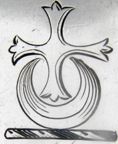 Image from Fred, 2 September 2010
I have had in my possession for a number of years some cutlery which dates c1850. The logo or crest on the terminals, to me, resembles what I believe could possibly be that of a shipping line. Can anybody throw any light on solving what has been a mystery for me for a long time.
Fred, 2 September 2010
From "Fairbarin's Crests of the Leading Families in Great Britain and Ireland and their kindred in other lands" (New York, 1911; republished facsimile by the Genealogicql Publishing Co., Baltimore, 1963), p. 223: "Haley, Suss[ex], on a crescent ar[gent], a cross patonce, gu[les]." It further references a drawing with a different cross, but then references the cross patonce. Following this yields the exact drawing on the UFE page. Thus we have the crest that appears over the arms of someone whose last name is Haley and who hails from Sussex in England. Of course, crests being what they are, this may not be the only such combination, there may be others with different colors, but this is the only one I find in Fairbarin's.
Dave Martucci, 27 February 2011
Dave's message raises serious doubts about whether this has anything to do with a UFE. So far it is just UC (Unidentified Cutlery). The inquirer speculated it "might" be silverware from a shipping line, but there is nothing indicating it really was. This is followed by an unspoken presumption that if it was then, it would reflect the line's house flag. This is a second bit of unsupported speculation. Dave's message also raises the very plausible possibility that the silverware was personal property of some armorigenous family or individual instead. There really is no indication yet that there is any F or E to be Identified in the first place. My own opinion would be that things like this shouldn't be on the UFE pages until there is some indication there is a flag connection.
Ned Smith, 6 March 2011
Some Speculation


Image from Fred Drews, 13 September 2010
Standard Image by Eugene Ipavec, 19 September 2010
I came across this flag, and I remember seeing it before, but I do not seem to place it,
Maybe someone will know, or it might be a good candidate for the UFE page.
Fred Drews, 13 September 2010
This is not a result, but merely a standard image.
Eugene Ipavec, 19 September 2010
Can anybody make out what it says on the hoist band? My old eyes fail me, yet again...
Pete Loeser, 25 September 2010
Looks like it's either Chinese of Japanese...and the eightfold symmetry of the central image reminds me of one of the Taiwan Independentist flags... perhaps there's some connection?
James Dignan, 25 September 2010
Maybe you're thinking of this Independentist flag.
António MARTINS-Tuválkin, 25 September 2010
Mmmm. That could be what I'm thinking of. In a completely different direction entirely, there are Northern Italy flags which also have a similar symbol, so there may be no Taiwanese connection at all.
James Dignan, 26 September 20010
Zooming in on the image makes it look to me that the items on the hoist band are pictographs showing how to attach the clips so that the flag is hoisted right side up.
Ned Smith, 25 September 2010
I can't tell you more than that the last bit says 2x3 above some mark. The rest looks like some logo with the name running through the middle of the red part. But unless Fred can tell us more, or has access to the flag (or a higher resolution photograph), it might not be easy to find.
Peter Hans van den Muijzenberg, 27 September 2010
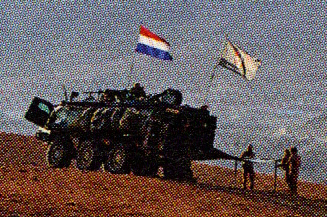 Image by Eugene Ipavec, 1 October 2010
A photo appeared in the May 8, 2010 issue of Time magazine, captioned "Dutch soldiers in Uruzgan province, Afganistan." The second flag is not that of NATO, ISAF, or Afghanistan, although I suppose it could be anything, like a Rotterdam football club...
Eugene Ipavec, 1 October 2010
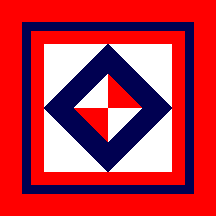 Image by Eugene Ipavec, 29 October 2010
A unidentified flag in my files; presumably British and sports-related.
Eugene Ipavec, 29 October 2010
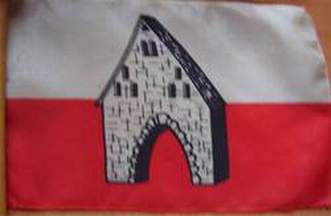 Image Klaus-Michael Schneider, 31 October 2010
This white over red horizontal bicolour table flag has in the centre a grey, masoned gate with an open door, eight windows and a triangular roof. I first spotted this flag on 28 May 2004, in Hamburg St. Pauli. I've been trying to identify this flag for more than 4 years without any success. I spotted this flag in a pub together with many houseflags of shipping companies. I believe that the flag is about 60 years old. The colour of the gate might be "stone-grey." As I have never before seen a flag using a "stone-grey" colour, that's not for sure.
Klaus-Michael Schneider, 31 October 2010
 Image by Klaus-Michael Schneider, 3 November 2010
I spotted this flag in the Gloucester Antiques Centre on 1 November 2010. The flag was approximately 20cm x 30cm, red, divided by a blue saltire fimbriated white. In the centre was a blue disc with two white drops. You could say the blue parts upon the disc form a special letter "S." This item was offered as a Russian naval flag, but with a big question mark. The basic pattern is one of the Soviet naval Ensign Project (1941–1945) and similar to the current Russian naval jack. It was made probably of cotton, but maybe linen or hemp instead, and seemed to be neither pre-1918 nor post-1990. I am in doubt whether it's a Soviet or non-Soviet Russian naval flag. It may also be a houseflag of a shipping company.
Klaus-Michael Schneider, 3 November 2010
 Image by by António Martins, 24 Feb 2008
[Editor's Note:] This unknown Comorian Flag was first reported back in 2008, but somehow never got added to the UFE pages for possible identification. What is known about it can be found on the Union of the Comoros page. Any ideas? - UFE Editor
Some Speculation
[Editor's note: Since the question of paintings and the Blue Ensign shown with red borders, and ones about Blue Ensigns with a red stripe are so similar, I've combine the discussions.]
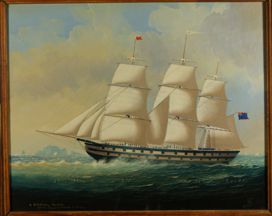
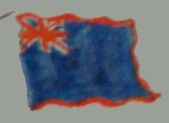 Images from Andy Rudoff, 4 November 2010
I recently bought a marine oil painting and began researching the flag on the ship. The flag appears to be the standard Blue Ensign used by the British Navy as well as other non-military ships having ex-Naval officers on board, and other conditions. This one, however, has a RED BORDER, and I was trying to determine what that means, type of ship, origin, etc. Might you know? The title on the painting concerns the Frigate being by the Hebrides, ie, Scotland. I would appreciate any information you could provide me with. I'm a history buff, but this has me stumped.
Andy Rudoff, 4 November 2010
I seem to remember that the practice of bordering an ensign (at least in the British merchant marine) was not entirely unknown under certain circumstances, but cannot at the moment track down a source. If the picture
was painted prior to 1863 then the vessel was almost certainly a ship of the Royal Navy under an Admiral (Rear- Vice-or full) of the Blue, but I have never heard of bordering the ensign of such a vessel? Perhaps David may be able to assist?
Christopher Southworth, 4 November 2010
Just curious... Isn't that an awful lot of guns for a merchant vessel, especially a Frigate? Perhaps its a Royal chartered company privateer or an actual Royal Navy warship? I count 26 gun ports per side, if my old eyes don't deceive me. Of course, this doesn't help with the red border question...
Pete Loeser, 5 November 2010
I wonder if it was meant to be the ensign of the United States of the Ionian Islands during their time under British protection. Of course, the gold Lion of St. Mark seems to be missing from the painting; perhaps the artist was painting only from a distance and didn't see it or maybe felt it wouldn't have been visible from the perspective he intended and so omitted it deliberately. Andy, any history on the ship? Especially anything which might connect her to the Mediterranean, Adriatic, or Aegean?
Ned Smith, 5 November 2010
Andy and I have had some small correspondence off-list, however, I can confirm that this is certainly not a vessel of the Royal Navy, for one thing it flies no commissioning pennant, but rather a vane and has a house flag at the fore. It is a merchant vessel of the so-called "Blackwall Frigate" type, however, the two rows of (most probably painted) gunports make it rather unusual since the term "frigate" (in the naval parlance of the time) means a ship which carried her armament on a single deck and all the photo's of Blackwall Frigates I've seen have only one row. The illustration Andy sent also shows no stern gallery, and such a gallery was (from memory) usual for the type? Does this mean that it is an inaccurate picture, I simply don't know, but the other flags seem carefully painted so the red bordered Blue Ensign remains a mystery? If the ship's master and a percentage of the crew belonged to the Naval Reserve, then an undefaced Blue Ensign would be perfectly proper, however, the only red-bordered Blue Ensign I've been able to find belonged to the British Ionian Islands and that was prominently defaced by a gold lion in the fly half (as well as being a long way from the Hebrides). Sorry that I cannot be of more help.
Christopher Southworth, 5 November 2010
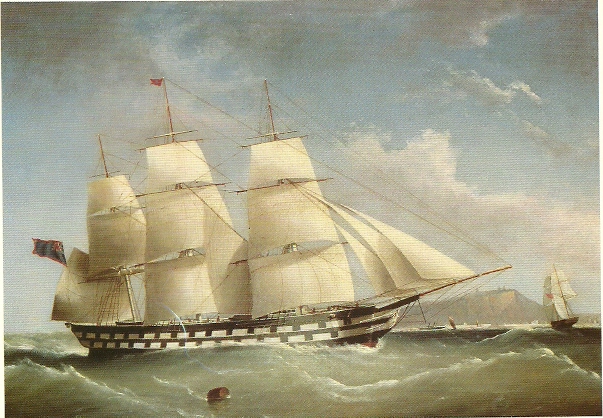 Post card
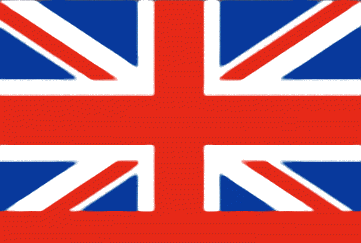
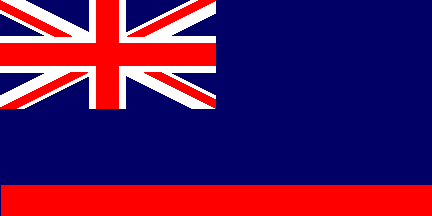 Liverpool Maritime Museum painting
Images from David Prothero, 6-7 November 2010 (Click on any of these to enlarge them)
I am unable to make any useful suggestions, but have details of other paintings with the same or similar flags. This painting, on a post card, is probably the same ship by possibly the same artist. Entitled "A Blackwall Frigate off a busy port" by J. Tudgay. 19th century. (Presumably John Tudgay) This painting has a red flag at the main masthead as opposed to the foremast on your painting. The flag might have a swallow tail and might have an emblem of some sort in the centre. I am not sure that they are justified, but I have doubts about the title. Is it a Blackwall frigate? I thought they had a slender hull, more like a clipper, and were merchant ships which would not have worn a Blue Ensign?
Another painting has two ships that have Blue Ensigns and Union Jacks with a red stripe along the lower edge. I have not seen the painting, which is in Liverpool Maritime Museum, but was sent the following description from the curator:
Perhaps it was a case of a ship whose Red Ensign was in disrepair. The Flag Institute's very comprehensive summary of British and British-related ensign use -"The Colours of the Fleet"- made mention of ships being authorized to fly red-bordered white or blue ensigns when their red ensign was in disrepair. "´White Ensign´ with red border. Authorised about 1819 for use by merchant vessels whose Red Ensign had become much torn and is being repaired. The red border was to be 14 inches wide for ships over 800 tons and 9 inches wide for vessels under 800 tons" [page 70] and "Blue Ensign with red border. This ensign was permitted as an alternative to the White Ensign with a red border. See ´White Ensigns.´" [page 62]
Ned Smith, 12 November 2010
I wonder if the flags with a red stripe in the Liverpool painting might have been local/special/temporay flags for privateers?
Probably not Royal Navy.
1. Liverpool was a commercial port with no naval dockyard. I guess that naval ships would have rarely been seen in Liverpool.
2. Naval ships operating independently flew the Red Ensign. Even two ships in company would, I think, fly Red Ensigns.
Possibly Privateers.
1. Liverpool was well known at this time for its privateers.
2. One might think that a privateer would not have a Blue Pennant, but a non-naval ship was given permission to wear a pennant.
"In consequence of the very gallant defence of the ship 'Liverpool', Mr.W.Hill, master, against the American privateer 'Snap Dragon', on the 3rd of March, off Surinam River, I have thought proper to permit her to wear a pendant, during the time of my command on this coast, and to grant her a protection for her crew, during the said time. The commanders of His Majesty's vessels under my command are hereby required and directed to respect the same. Given under my hand, on board His Majesty's sloop 'Columbine', in the River Demerara, 16th March, 1814. R.Henry Muddle, Commander." [p. 444 "History of the Liverpool Privateers." Gomer Williams, William Heinemann, 1897, and Frank Cass & Co. Ltd. 1966.]
3. A particular class of privateer, known as 'hired armed vessels' might possibly have been allowed a distinctive flag.
"The 'Swallow' was not an ordinary privateer, or Letter of Marque ship, but an armed vessel, specially hired by Government, as will be seen by the following letter, addressed to Capt.MacIver by Mr.Huskisson :- 'Parliament St, December 7th, 1797. Sir, - I am directed by Mr.Dundas to desire that, on the receipt of this letter, you will put yourself under the orders of Capt.Lane, of His Majesty's ship 'Acasto', and obey such directions as you may receive from him, until the period of your arrival at St. Domingo, which you will immediately report to the Officer commanding His Majesty's Troops there, and obey such further orders as you may receive from him. To the Officer commanding the 'Swallow', hired armed vessel." [p.356, Liverpool Privateers.]
David Prothero, 15 November 2010
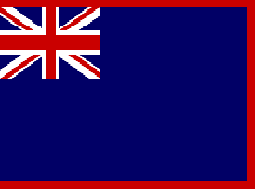 Speculative image by Pete Loeser, 22 December 2010
I just noticed something about the original blue ensign with red borders in the painting, it doesn't seem to have the red border on the hoist side. The border is only on three sides, if my eyes don't deceive me. Of course, if true, this doesn't change anything much.
Pete Loeser, 22 December 2010
Some Speculation
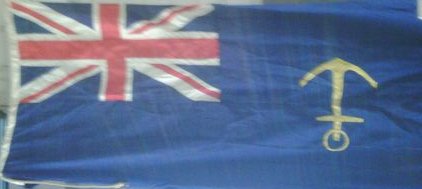 Image from Richie Leonard, 8 November 2010
[Image distorted and cropped on left fly - Ed.]
I am a member of a group who are restoring an old RNLI Lifeboat for display as local heritage item. We have been given numerous items to show in our displays and one of these is an blue ensign. It is basically the RFA ensign, but the anchor is upside down! I have contacted a friend who was in RFA for many years but he is not aware of this. Having read through your site, I have found many interesting facts on flags and the ensign in particular, but nothing that seems to mention this particular one (however, it could well be hidden amongst the wealth of information). Hope you may be able to help.
Richie Leonard, 8 November 2010
Our page on the Royal Fleet Auxiliary Service indicates upright and horizontal versions of the anchor are known, but not an upside down anchor. I wonder if this is a flag made in error?
Rob Raeside, 8 November 2010
I beleive the anchor has simply been sewn on upside-down. There was a similar error, perpetuated for quite a long time, which gave the Dutch East India Company flag the initials "AOC" instead of "VOC." This was simply the result of one flag having the white stripe being sewn in upside-down. I saw a similar error in the Iraqi flag, flying over the Iraqi Embassy in Harare, Zimbabwe, in 1984, where the order of colours was correct, but the stars were inverted. When I pointed it out to the Chargé d'Affaires, he was horrified. The flag had been made in the embassy!
Michael Faul, 12 February 2011
Tentative ID
This flag has been moved to a more permanent location under the title "Possible manufacturer's variant of Chief of Defence Staff."
Some Speculation
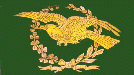
This flag, while still not identified, has been moved to its own page at: Unidentified Irish Eagle Flag.
 Speculative Image by Eugene Ipavec
An Iraqi army flag was shown in BBC News footage of a military funeral ceremony on August 12, 2010.t was lilac, with a green hoist triangle and a black-edged map of Iraq in the fly, a curved line of writing above it. I crudely reproduced it here. Does anybody recognize it?
Eugene Ipavec, 27 December 2010
Some Speculation
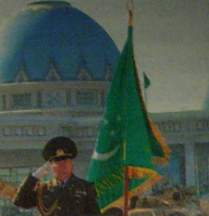 68a
68a
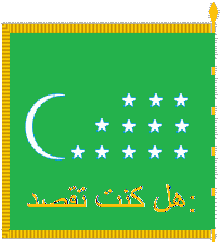 #68b
#68b
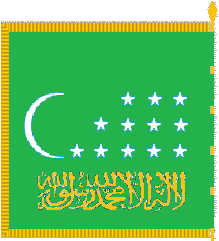 #68c
#68c
Photo #68a from Spiegel - Images #68b and #68c by Klaus-Michael Schneider, 12 May 2010
It is a squarish green flag with golden fringes at three sides. In the centre of the flag is a white crescent with an unknown number of stars. At the bottom end is a golden inscription in perso-arabic characters. So my images are mere attempts or in the best case reconstructions. I placed the same number of stars next to the crescent as being upon the national flag. I sent two variants of inscriptions: One [#68b] means "Uzbeskistan" (taken from Arab version of Wikipedia), the other [#68c] is a "shahada". I also have no idea, whether it is a president's flag or a mere rank flag of the army. My image is based upon a photo [#68a] displayed in SPIEGEL, no.21 of 2008, showing a trooping-the-colour ceremony in Usbekistan's capital. The man in the car wears an uniform and is probably not President Karimov. This item should be discussed.
Klaus-Michael Schneider, 12 May 2010
It should be noted that the same photo was captioned on USA Today as "Tanks take part in a military parade marking Turkmenistan's
Independence Day in October 2007." It is almost certainly a Turkmen military colour of some sort, based
on the Turkmen Army flag.
Miles Li, 23 July 2016