
Last modified: 2026-10-24 by  zachary harden
Keywords: kohtla-jarve | ida-virumaa | jarve | sun |
Links: FOTW homepage |
search |
disclaimer and copyright |
write us |
mirrors
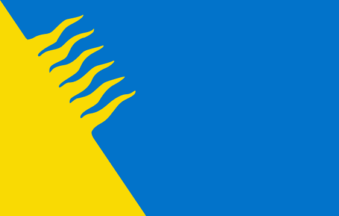
image by Tomislav Šipek, 30 September 2026
See also:
Other Sites:
From <http://www.estpak.ee/~kjlv/uk.htm> (defunct):
The town Kohtla-Jarve received its name from the name of two
villages - Kohtla and Jarve. Kohtla-Jarve is one of youngest
modern towns of Estonia. It received its designations as a town
50 years old, after transformation and merging of town Johvi with
workers’ settlements, in which mainly chemists and miners
lived. Being the large industrial centre of republic,
Kohtla-Jarve during all these years has been made for domestic
needs and on export chemical products, received at oil shale
processing, building materials, products of furniture industry,
ready-made sewing articles. The area of town, after
transformation of Johvi and Kivioli into separated townships in
1991, makes 46 square kilometres, the population amounts to 54
thousand people. The town has tight economic connections with
many regions in Estonia and abroad. This is due to a profitable
location of town and its part in Ida-Viru county region, along,
railroad and highway, connecting Tallinn with Narva and
St.-Petersburg, and through their seaports with many other
consumers and suppliers of production and raw material outside
Estonia. The town consists of various parts, which were built
mainly after World War II near of working mines (some of them are
working still), enterprises for oil shale processing, power
stations, peat industry. These parts are Vanalinn (Old town),
Käva, Järve, Ahtme, Kukruse, Iidla, Oru, Sompa, Sirgala,
Viivikonna. They are situated apart from each other at the
distance from 2 up to 40 kilometres. Adopted: 6 March 1995
Dov Gutterman , 25 June 1999
Flag adopted 6 March, 1995. Golden color and flames refers to
oil-shale. Blue refers to the Jarve village which gave the name
to the town (Estonian jarv is lake). Number of flames refers to
two events in the history of town. 1916 - starting of the mining
of oil-shale. 1946 - Kohtla-Jarve got rights of town. Sloping
line refers to the mines ant artificial hills.
Erki Kurrikoff, 6 April 2001
A diagonal line starting from the upper corner of the flag nearest the hoist (at a 34-degree angle to the vertical) divides the flag into two fields. To the left lies a cadmium yellow field (100% Y according to the Pantone color chart), and to the right, a blue field (91% C and 43% M). Six yellow flames extend from the yellow field, perpendicular to the diagonal line. The group of flames is positioned along the diagonal line according to the golden ratio (the ratio of the line segment above the group of flames to the segment below it is 0.618). The standard dimensions of the flag are 105 × 165 cm.Tomislav Šipek, 30 September 2026
kohtlajarve.gif)
image by Tomislav Šipek, 30 September 2026
The flag’s design incorporates motifs from the city’s coat of arms. The yellow field and the flames symbolize yellowish-brown oil shale and its processing. The blue color, representing water, alludes to the village of Järve, from which the city takes its name. A diagonal line characterizes the cityscape, symbolizing inclined mine shafts and spoil tips. The flagstaff is blue, and the finial (knob) is gold.Tomislav Šipek, 30 September 2026