Last modified: 2026-04-11 by  zachary harden
Keywords: east timor | timor-leste | timór lorosaʔe | star: 5 points (white) | arrowhead | triangle (black): hoist | leitão (natalino) | law | rdtl | constitution |
Links: FOTW homepage |
search |
disclaimer and copyright |
write us |
mirrors
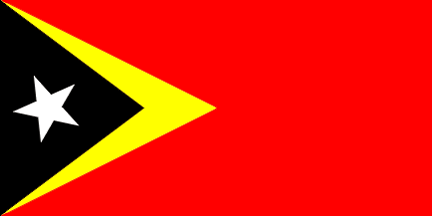
 image by Zoltan Horvath, 05 March 2026
Following the (overwhelming) victory of
FRETILIN in the
parliamentary elections, the
constitutional assembly restored all the symbols from the
1975 independence, including the name, the flag, the
anthem, etc. The hymn is causing some uproar, and will probably have its lyrics
changed, but the version sang in the independence ceremony was the 1975 one. In
the ceremony, by the way, what was declared was the "restoration of the independence of
the Democratic Republic of East Timor"…
Jorge Candeias, 20 May 2002
In East Timor only the national flag is prescribed
by the Constitution, while all
other national symbols must be described by special laws.
Jan Zrzavy, 17 May 2002
The constitutional assembly finally approved East Timor’s constitution on 22 March 2002. As for the flag, the community consultations on the draft constitution produced some wishes to add the colour green to the flag. However, in the final revision of the constitution’s section 15, only a minor linguistic change was made, a revision that removes the confusing reference to the colour red as "vermelho-púrpura" (purple-red). The constitution is now clear, the colour is simply called "red".
In the final document a change was also made to the official symbolism
of the yellow colour. Whereas golden-yellow was said in the draft to represent
"the wealth of the country", the official meaning is now
that this colour stands for "the traces of colonialism".
Black still represents "the obscurantism that needs to be
overcome", red is for "the struggle for national
liberation" and white symbolizes "peace".
Jan Oskar Engene, 03 May 2002
The East Timor national flag will be raised tomorrow
(20 May
2002)
at the nation’s independence celebrations. (Darwin based manufacturer
Ron Strachan who has had made and supplied the new flag for East Timor,
informed me earlier today that eyelets have been placed along the top of
the large 7,2 m × 3,6 m flag so that
it may be raised or displayed horizontally depending upon the conditions
on the day.
Ralph Bartlett, 19 May 2002
The 2002 Corr. Nº2 [pay02]
to the Album [pay00] shows a
1:2 red flag with a five-pointed white star on a black triangle at hoist
superimposed on a yellow triangle, and marks it for all uses:
Željko Heimer, 30 March 2003
In Tetum language, the territory is called Timór Loro Saʔe,
meaning "Timor of the rising sun". This is the name adopted for the
new state. In the other two official languages of the country, Portuguese and
Bahasa Indonesian, it’s spelled "Timor-Leste" and
"Timor Timur", respectively (both meaning "east-east"
because "Timor" is a Portuguese (or local) corruption of
"timur", "east").
Jorge Candeias, 29 October 1999
From the UN web page:
27 September — The General Assembly will admit Timor-Leste, formerly East Timor, as the 191st Member State of the United Nations today.Interesting, isn’t it? It seems that Timor-Leste will be listed as UN member under its Portuguese, not English name, like Cote d’Ivoire and Myanmar.
The protocol manual for the London 2012 Olympics (Flags and Anthems Manual London 2012 The law about the national symbols only talks about the size of the flags
[not ratios], check
on
line (Portuguese language). The annex to this law shows a very crude solid
back and white image of a ~7:12 flag,
horizontally asymmetrical (upper part noticeably smaller than the rest,
should be a mirror half), and the star misplaced and misshapen. Could this be
a squeezed version of the infamous first draft
of the “new” flag as specified by UNTAET in 2002? A very incorrect,
yet legal design. António Martins, 07 September 2007 Jan Oskar Engene, 03 Mar 2002, My translation and comment from the Portuguese language original: I had expect to find a disposition that a more detailed law would set
all remaining details, as constitutions often do, but there is none.
The text is almost untouched (comparing with the
1975 version), even in those points it would
need some revision — namely in the evident misplacement of the
meaning of the star within the geometric details, and not in the symbolism
section. The construction prescription, however verbose, is ambiguous as
flag laws tend to be — the part about the triangles could be
describing St. Lucia instead. Media Release from Government of Timor-Leste: An incident where the national flag was dropped on the ground illustrates
reverence the East Timorese have for their flag:
http://gedirem.blogspot.com/2009/05/dropping-flag.html: This text is from Douglas Kammen: Three Centuries of Conflict in East Timor. Rutgers University Press, 2019, ISBN 978-0-8135-7412-7. It describes the distribution of the national flag after independence to every suco (third administrative level) in the country:
You can find every variation (1:2, 2:3) of all flags in Timor-Leste,
because the law about the national symbols only talks about the size of the
flags [not the ratio]. The 1:2 ratio is not prescribed in the constitution,
only in the UNTAET specifications. (As also the
darker color shades.) I was in Timor Leste (East Timor, Timor Lorosae) in the end of June 2002;
the flags, made of cotton, are 1:2, maybe because they were produced in
Australia (I heard it here). Paper flags and flags on
T-Shirts are 2:3. They seem to be as official as the 1:2, because in Timorese
parliament, the representatives has paper flags on their table. Why did all or nearly all the East Timorese flags in
use all these years have been 2:3 or whereabouts? Though the ratio was not fixed in the 1975
constitution, 2:3 has been in consistent use ever since. I cant’
see any valid reason for the new 1:2 ratio — but apparently it is the
law. (I just hope it was not “imposed” by some kind of
manufacturing constraints made in Australia…) My point is that the recently re-approved
DRET constitution of
1975 should have caused the approval of the 2:3 ratio established
by tradition based upon that very document. Any contrary opinions
should prove either that there was no such tradition or that the
original constitution prescribed 1:2 after all. In 1978, Vexilologie 27 [vex]
has presented some details on the East Timorese national flag (i.e. that of
1975). As a source, FB XVI:4
[tfb] is mentioned. According to this
article, the 1975 flag is exactly the same as the present day, including the
flag ratio 1:2. As an author of the flag is mentioned Natalino Leitão,
and description of the flag is reported as in Article No. 20 of the
(former) constitution. The ETAN
website says:
The Democratic Republic of Timor-Leste has been admitted in the UN. The flag
shown in this
photo is 2:3 as all those hoisted outside the UN
building. It’s interesting to note that the very same UN who come up with a
never-heard-of prescription for 1:2 national
flag ratio, now uses a 2:3 flag at its flag yard in New York. The only variation was (in 1975-1999)
ever the orientation of the star, mostly depicted pointing up.
Unlike the ratio and
color shades, though, the orientation of
the star (to upper hoist) is specified in the
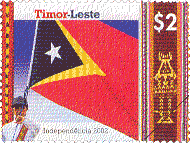
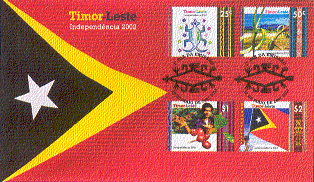
constitution. The stamps issued by East Timor
on 20 May 2002, with the inscription "Independência 2002"
include a $2 value showing this very flag. Australia Post has designed and printed the first postage stamps
for newly independent East Timor. One
of the four stamps shows the national flag, as also the
First Day Cover.
Ian Sumner, 11 October 2012 Flag laws
Flag law (2007)
J. Patrick Fischer, 09 July 2007Image in the 2007 flag law
(colorized)
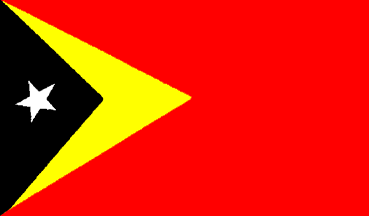 image by António Martins, 07 September 2007
Constitution (2002)
Section 15
(National Flag)
quoting from
this
document1. The national flag consists of two isosceles (i.e.
symmetrical) triangles with superimposed bases (the
odd side of each triangle), being one triangle black, and as high
as one third of the length of the flag, supposedly, which is set over the yellow
triangle, whose height is half of the length of the flag. On the
center of the black triangle there is a white five-pointed star, standing
for the guiding light. The white star is pointed to the upper left corner of
the flag (meaning supposedly top hoist).
The rest of the flag is red.
António Martins, 08 Jan 2003Flying the National Flag on Solemn Days
The Secretary of State for
the Council of Ministers and Official Spokesperson for the Government of
Timor-Leste Ágio Pereira,
July 30, 2011
Dili, Timor-Leste
Flying
the National Flag on Solemn Days
The National Flag and the National Anthem
are the unifying symbols of the Timorese Nation, representing national
sovereignty and the independence, unity and integrity of Timor-Leste. As such,
they must be respected by all Timorese citizens, regardless of their political
convictions, religious beliefs and social origins.
It is an obligation of
the State to ensure that every Timorese citizen throughout the country respects
the National Symbols, particularly the National Flag and the National Anthem.
This is even more so on Solemn Days associated with important and meaningful
dates for the Nation's sovereignty and independence.
Acknowledging that
civil servants have a greater responsibility in terms of giving the proper
respect to the National Symbols, the Government has decided to Fly the National
Flag in all State Agencies and education establishments on 2 February (Falintil-FDTL
Day), 27 March, (PNTL Day), 20 August, (FALINTIL Day) and on the first Monday of
every month.
The National Flag will be raised on these dates at 8:00 AM,
starting next 1 August, in a ceremony to be attended by all civil servants
working at the various State Departments, who will sing the National Anthem.
Any citizens wishing to associate themselves with this initiative are hereby
invited to attend the designated places, namely the Government Palace,
Ministries, Secretariats of State, education establishments and other State
agencies, on the dates above.
Website:
http://www.timor-leste.gov.tl
J. Patrick Fischer, 31 July 2011Reverence for the flag
"One of the honor
guards dropped part of the flag on the ground... There was a collective gasp...
The guard was in shock himself... Many Timorese are superstitious and that
includes issues concerning the flag. Some believe what happened yesterday is a
bad omen -- signaling trouble ahead.
J. Patrick Fischer, 21 May 2009Distribution of the national flag after independence
The new Fretilin government, recognizing both the historical importance of the flag in Timorese cultures and the desire that many people
in scattered villages and hamlets had to participate in the national project, announced a plan to distribute the national flag to each suco. When the district administrator distributed the flags, each village set a date for its own flag raising ceremony. I attended the ceremony in Lissadilla, in the Loes Valley. Lissadilla was one of the early settlements that is said to have contributed a representative to serve the stranger kings from Suai-Camenassa and actively contributed to Maubute s uprisings in the latenineteenth century. The original dato lineage, the Lobos, had lost many sons in the resistance but continued to exercise a strong presence in public affairs and ritual life in the village.
Lissadilla held its flag ceremony on 12 July 2003, a little over a year after the restoration of independence. It was the dry season and the valley was parched: many trees had shed their leaves, fields were barren, and the dirt tracks were thick with dust. The ceremony began with a procession of adult men dressed in traditional finery of colorful double-woven cloth, batik headscarves, silver medallions, and feathers, many carrying swords or machetes, and all marching in a stiff, highly exaggerated imitation of Western military step to the beat of drums. There were dances and songs. A group of children paraded with homemade wooden toy guns. Then, with the full platoon of warriors standing stiffly at attention, the red, yellow, and black flag of Timor-Leste was raised on a wooden flagpole. After the solemn flag ceremony, a series of entertaining skits were performed. The first, titled Youth and the Red and White Iron Militia, depicted the BMP terrorizing the village, the day of the referendum, the announcement of the results and exuberant cries of Viva Timor-Leste! The second skit, called Falintil and the Indonesian Intelligence Task Force, depicted clandestine activists carrying baskets of provisions to the Falintil guerrillas, Indonesian military intelligence personnel roughing up the couriers and inappropriately searching the young women, andfinally a Falintil ambush on the oppressors. The skits were greeted with wild cheers from the audience. Next it was time for speeches by the dignitaries in attendance. While many of the villagers drifted away, eagerly awaiting the cockfights, a lone warrior wearing a full headdress and holding a machete guarded the shadow of the flag as it imperceptibly edged away from the setting sun. The district administrator, who before her appointment had been a lecturer in politics at the new National University of Timor Lorosae, gave a long speech. At one point she told her audience that she was tired of seeing people in the villages perform the same old traditional songs and dances, and declared a need for them to become modern. 19 Bored by the length of the speech and now offended, more people drifted away from the stage to watch the preparations for the cockfight or simply chat in the shade.
The flag ceremonies in Lissadilla and other villages were intended to be a celebration of community historical communities of lineage and
house, the experiential bonds of the resistance, the administrative community of the village unit, and beyond that the imagined community of fellow East Timorese one had never met. But in the case of Guguleur, such assumptions about community could just as easily become the source of disputes. At the time the flags were distributed, the village head of Guguleur was a man named Luis, who had been active in the clandestine resistance during the 1990s.20 Luis did not want to hold the ceremony in Caicasa on grounds that the Indonesian state had made Caicasa the seat of village government and that it had been the base of the BMP. Instead, he argued,the ceremony should be held in Lissalara, where the surviving members ofthe Doutel family lived and where Mau Kuru had been murdered. But the district administrator, who was not from the area, insisted that the flag ceremony be held in Caicasa. In the end, deadlock meant that the much-anticipated flag ceremony was never held in Guguleur.
J. Patrick Fischer, 18 December 2025Differences respective to 1975
Ratio?
J. Patrick Fischer, 09 July 2007
António Martins, 25 September 2002
J. Patrick Fischer, 07 August 2002
Jorge Candeias, 26 May 2002
António Martins, 22 May 2002
António Martins, 10 June 2002
Jan Zrzavy, 26 May 2002The flag that will be hoisted tomorrow night had been hastily
designed before November 28 by Natalino Leitao, a Fretilin militant who was
to die soon after resisting the full-scale invasion launched 10 days after
his flag first flew.
J. Patrick Fischer, 23 September 2006
Manuel Gabino, 27 September 2002
António Martins, 30 September 2002Orientation of the star?
António Martins, 27 May 2002 and 25 September 2002Flag on stamps
Mike Oettle, 26 June 2002
Ralph Bartlett, 23 May 2002