
Last modified: 2026-10-31 by  klaus-michael schneider
Keywords: princely states | sakabuano | saparua | siak | siantan | surakarta | sumatra |
Links: FOTW homepage |
search |
disclaimer and copyright |
write us |
mirrors
 2:3
 image by Željko Heimer, 2 Jan 1996
See also:
 2:3, image by Jaume Ollé
The flag consists of white, yellowish, and red triangles and is one of the flags that feature a so-called "Tatumbu" pattern.
"Tatumbus" (more commonly referred to as "tatumbu susun" are traditional, richly decorated chests or wooden boxes from the Moluccas in Indonesia. They originate from Buano, a small island west of Ceram.
Serving as a traditional storage vessel for valuable textiles, it plays a significant role in ceremonial occasions, weddings, and the cultural heritage of the Indonesian island groups in the eastern part of the country.
Source: Klaus-Michael Schneider: "Flaggen über dem Archipel - Fahnen und Wimpel indonesischer Regionen und autonomer Staaten vor dessen Unabhängigkeit"
Klaus-Michael Schneider, 21 Oct 20226
 ca. 1:2, image by Klaus-Michael Schneider
The standard was dated as 1877. It was red with a broad white stripe at top and bottom. Issuant from both stripes were white swallowtails.
On the the red field was a white crescent accompanied by three white 4-point stars ordered per triangle.
The Kingdom of Salamanga acc. to source had been a vassal of the Aceh Sultanate.
Source: collectie.wereldmuseum.nl.
 image by Rob Raeside, 6 June 2010, based on sketch by John McMeekin
Bendera Sultan Sambaliung
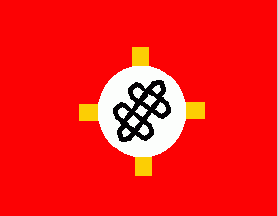 image by Klaus-Michael Schneider,
Sameth, Oma and Rohomoni are located on the southern and western shores of the tiny Haruku Island.
They all share the same flag, red with a white disc with three black ellipses forming an armillary sphere. Emerging from disc are four golden cross beams slightly shifted.
The 4th village in this confederation is Ihamahu, having a simple red flag.
The three black ellipses on the white disc are interpreted as an armillary sphere, suggesting that the flags were influenced by the Portuguese, whose flag also features an armillary sphere.
The two tiny islands of Haruku and Saparua lie south of Seram and west of Ambon, the centre of the short-lived Republic of South Maluku.
Source: Rühl 1952,, p.145
Klaus-Michael Schneider, 7 Oct 2026
 by Jaume Ollé
Ratio 2:3.
Adopted: ? .
Abolished: ? .
Note: Reverse.
 by Jaume Ollé
Ratio 2:3.
Adopted: ?.
Abolished: ?.
Sampit state in Dutch East India has two flags or ensigns. The images above are from D. Ruhl, and variations below are from a plate in Flagmaster 99.
 by Jaume Ollé
 by Jaume Ollé
Sampit is a settlement along the Sampit river in south central Kalimantan. It was one of several Muslim sultanates in Dutch Borneo that were used as buffer states between inland Dayaks and sea-faring peoples like the Buginese and Sulu-peoples. They were described as 'weak states', although there were fierce rebellions in the 19th century, which threatened the Dutch presence in the whole archipelago.
Jarig Bakker, 24 January 2001
Note that all of these flags show the zulfikar, one of the most ancient of
Islamic symbols. More information about this symbol can be found in on our page
about zulfikar on Ottoman Empire flags.
Jaume Ollé
.jpg) image provided by John McMeekin, 5 February 2015
 photo from Janis Lasmanis, 25 April 2020
Royal flag
 image by Rob Raeside, 8 June 2010
based on a sketch by John McMeekin
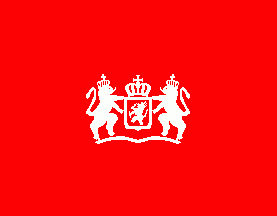 image by Klaus-Michael Schneider, 5 Oct 2026
The red flag shows in on a red shield with white edges the arms of the Netherlands in white.
The shield is supported by two crowned lions rampant as supporters, based on a white wing, the shield is surmounted by a white royal crown.
Source: Wereldmuseum (department Leiden) filing card archive no.RV 370-2077
|
 2:3, image by Olivier Touzeau, 12 Nov 2022 |
Sawitto is in The Celebes (now Sulawesi).
Sawitto State Flag (until 1957): A white flag with the image of an animal
(drawn in black), near the hoist in black, is a vertical "Jawi" inscription (line
drawing only).
John McMeekin, 8 Nov 2011
The Sawitto Flag has a yellow vertical stripe on the hoist, (between the hoist and the inscription), as wide as the inscription.
I found this on Google images. "BENDERA KERAJAAN SAWITTO" The drawing of the animal is in red, the inscription is black.
John Duncan McMeekin, 13 Oct 2022
 modern flag;
photo from Janis Lasmanis, 25 April 2020
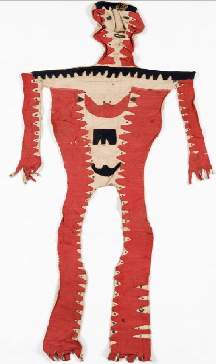 approx. 3:5, image by Klaus-Michael Schneider, 5 Oct 2026
Very unusual is a ceremonial "flag" of Seram, shaped like a human figureand made of cotton and wood.
Its greatest length is just under one meter, and its greatest width is about half that.
The flag was raised during the Poreka festival. This festival has animistic origins and served to summon spirits and venerate ancestors.
It is made of red, white, and black cotton with black wooden buttons, for example, for the eyes and mouth,
a wooden nose covered with white cotton, a red crescent moon on the chest, a black one over the genitals, and a black banner across the belly.
Source: Wereldmuseum (department Leiden) filing card with archive no. RV-1121-4
Klaus-Michael Schneider, 5 Oct 2026
 image by John McMeekin, 6 December 2010
Serdang State Flag. Serdang is in north-central Sumatra.
John McMeekin, 6 Dec 2010
 image by John McMeekin, 4 December 2010
The old red over white flag of Siau Kingdom (Sangihe & Talaud Islands, off
the northeast tip of The Celebes) [an Indonesian flag in the same image is noticeably
more red (RGB = 180,80,80) and white, making this flag look decidedly brown -
may be age?]
John McMeekin, 4 December 2010
 image by Ben Cahoon, 8 September 2020
Siau flag photo (by Janis Lasmanis) and flag image (white - red)
SIAU island in North Sulawesi, whose capital is Hulu Siau, state was founded c.1510
Ben Cahoon, 8 September 2020
 2:3, image by Jaume Ollé
Note: The flag is the same for all three entities.
 2:3, image by Jaume Ollé
 by Jaume Ollé
approx. 3:5, speculative image by Klaus-Michael Schneider, 29 Oct 2026, based on description by John McMeekin, 9 Aug 2014
I am given to understand that the flag of Sidenreng had a white field with a red band on it, which would suggest a horizontal tricolour
of white over red over white in equal bands.
Details from Donald Tick: Sidenreng had a King called The Addartuang.
The present King is Yang Mulia Paduka (Y.M.P. -or- H.M.) Haji Andi Patiroi Pawiccangi, who was crowned 22 December 2012, (born in 1927).
He is grandson of Addatuang, La Cibu, reigned 1906-1942 & 1945-1949 (d.1949)
John McMeekin, 9 Aug 2014
 image by Rob Raeside, 4 June 2010, based on a sketch by John McMeekin
The flag was yellow.
Klaus-Michael Schneider, 24 Oct 2026
 image by Klaus-Michael Schneider, 24 Oct 2026
The flag was green with yellow edges at hoist, top and bottom.
Klaus-Michael Schneider, 24 Oct 2026
 image by Klaus-Michael Schneider, 24 Oct 2026
The flag was black with white edges at hoist, top and bottom.
Klaus-Michael Schneider, 24 Oct 2026
 image by Klaus-Michael Schneider, 24 Oct 2026
The flag was black with red edges at hoist, top and bottom.
Klaus-Michael Schneider, 24 Oct 2026
 image by Klaus-Michael Schneider, 24 Oct 2026
The flag was red with white stripe alongside the hoist.
Klaus-Michael Schneider, 24 Oct 2026
 image by Klaus-Michael Schneider, 24 Oct 2026
The flag was black with red stripe alongside the hoist.
Klaus-Michael Schneider, 24 Oct 2026
The Sirisori villages are located on Saparua Island half way between Saparua city and Ouw.
 image by Klaus-Michael Schneider, 11 Oct 2026
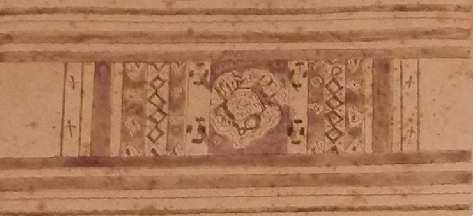 image by Klaus-Michael Schneider, 11 Oct 2026
Source: Wereldmuseum (department Leiden) filing card archive no. RV-370-2099
Klaus-Michael Schneider, 11 Oct 2026
 by Jaume Ollé
Ratio 2:3.
Adopted: ?.
Abolished: ? .
Note: The flag is the same for both entities
 image provided by John McMeekin, 8 Nov 2011
Soppeng is in The Celebes (now Sulawesi).
John McMeekin, 8 Nov 2011
 image by Rob Raeside, 8 June 2010, based on a sketch by John McMeekin
 2:3, image by Jaume Ollé
 image provided by Ben Cahoon, 4 May 2022
 image located by John D McMeekin, 11 Dec 2013
Sumbawa Sultan's Flag also had a flag which was dark-blue with a broad red edge with a 4 legged beast on it in white, as seen on this photograph of the original flag.
The long black flag with the white beast is the War Flag
John McMeekin, 29 Sep 2014
 3:5, image by Rob Raeside, 4 June 2010 based on a sketch by John McMeekin |
 4:5, image by Jaume Ollé |
Present state flag.
John McMeekin, 4 June 2010
 3:5, image by Rob Raeside, 4 June 2010, based on a sketch by John McMeekin |
 4:5, image by Jaume Ollé |
The Sunanate of Surakarta had been one of the successors of the Sultanate of Mataram. It was established already in 1745 and, at that time, also encompassed the Principality of Mangku Negara.
In September 1945, Sultan Hamengkubuwono IX and Prince Sri Paku Alam VIII signaled their support for the formation of a new Indonesian state in letters to Ahmed Sukarno, confirming the Sultanate of Yogyakarta as part of the new Republic of Indonesia.
The Sunanate of Surakarta did the same. In recognition of this, both were granted a special status within the Republic, effectively remaining princely states under this arrangement.
However, due to a communist and anti-royalist insurrection, Surakarta lost this status already in 1946 and was incorporated into the province of Central Java.
A Susuhunan (often abbreviated as Sunan) is a traditional Javanese royal title in Indonesia. The word originates from Old Javanese and is translated roughly to "the honoured one" or "Your Highness".
Historically, it is derived from a gesture of profound respect: pressing one´s palms together in front of the face. The title was originally used by the rulers of the Sultanate of Mataram.
Following the partition of the Mataram Empire in the 18th century, the title became reserved exclusively for the hereditary rulers of Surakarta (also known as Solo).
A realm governed by a Susuhunan is referred to as a "Sunanate".
While the rulers of the neighbouring dynasty in Yogyakarta held the title of Sultan, the rulers of Surakarta traditionally used the title of Susuhunan, combined with the regnal name "Pakubuwono", which is adopted upon their coronation.
Source: Klaus-Michael Schneider: "Flaggen über dem Archipel - Fahnen und Wimpel indonesischer Regionen und autonomer Staaten vor dessen Unabhängigkeit"
Klaus-Michael Schneider, 21 Oct 2026
back Indonesia Princely States index page click here


