Last modified: 2026-10-31 by rob raeside
Keywords: atlantico | colombia | cartagena | nueva granada |
Links: FOTW homepage |
search |
disclaimer and copyright |
write us |
mirrors
 (3:5)
image by Carlos Thompson, 11 August 2004
See also:
Municipalities:
The Department of Atlàntico was formally established through "Ley 17 del 11
de Abril de 1905" (Law 17 of April 11, 1905)
https://www.alcaldiabogota.gov.co/sisjur/normas/Norma1.jsp?i=13666
Source:
https://www.atlantico.gov.co/index.php
Esteban Rivera, 2 April
2026
The flag of the city of Barranquilla was
previously reported as the department flag. According to www.bundenet.com,
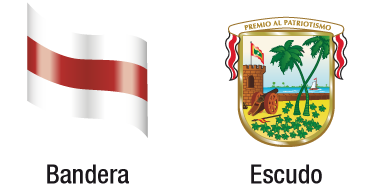
the department flag is a white-red-white triband. The presidency official site www.presidencia.gov.co
shows the same WRW triband as Atlantico Department flag.
Dov Gutterman , 14 May 2000 and 22 May 2000
I live in Barranquilla, Atlantico, Colombia. The
correct Atlantico flag is the white-red-white
horizontal-striped one, and it was officialy adopted in 1989,
before then, there was no departmental flag. The green,
red-yellow fringed, five-point star flag, is the flag of the city
of Barranquilla. The mistake was
because Atlántico flag is relatively recent (1989) and there's
no enough information about it, so the Barranquilla flag is shown
as the Atlántico flag frequently, but the real and correct flag
is the white-red-white one.
Carlos A. Leiva, 18 July 2000
According the official website www.gobatl.gov.co,
the departmental flag was adopted by decree 000589 of 27 November
1989. The flag is indeed the W-R-W triband. The decree (in
Spanish) at that page.
Dov Gutterman, 19 November 2000
From the site of the Atlantico Governorship, the ratio of the
flag is 3:5. Translation: The flag adopted by the present decree,
will have the following characteristics: a rectangular shape, in
the proportion of three (3) units height by five (5) units
length. The flag will be divided in three longitudinal
strips of equal height, whose colors will be white, for the two
outer strips, and red for the mid strip. This is from Decree No
589 of 27th November 1989 by the Atlantico Governorship.
Carlos Thompson, 11 August 2004
The white-red-white colour of the flag might allude to the
traditional men's dress at the coast that combines a white shirt
and a white pair of trousers with a red neckerchief.
Nahne Bienk, 12 February 2008
When the Spaniards arrived, they established the "Partido" (District) of
Tierradentro which belonged to the Governorship of Cartagena from 1533. In 1781
it was denominated "Departamento" (Department) until 1821 when the Department of
Barlovento was added to the Magdalena Department.
In 1845, the Congress
of the canton of Barranquilla by law, which belonged to the province of
Cartagena; in 1852, as a result of the reopening of the port of Sabanilla for
the export of goods, and the establishment of a customs house, which gave the
said port greater commercial importance, the province of Sabanilla was created.
When the Sovereign State of Bolívar was
established in 1857, Sabanilla became part of it as one of its administrative
divisions; With the
1886 Constitution, the country entered a new administrative era, and the States became known as
Departments, but with the same previous territorial configuration.
By
"Ley 17 del 11 de Abril de 1905" (Law 17 of April 11, 1905) (https://www.alcaldiabogota.gov.co)
the provinces of Sabanalarga and
Barranquilla were
merged to form the Department of Atlántico, which was initially called
Barranquilla, but was soon abolished afterwards by "Ley 65 del 14 de Diciembre
de 1909" (Law 65 of December 14, 1909) (https://www.funcionpublica.gov.co) to
be restablished again through "Ley 21 del 14 de Julio de 1910" (Law
21 of July 14, 1910" (https://www.suin-juriscol.gov.co).
Sources:
https://www.atlantico.gov.co/index.php/turismo and
https://es.wikipedia.org/wiki/Atl%C3%A1ntico_(Colombia)
As already mentioned, the flag
was formally adopted by "Decreto Número 589 del 27 de Noviembre de 1989"
(Decree No. 589 of November 27, 1989) although it has been in use in
modern times at least since 1985.
Source:
https://www.atlantico.gov.co/images/stories/adjuntos/planeacion/anuarios/anuario2024/anuario2024_capitulo1_generalidades.pdf
It was designed by Ramón Oswaldo de la Hoz.
The description is as
follows (original in Spanish): "The flag of the Department of Atlántico,
Colombia, consists of three horizontal stripes of equal size. The top and
bottom stripes are white, while the center stripe is red. The color white
symbolizes peace, purity, and harmony among the inhabitants of Atlántico. It
also represents the hope for a prosperous future and the conviction to
build a just and equitable society. The color red represents the bravery,
strength, and courage of the people of Atlántico. It symbolizes their passion
and commitment to democratic values, as well as their determination to
overcome challenges and achieve progress."
Esteban Rivera, 23 February 2026
The coat of arms (was) adopted in 1913,
created to commemorate the centenary of the granting of emblems by the
government of the "Estado Libre de Cartagena" (Free State of
Cartagena) to the city
of Barranquilla. The distinction was awarded in recognition of Barranquilla's
participation in the
liberation of
Cartagena during the wars of independence.
Esteban Rivera, 23 February 2026
atl0.jpg)
atl1.jpg)
atl2.jpg)
atl3.jpg) images located by Esteban Rivera, 23 February 2026
First image: ca. mid 20th century, b/w
Second image: ca. mid 20th century,
b/w
Third image: ca. mid 20th century, color
Fourth image: stylized
version in use since 2008
The coat of arms description is as follows (original in Spanish): The shield has a Spanish shape, characteristic of many heraldic shields. Inside, a flowing river is depicted, evoking the numerous bodies of water that run through the department and their historical importance as routes of communication and trade. Each of our 22 municipalities and the District are represented by hibiscus flowers.
The Coat of arms has several distinctive features. Among the most notable elements is a tower, which on the right pays homage to the fortress used to defend the territory. Above the tower is the flagpole with the national flag of that time. Next to the tower is a battery, a symbol of protection, and on the left, two coconut palms symbolize the union of the provinces of Sabanalarga and Barranquilla, which merged in 1905 to form the Department of Atlántico. At their base are 23 hibiscus flowers, representing the 22 Municipalitiesof the department and the present-day District of Barranquilla, its capital. (It also features) a helmet and a (red) flag as a sign of the Spanish surrender. In the background of the shield, a flowing river can be seen on which a sailboat and a sampan are sailing, representing the river ports that existed in the Department.
The
flag's design changed from oblong to rectangular for several reasons. One of
them was to further differentiate the symbols of the Atlantic from those of
the region. The oblong flag design, as it was originally conceived (in
earlier versions), is shared by the history of Colombia when it was New Granada, as well as
Cartagena de Indias,
Barranquilla, El Carmen
de Bolívar, Malambo, and
Tenerife. In this version, the
flag was modified to the one adopted by the Department of Atlántico in 1985:
a white flag with a red stripe across it.
Defensive Batteries: A battery is
an armed emplacement for the defense of a territory or a facility of
strategic value. Thanks to these batteries, navigation on the Magdalena
River, ports, and customs houses were defended. Their presence on the coat of
arms is due to the
Legislative Decree of (April 7) 1813, which, in the midst of the War of Independence, ordered the placement of a
defensive battery on this emblem.
The Keep or Merlon structure: The towers or
battlements symbolize that the city or territory has been won or defended
with strength and personal virtue or power. In 1985 the Department of
Atlántico adopted a white flag crossed by a red stripe (ribbon).
Palm Trees
and coconut trees: Palm branches in heraldry denote victory. These
intertwined palm branches symbolize the Provinces of Barranquilla and
Sabanalarga, which comprised the jurisdiction of the Department of Atlántico
from 1905, restored in 1910.
The shield thus adopted will have the
following configuration, meaning, and interpretation:
a. Crenellated
Tower: On the left side of the field, on a white background, as clean as our
peaceful tradition, rises a crenellated tower, a traditional symbol of
strength, security, and protection, above which flies the flag of the
Sovereign State of Bolívar, from whose territory we were separated by mandate
of the Congress of the Republic.
b. Defense Battery: To the right, at the
foot of the Tower, facing east and on a blue strip symbolizing the Magdalena
River, a cannon forms a defensive battery. This battery recalls the protection
exercised from the San Antonio Battery over the security of international trade
and the constant safeguarding provided from the riverbanks at Barranquilla over
the passage of armies seeking to control the Mother River of the Nation and,
with it, the fate of the Republic. Five cannonballs piled beside it remind us of
the heroic contribution made by Barranquilla, Soledad, Santo Tomás, Sabanalarga,
and Baranoa to the consolidation of our independence and the organization and
construction of the Republic. The memory of this heroic feat is complemented by
the defeated colonial banner lying on a golden field symbolizing the wealth of
our land.
-Magdalena River and Navigation to Barlovento: On the Blue
River,
backbone of the national economy, guiding thread of our future, which runs
North-South, a ship sails to Barlovento, a name that identifies our
territory, penetrating the homeland carrying riches, culture and development
as befits the motto of "Golden Gate" with which President Marco Fidel Suarez
distinguished us.
c. Intertwined Palm Trees, Palms and Hibiscus: On this same
ground, on twenty-three hibiscus, heraldic flower, which symbolize the towns
that made up the Cantons of Barlovento that continue to form part of our
territory, namely: Barranquilla, La Playa, Sabanilla, Galapa, Baranoa, Tubará,
Zamba, Soledad, Malambo, Sabanagrande, Santo Tomás, Palmar de Varela, Pueblo
Nuevo, Sabanalarga, Usiacurí, Piojó, Ponedera, Candelaria, Manatí, Campo de La
Cruz, Palmar de Candelaria and Aguada de Pablo; And that also symbolize the
twenty-three municipalities of our current territorial jurisdiction, two intertwined palm trees stand, reminding us that in our
original territorial organization in 1912, the Provinces of Barranquilla and
Sabanalarga existed, and the fact that they are intertwined signifies the
indissoluble destiny between the Atlantic Province and the Capital City,
whatever the future may hold for us. The first Palm Tree, Barranquilla
Province, has nine palm trees located on the right side of the field, each
corresponding to one of the municipalities that comprised it: Barranquilla,
Puerto Colombia, Soledad, Malambo, Sabanagrande, Santo Tomás, Palmar de
Varela, Galapa, and Tubará. The second Palm Tree, Sabanalarga Province, has
11 palm trees located towards the center of the field, corresponding to the
municipalities that comprised it, namely: Sabanalarga, Repelón, Campo de la
Cruz, Manatí, Candelaria, El Suán, Piojó, Juan de Acosta, Usacurí, Baranoa,
and Polonuevo.
d. Green Horizon: Against the horizon, a green line of
vegetation stands out, the Island of Salamanca, a symbol of our commitment to
respecting life and, especially today, when we suffer the hardships of a war
that threatens civilians, to respecting freedom. The Island of Salamanca,
whose channels and marshes are a physical element that connects us to the sea
and links our future to the entire western bank of the Magdalena River, with
which we are inextricably linked by history and economics, from El Banco to
the western breakwater.
e. Bounding Ribbon: At the top of the emblem,
bordering the field, on a white ribbon, in gold letters, is written:
"Patriotism Award," the emblem that distinguished our land and our ancestors.
On both sides, the ribbon ends with the white, red, and white flag, the
emblem of our department.
The stylized logo (in use since 2008) has the following colors:
Red: CMYK
0 - 99 - 91 - 0 ; RGB E40E20 ; PANTONE P 48-8 C
Crimson: CMYK 0 - 97 - 80 -
10 ; RGB D31A2B ; PANTONE P 52-16 C
Dark grey: CMYK 71 - 56 - 49 - 22 ; RGB
4A4F55 ; PANTONE 7540 C
Soft grey: CMYK 50 - 33 - 30 - 3 ; RGB 7A858C ;
PANTONE 430 C
Grey: CMYK 27 - 18 - 18 - 0 ; RGB C1C5C8 ; PANTONE 428 C
Orange: CMYK 3 - 34 - 91 - 0 ; RGB F4B223 ; PANTONE 7409 C
Yellow: CMYK 3 - 8
- 100 - 0 ; RGB FFDD00; PANTONE PROCESS YELLOW C
Light blue: CMYK 78 - 23 - 0
- 0 ; RGB 009ADE ; PANTONE 2925 C
Dark blue: CMYK 96 - 72 - 0 - 0 ; RGB
0047BA ; PANTONE 2728 C
Sky blue: CMYK 45 - 8 - 0 - 0 ; RGB 95D4E9 ; PANTONE
2975 C
Dark green: CMYK 95 - 15 - 96 - 4 ; RGB 00833E ; PANTONE 348 C
Light green: CMYK 85 - 0 - 86 - 0 ; RGB 00B451 ; PANTONE 7481 C
The Font
type is Gotham
Even though a proposed flag version with the coat or arms in the middle of
the flag is proposed, I have yet to see one such specimen.
Source: "Manual de
Marca Atlántico 2024" (https://www.atlantico.gov.co/.../Manual_Marca_2024.pdf),
developed by Design Agency "Dávila". Also, even though the above mentioned
official document states the use of the 2008 arms version, on the official
website the coat of arms they show (https://www.atlantico.gov.co/.../escudo_bandera.png,
from:
https://www.atlantico.gov.co) is very well the
fourth image above.
Esteban Rivera, 23 February 2026