
Last modified: 2026-04-11 by  zachary harden
Keywords: ermera |
Links: FOTW homepage |
search |
disclaimer and copyright |
write us |
mirrors
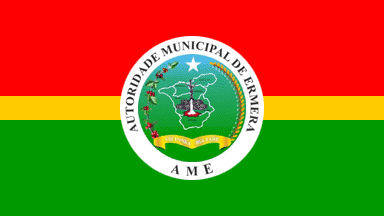 image by António Martins-Tuválkin, 04 March 2026On 6 November 2025, the municipality of Ermera (Timor-Leste) adopted its first CoA (seal) and flag. Here is the automatic translation of the announcement in Tetum on the official Facebook account of the Autoridade Munisípiu Ermera, posted on 6 November 2025:
“Ermera Municipal Authority held an extraordinary Municipal Advisory Council Meeting to present the Motto, Emblem and Flag of Ermera Municipal Flag from the Elaborator Working Team, meanwhile from this presentation, His Excellency the President of the Advisory Council also presented and encouraged the members of the Advisory Council to implement the Regulations again. communities that continue to make death and life. Thursday, 06/10/2025 [sic! It was November] , His Excellency the President of the Ermera Municipal Advisory Council, Mr. José Martinho dos Santos Soares, accompanied by the Secretary of Administration and Finance, Secretary of PIDI and Secretary of Social Affairs and Organization, held an Extraordinary Municipal Advisory Council (KKM) meeting with KKM Members, at the Ermera Municipal Authority Hall. In this Extraordinary KKM meeting, the Final Results on Important Documents such as the Motto, Emblem and Flag of the Municipality were presented by the PARTISIPA Advisor, Mr. Calisto Babo Soares, elaborated by the Working Team of the Planning Agency including the PARTISIPA Advisor led by the Excellent Secretary of PIDI, Mr. António Alves da Costa. In addition, the President of KKM and all Assembly Members discussed and gave appreciation to the Municipal Emblem with Votes in Favor (29), Against (7), Abstain (9) and the Municipal Flag with Votes in Favor (29), (7), Abstain (4) as a preparatory phase for the Local Government, Number 2022, 2023 Article 22, at the same time received appreciation from KKM Members for the Regulation on Tara Bandu [traditional law] with Votes in Favor (39), Against (2) and Abstain (2), means passed and the Regulation is implemented in nine (6) Administrative Posts of Ermera Municipality.” (Source)
Unfortunately, there is no official description of the symbolism. The seal depicts a map of the municipality of Ermera, divided into its named administrative districts, including their names. At its center stands a traditional stone altar, similar to those found in Apido. On the altar stands a totem (called Ai To'os in Timor). Below it, a spring flows into a red basin (?). Above the map is a white star, similar to the one on the national flag. To the left, a coffee branch forms the frame, and to the right, a branch with cotton and a grain. The usual staple foods here would be maize, rice, or cassava. Below the map, the motto "USI TONKA BIA TANE" is displayed in a yellow banner. The background color of the seal transitions from light blue at the top to medium green. It is unclear in which language the inscription is written. Mambae is the primary language spoken in the municipality, along with Kemak. In Tetum, the official language, which is related to both languages, "Usi" is a title of ruler, "tonka" means "to support," and "tane" means "to offer." Around the seal, the official name of the authority, "AUTORIDADE MUNICIPAL DE ERMERA," is written in Portuguese. The abbreviation AME is shown below. The flag appears to have a 2:3 aspect ratio and is horizontally divided into three stripes in a 4:1:4 ratio. The colors are red, golden yellow, and medium green. The municipal seal is positioned in the center, spanning half the flag's height.
J. Patrick Fischer, 30 November 2025
On the right and the left wall of the East Timor national parliament
are hanging traditional weavings, each with the name of one of the
districts. Each district has such a weaving
on the left and the right, but
there are not exactly the same, just similar.
J. Patrick Fischer, 08 August 2002
 image by J. Patrick Fischer, 08 August 2002
 image by J. Patrick Fischer, 08 August 2002
Some, not all, Portuguese overseas municipalities received arms and
flag in the period 1940-1974, after all metropolitan
municipalities got one. In Portuguese Timor overseas province only
Díli had a flag and a coat of arms, all other
12 municipalities (currently named districts)
being confirmedly flagless.
António Martins, 15 January 2003 and 06 August 2005
.jpg)

