
Last modified: 2026-08-29 by martin karner
Keywords: yoqne'am illit | upper yoqne'am | mo'atza mekomit yoqne'am illit | text: hebrew (blue) | flower (blue) |
Links: FOTW homepage |
search |
disclaimer and copyright |
write us |
mirrors
(source)
See also:
![[Local Council of Yoqne'am Illit (Israel)]](../images/i/il-lcyqn1.gif) image by Dov Gutterman | 2:3  Emblem adopted 28 December 1961 |
Local Council Yoqne'am Illit (meaning Upper Yoqne'am, after
the nearby Yoqne'am colony est. 1935, itself named after Joshua 12:22)
is situated on the border of Jizrael Valley and Carmel
(and Menashe) mounts, SE of Haifa. Pop: 12'000.
In the two visits I made there were no flags on the city hall
which is under construction. I was told that the emblem on
various colours is used. Until confirmation I made a blue on
light blue with the original emblem. The municipal emblem was
published in the official gazette (Rashumot),
'Publications Gazette' section (Yalkut ha'Pirsumim), YP
898, 28 December 1961, for the then Local Council Yoqne'am. I
suspect that the flags may carry a revised inscription with
"Illit" added.
Dov Gutterman, 14 November 2001
In my visit of 19 July the flag was there (and more then one).
It is white and charged with the emblem in blue-green-white (see Previous Flag below).
Dov Gutterman, 23 July 2003
Yoqne'am Illit (usually called just Yoqne'am and the original
nearby Yoqne'am is called Yoqne'am-Moshava
(Yoqne'am-Colony) was established as transitional residency and
as frequently happened became a permanent community.
Yoqne'am is mentioned twice in the bible (Joshua 12:22
and 19:11) as the southern border of
Zevulun tribe estate. Local coucil since 1967 with 17'000 inh. (2004).
No information on symbols at the official site [partially retrievable].
Dov Gutterman, 15 April 2005
In my visit of 4 May 2005, I noticed that only one type of
flag is used now – 2:3 blue with wide white border all around and
charged with the emblem with inscriptions YOQNEAM in Hebrew
(above the emblem) and English (below) in white.
Dov Gutterman, 8 May 2005
![[Local Council of Yoqne'am Illit (Israel)]](../images/i/il-lcyqn.gif) image by Dov Gutterman
image by Dov Gutterman
.jpg)
(source)
From Hebrew Wikipedia:
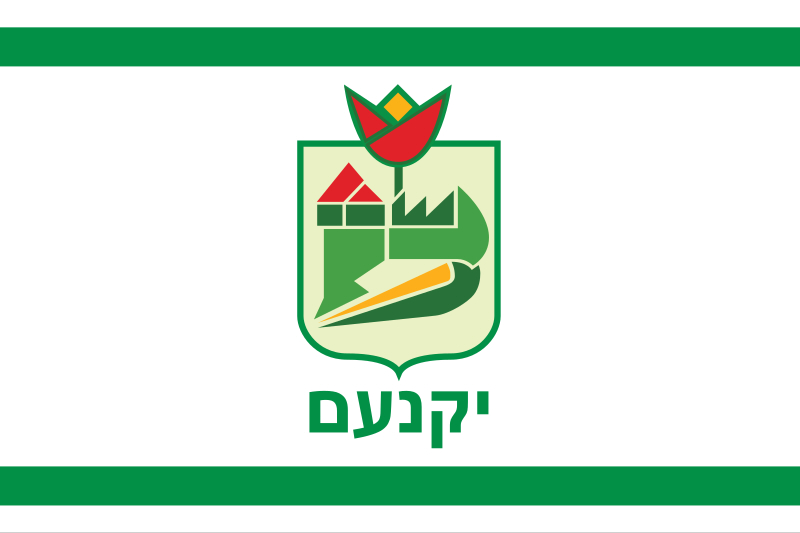
The coat of arms consists of a shield with a green border and a light green field, at the bottom of which is the inscription "Yokneam Municipality" in Hebrew and English. The shield features several symbols:A rose – situated at the top of the coat of arms, symbolising the city's "blooming" from its transition in the 1950s into a major city. It also symbolises Yokneam's status as the "Rose of the Valleys". The rose is coloured red and green. A residential building – in red and green – symbolises the city's construction boom and its "commitment to high-quality building". Three industrial buildings, depicted in green, symbolise the city's three industrial parks and its status as a "leading high-tech city". The emblem is intended to express the city's development and its extensive construction, including residential buildings and industrial parks. The dominant colour in the emblem, green, symbolises Yokneam as a green city.
(Translated with DeepL.com)
lcyqn.gif) image by Dov Gutterman
image by Dov Gutterman
From Hebrew Wikipedia:
The town's previous coat of arms was in use even when it was recognised as a local council. It featured an illustration of a barn and an adjoining dwelling against a mountainous backdrop; a path ran from between the buildings down to the bottom of the coat of arms, where there were two wavy lines symbolising the Kishon Stream. In addition, at the top of the coat of arms was the "Rose of the Valleys", which also appears on the current coat of arms. The coat of arms usually appeared on a blue background, with the lines of the design in green and white. The coat of arms was adopted on 28 December 1961. When the town was granted city status, the coat of arms was changed.
(Translated with DeepL.com)

