Last modified: 2026-09-12 by martin karner
Keywords: appenzell | rhodes |
Links: FOTW homepage |
search |
disclaimer and copyright |
write us |
mirrors
 (source)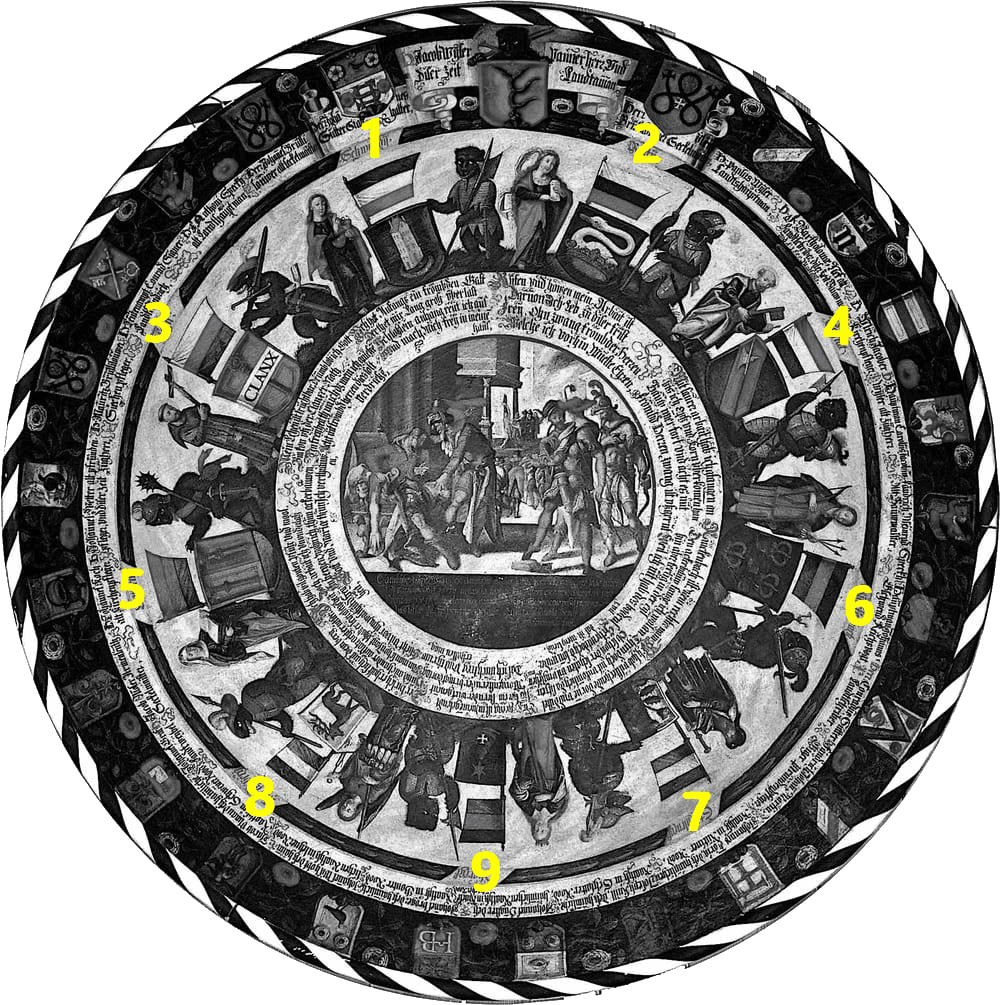
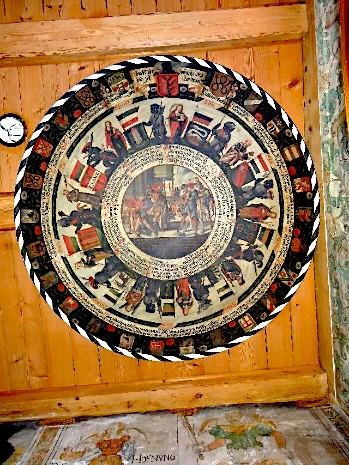
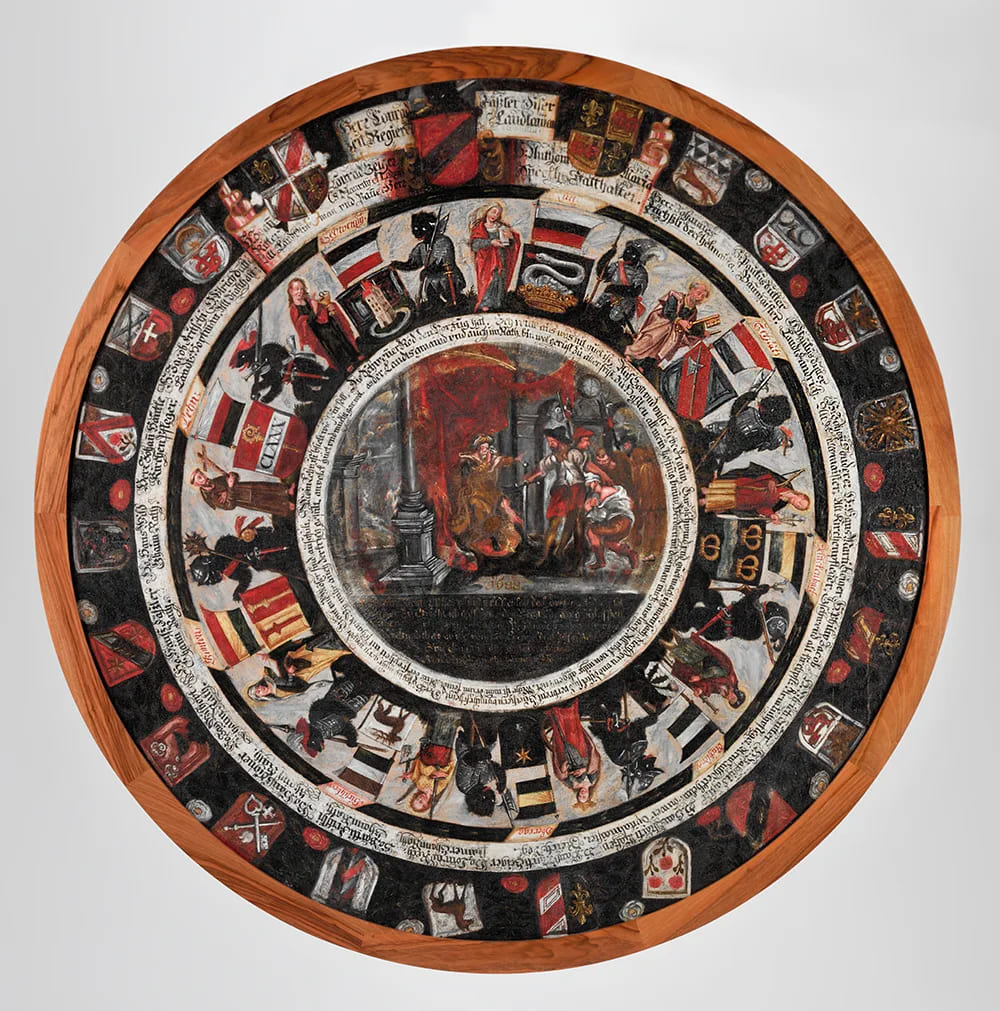
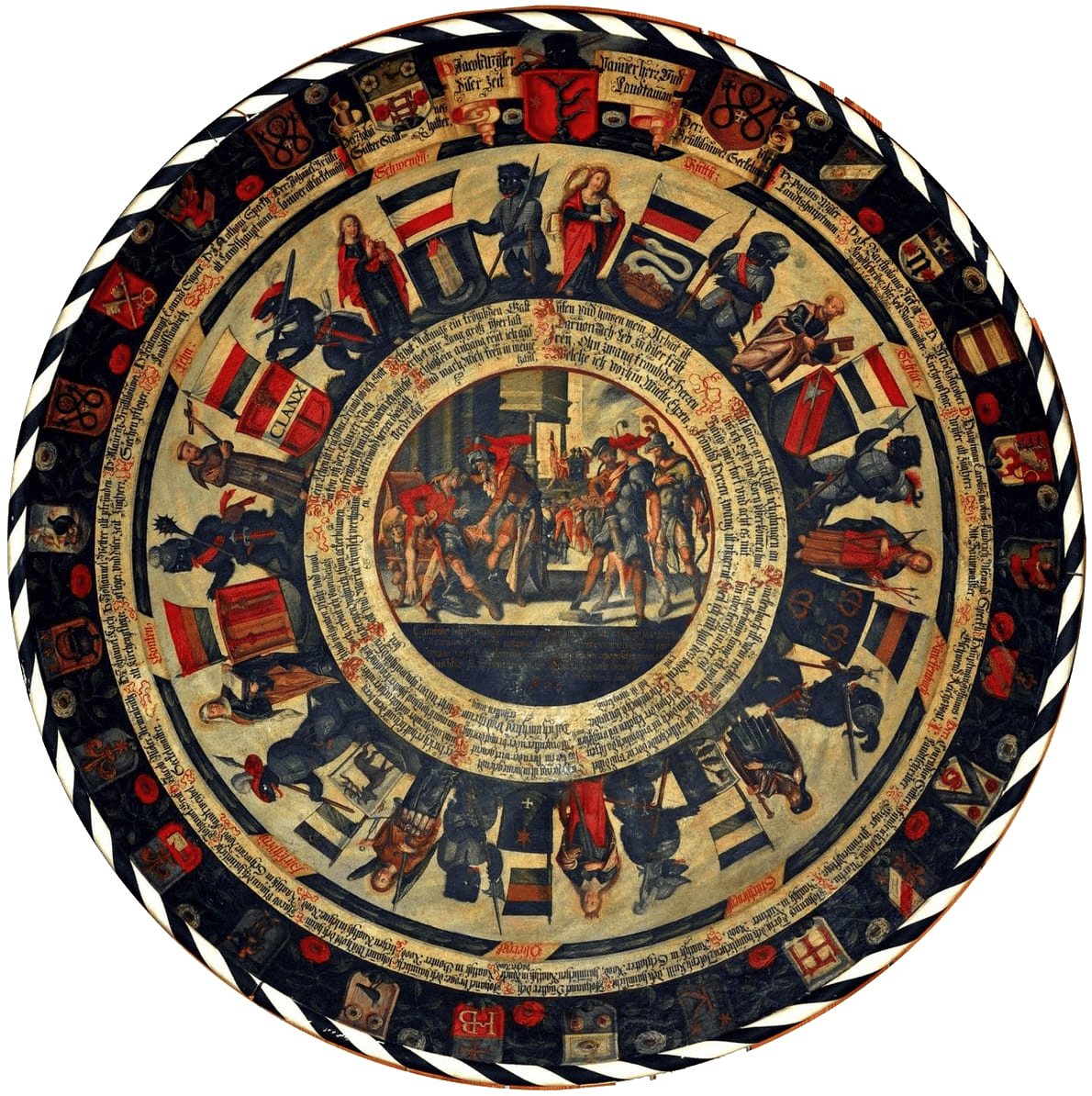
The so-called Council Rose (Ratsrose) is a 180 cm large, circular political and historical panel
dating from 1651 (wooden disk covered with canvas). It was created by Hans Bildstein and is located in the
Town Hall of Appenzell
(photo source,
photo source).
The name "Council Rose" refers to its rose-like, circular design. The panel commemorates the
former political organization of the canton of Appenzell Innerrhoden.
At the centre there is not a coat of arms but a dramatic scene from the ancient history of the Persian King
Cambyses II. It depicts the judge Sisamnes, who was punished for delivering an unjust verdict.¹
The scene had a very specific political purpose: It was intended to remind the judges of the state to
administer justice fairly and impartially (However, the depiction of a scene from such a gruesome story
does not suggest a great deal of confidence in the judiciary of that time).
Around this central scene are arranged concentric circles. In the middle section are the coats of arms of
the nine Rhodes and Half-Rhodes, the traditional political and territorial subdivisions of Innerrhoden.
The coats of arms
are arranged in pairs, in accordance with their traditional order (see b/w image above). Each one of them
is accompanied by their colour flag², their patron saint and a bear supporter. The different sizes of
the shields and flags indicate the rank that the Rhodes hold amongst themselves. Within this circle there
is a ribbon-circle with texts in verse form, portraying each Rhode.
The outer circle contains the 25 coats of arms of the members of the government and the Secret Council
(regulatory oversight commitee).
With this system of concentric circles, the political structure of the state at the time is represented
visually. It is thus a remarkable testimony to the political culture of the Ancien Régime and
to the strongly corporate character of Appenzell's political system. The Council Rose was originally
located in the Grand Council Chamber of the Town Hall (Today it's still in the Town Hall, but in an other
room).
(There is also a smaller [166 cm] Council Rose dating
from 1688, attributed to Johann Martin Geiger, and exhibited in the Swiss National Museum in Zurich. It
likewise features concentric circles containing political coats of arms and figurative scenes; in this
case, the Greek judge Bias is depicted as
a positive role model at the centre. The smaller Council Rose was originally located in the Small Council
Chamber of Appenzell. [source])
¹ More information on Wikipedia.
Viewer and reader discretion is advised. Very cruel story and images.
² colour flag (Farbenfahne): flag with coloured stripes, representing the colours of
the regular flag and/or the arms. On the panel the colours may differ from the official description due to
discoloration over time. Incorrect representations are also possible.
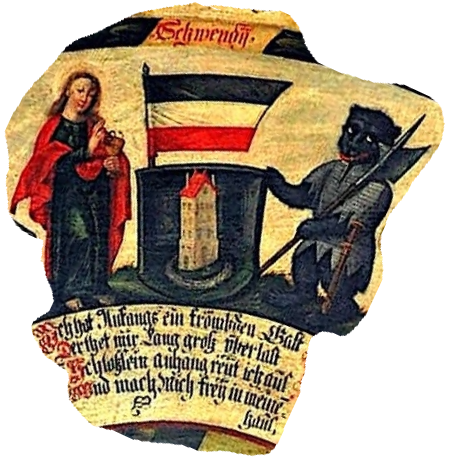
Blazon: Azure issuant from a coupeaux of three Vert surmounted by a moat Argent a tower of this Last roofed Gules.
The tower represents Rachenstein castle, built around 1080 by Ulrich III, prince-abbot of St. Gallen. It served as a place of refuge for him during times of war. It was destroyed by the people of Schwende at the beginning of the Appenzell Wars – others would follow.
On the right side of the shield stands Schwende's patron saint, the apostle John. He is holding a
chalice from which a snake is writhing its way out. This alludes to the legend according to which he drank
poison without suffering any harm.
The supporter carries a halberd as his weapon, the traditional design of which is reminiscent of those
used in the Wars of Independence.
Colour flag: blue-white-red
Text:
Ich hat Anfangs ein frömden Gast
Der thet mir Lang gross überlast
Schlösslein anhang reut ich aus
Und mach Mich frey in meine haus.
(At first I had a stranger as my guest
Who for long laid a great burden upon me
I root out the little castle and all that belongs to it
And make myself free within my own house.)
Text on the small Council Rose:
Die Schwenner Rod den Vorzug hat,
an der Landtsgemaind und auch im Rath.
(The Schwende Rhode takes precedence,
at the Landsgemeinde and in the Council.)
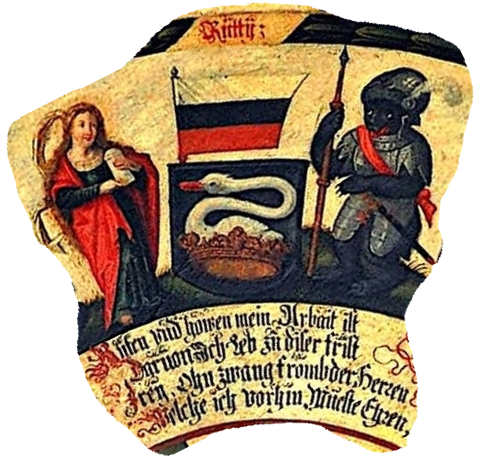
Blazon: Sable a crown Or garnished Gules issuant from it a demi-swan Argent beaked of the Third.
The arms are those of the von Schönenbüel family, they commemorate the first Landammann elected by the people, Hermann von Schönenbüel († 1278). He was the first to campaign for independence from the prince-abbot of St. Gallen (cf. Rüte district).
The patron saint is Mary Magdalene, holding an ointment jar (Luke 24, verse 1 and
verse 10).
The supporter, in armour, is holding a spear and wearing a sash, which suggests a leader, perhaps
Landammann von Schönenbüel.
Colour flag: white-black-yellow
Text:
Rüten* und howen mein Arbait ist
Daruon Ich Leb zu diser Frist
Frey, Ohn zwang frömbder Herren
Welche ich vorhin Mueste Ehren.
(Clearing and hewing, my work it is
Thereof I live at this time
Free, without compulsion from foreign lords
Whom I formerly was obliged to honour.)
Text on the small Council Rose:
Ich reute* aus was nit guet ist,
bin wol grüst zu aller Frist.
(I root out what is not good,
I am well prepared at all times.)
* rüten/reuten (to clear land, to uproot) are the origin of Rüte's name.
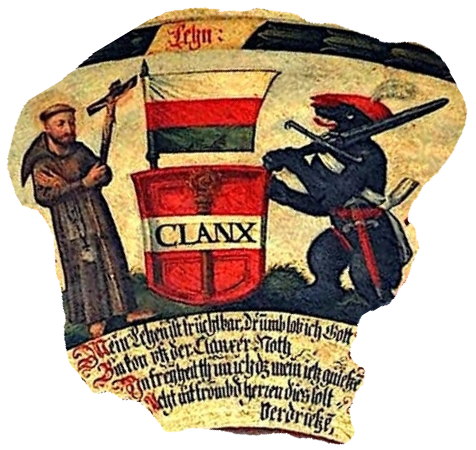
Blazon: Gules a crozier transversed Or overall a fess Argent charged with the name "CLANX".
The white/silver fess symbolizes the Sitter river, which flows through the Rhode. The abbot's staff is a
reminder of the latter's former rule. The fess did not originally bear any writing, and on other variants
it is still missing.
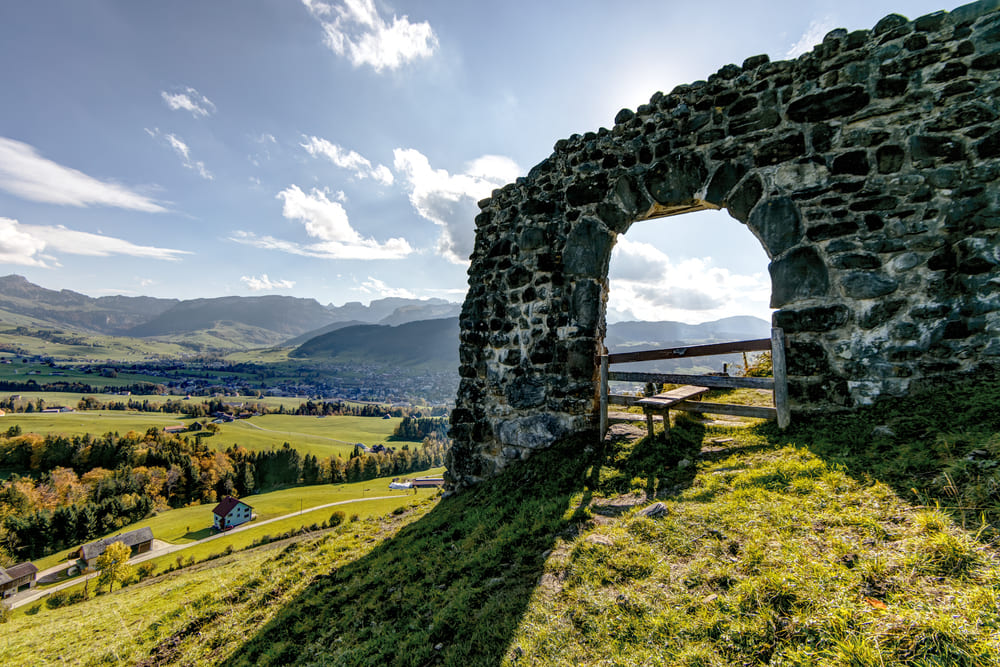
The name "CLANX" refers to the historical Clanx Castle, of which only ruins remain today
(photo source).
Clanx was built around 1210 (The Walser Chronicle reports: around 925) as a centre of the St. Gallen
administration and authority over the Appenzell region; it received its name from the
Calanca homeland of the Lords of Sax; it was first destroyed in 1289 and
rebuilt, and was finally destroyed by the rebellious Appenzellers in 1402 – after which its ruins
became a symbol of the Appenzellers' aspiration to freedom and independence.
As the Rhode's patron saint Francis of Assisi is depicted with his main attribute, the cross.
The supporter carries a short sword, like all his colleagues, sheathed, but with the characteristic
hilt of the Swiss sword. He also carries a second sword, slung over his shoulder. This second sword is a
symbol of jurisdiction. In Appenzell, on the territory of the Lehn Rhode, the court was based alongside
the government. In addition, the supporter wears a sash in the cantonal colours of white and black,
as a reference to the capital, Appenzell.
Colour flag: white-red-yellow
Text:
Mein Lehen* ist fruchtbar, drumb lob ich Gott
Bin kon uss der Clanxer Noth
In Freyheit thun ich dz mein ietz geniesse
Acht nit frömbd herren dies solt Verdrisse.
(My fief* is fruitful, therefore I praise God
I have come out of the distress of Clanx
In freedom I now enjoy what is mine
I heed not foreign lords – this should vex them.)
* fief, in German Lehen. The name Lehn comes from it.
Text on the small Council Rose:
Mein Lehn ist bestelt wie sein soll,
An volck guet und mueht gar wol.
(My Lehn [fief] is well ordered, as it should be,
With good and diligent people.)
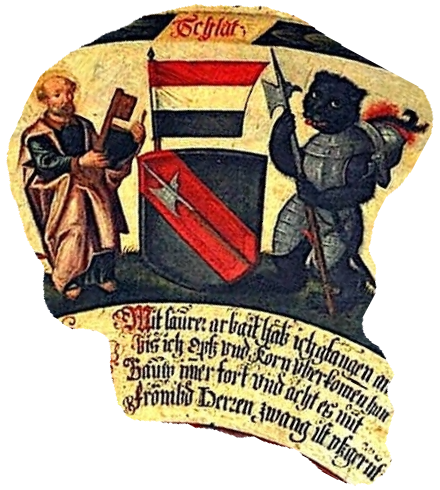
Blazon: Azure a bend Gules bearing a halberd bendwise Argent hafted Brunatre.
The halberd makes the arms canting. "Schlatt" comes from the Alemannic schlàtte
(to hit); the halberd is also a blunt weapon.
Other explanations describe the halberd as a tribute to Saint Wiborada, who is widely revered in
the Appenzell region. Wiborada lived in the early 10th century in St Gall as an anchoress, that is, a
religious recluse who had herself enclosed in a cell. She was killed during the Hungarian invasion of 926.
She is said to have warned the abbot of St Gall in advance of the impending Hungarian invasion. This
enabled the monks to bring the monastery's treasures, above all its valuable manuscripts, to safety. Her
iconographic attributes are therefore a book, accompanied by a halberd or axe. The halberd symbolizes her
martyrdom: According to tradition, she was killed by the Hungarians with such a weapon* (cf. Schlatt-Haslen district).
* In fact it was a shepherd's axe. Halberds didn't come into existence until the 15th c.
Schlatt's patron saint is the apostle Peter, depicted with a key and a rolled-up fishing net.
The supporter, consistent to the arms, is holding a halberd.
Colour flag: red-white-blue
Text:
Mit saurer arbait hab ich gfangen an
bis ich Opss und Korn oberkommen han
Bauw immer fort und acht es nüt
Frömbd Herren zwang ist ussgerüt.
(With toil and hardship I began
until I had won both fruit and grain
I build and labour on, and heed it not
The yoke of foreign lords has been cast off.)
Text on the small Council Rose:
Auf Gott und unser Liebe Frauw
zu Hasslen all' mein hofnung bauw.
(In God and Our Lady in Haslen*
I place all my hope.)
* Site of a pilgrimage church
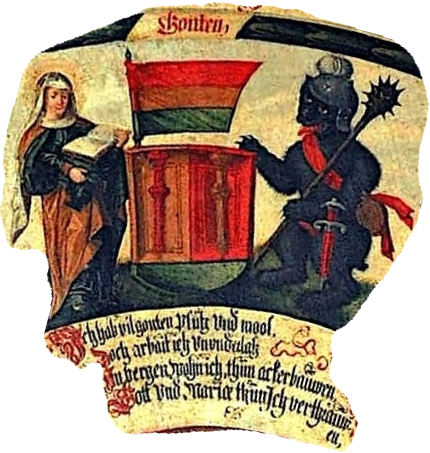
Blazon: A base Vert then per pale Or and Gules bearing two pilgrim's staffs of the Latter counterchanged.
In Gonten and surroundings there is a traditional veneration of the apostle James, who is also the patron saint of the alpine herdsmen (Quite a few lived in the high-altitude village of Gonten). As a tribute to his place of pilgrimage, Santiago de Compostela, the main colours of the arms are yellow/gold and red – the colours of Spain. The pilgrim's staff is an attribute of Saint James. The green base alludes to the green plateau of Gonten (The roots of Gonten's name can either mean marshy land with areas rich in water, or high valley, plateau – both apply to Gonten.)
Verena of Zurzach is depicted as
patron saint. Because she was known for teaching young women, her main attribute is an open book. In her
right hand she is holding a jug and a comb – symbols for her care for the sick and poor.
The supporter is holding a mace and wearing a sash, probably referring to the high number of military
leaders, who came from this Rhode.
Colour flag: red-yellow-green
Text:
Ich hab vil gonten, pfütz und moos
Doch arbait ich un underlass
In bergen wohn ich, thun ackerbauwen,
Gott und Maria thun ich verthrauwen.
(I have many "gonten", pools and bogs
yet I labour without cease
I dwell among the mountains, and till the soil,
in God and Mary I place my trust.)
Text on the small Council Rose:
Gont und Moser sind ausgfült,
By mihr auch der krieg gstilt.
(My marshes and moors are filled,
and with me the war is stilled.)
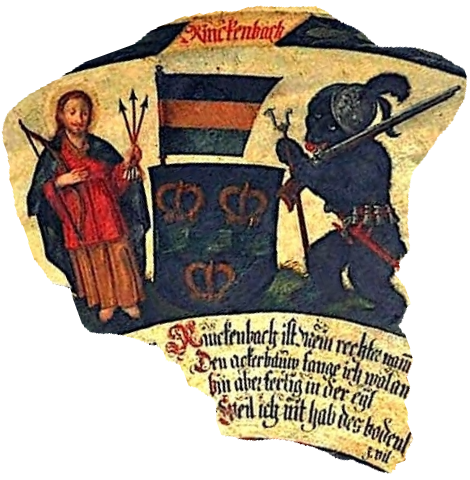
Blazon: Sable two buckles fesswise in chief Or garnished Gules a bar wavy Azure and in base a further buckle of the Second and Third.
With the buckles and the brook the arms are canting in two senses. On the one hand "Ringgen" means belt buckles; secondly the blue wavy bar symbolizes the Rinkenbach brook, which runs through the Rhode with many turns. "Ringgen" has also the meaning of turns.
The Rhode's patron saint is Saint Sebastian, who is unusually depicted here wearing elegant clothing
(usually depicted as being pierced by many arrows). He's holding the instruments of his martyrdom: arrows
and a bow. For centuries, he has also been the patron saint of the archers', crossbowmen and shooters'
guilds in many countries.
The supporter also alludes to the art of shooting, as he is the only one among his peers to be
equipped with a musket, a musket rest and a cartridge belt. The art of shooting has long been popular in
this Rhode, which was the first to have a shooting range in the land, even before the capital, Appenzell,
had one.
Colour flag: black-yellow-blue
Text:
Rinckenbach ist mein rechter nam
Den ackerbauw fange ich wol an
bin aber fertig in der eyl
Weil ich nit hab des bodens zvil.
(Rinkenbach is my proper name
I gladly take to tilling the land
but soon enough I have to cease
for I have not too much soil at my disposal.*)
* Due to the abundance of shade and the shallow layer of humus, the local soil does not yield much
produce.
Text on the small Council Rose:
Gar gschwind und guet mach ich mein sach,
Verdien nit das man mich auslach.
(Swift and well I do my work,
I give no cause to laugh at me.)
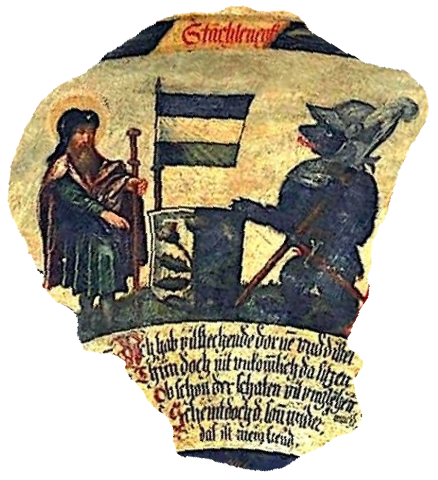
Blazon: Per pale Argent and Sable overall a three-headed four leaved-thistle Vert with flowers Azure issuant from a coupeau of the Third.
Stechlenegg is, like Hirschberg and Oberegg, a Half-Rhode, which is symbolized by the smaller size of its shield. The arms are canting with the thistles (Stacheln = thorns). The tinctures white and black very probably allude to the two brooks Weissbach and Schwarz, which run through the Rhode.
Stechlenegg is nearby Gonten and shares its reverence for Saint James, who is Stechlenegg's patron saint.
He is depicted with pilgrim's attire and staff.
The supporter wears an armour collar and holds a so-called partisan (thrust weapon 15th–18th c.).
Colour flag: black-white-green
Text:
Ich hab vil stechende dornen und distel
Thun doch nit unkommlich da sitzen
Ob schon der schaten vil unglegheit macht
Scheint doch d sonn wider,
das ist mein freud.
(I have many piercing thorns and thistles
Yet they are not ill-placed there
Though the shade causes much inconvenience
The sun shines again,
That is my joy.)
Text on the small Council Rose:
Stechdörn und distel sind verbrent,
All übel von mihr abgewendt.
(Thorns and thistles have been burned,
all evil has been turned away from me.)
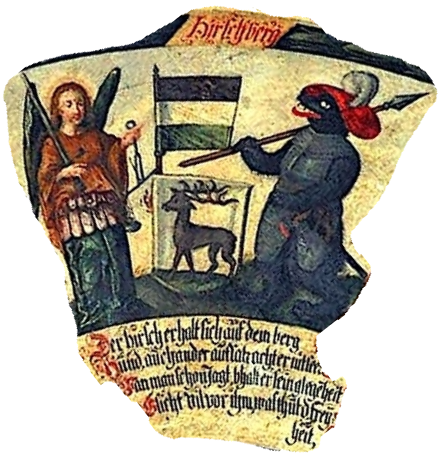
Blazon: Argent a stag trippant Sable issuant from a base Vert.
This is an unusual version with the stag in black (or the red discolorated to black, together with the colour flag). The usual tincture is red. There is also a second version with a yellow/golden stag on a plain blue field. The arms are canting with the stag (Hirsch), though the mount (Berg) is missing to make it fully canting (On the district emblem the mount was added).
The patron saint, the archangel Michael, is depicted with his usual attributes, sword and scale of souls.
The supporter is holding the third attribute of Michael, a lance.
Colour flag: red-white-green
Text:
Der Hirsch erhalt sich auf dem berg
Hund, auch ander aufsatz acht er nit seer
Wann man schon Jagt, bhalt er sein glegeheit
Gsicht vil vor ihm was thut d'freyheit.
(The stag holds its ground upon the mountain
He pays little heed to hounds* or any other attack
Though he be hunted, he keeps his advantage
and sees before him all that freedom grants.)
* The "hounds" could be an allusion to Count Friedrich of Toggenburg, whose attack on the
Rhode was successfully repelled in 1428. His heraldic animal was a dog.
Text on the small Council Rose:
Der Hirsch by mihr gern waydt,
Aus der freyheit nit schaydt.
(The stag gladly grazes here with me*,
and never strays from freedom.)
* "with me" reflects the historical by mihr, meaning "in my territory / in my
domain" rather than "together with me".
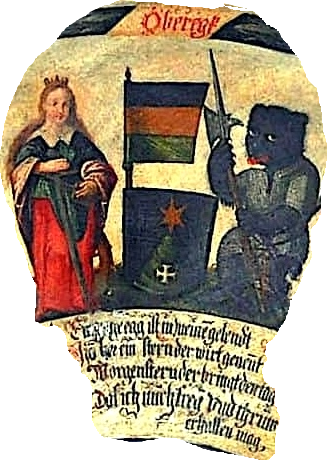
Blazon: Per pale Sable in chief a mullet of six Or in base a triangle Vert surmounted by a cross pattée Argent.
Oberegg owes its name to the protruding spur of a mountain range, on which the village is situated. This makes the emblem canting with the angular mount. The cross stands for Oberegg's church built in 1654, which means that it was added later on this panel. Since then the cross has become a part of the arms (cf. Oberegg district).
As Oberegg's patron saint Catherine of Alexandria
is holding the sword with which she was finally executed, after the breaking wheel shattered. Her crown
symbolizes victory and reward.
The supporter is holding a halberd.
Colour flag: black-yellow-green
Text:
Eine hohe egg ist in meine gelendt
Höcher ein stern, der wirt genent
Morgenstern, der bringt den tag
das ich mich frey und thrüw
erhalten mag.
(A lofty ridge lies in my land
Above it shines a star
called the Morning Star, which brings the day
that I may remain free and true.)
Text on the small Council Rose:
Guet stern by mihr scheint,
Mihr ist man drum feindt.
(A good star shines over me,
that is why I have enemies*.)
* In Oberegg, the majority remained Catholic, which made it a Catholic enclave surrounded by
Protestant territory. In the division of Appenzell in 1597, Oberegg was assigned to the canton of
Appenzell Innerrhoden, thereby becoming an enclave within Appenzell Ausserrhoden. This resulted in a
territorial patchwork that persisted into the 19th century and repeatedly led to border disputes between
Inner- and Ausserrhoden. The "enemies" in the text could be an allusion to that.
Sources:
https://www.ai.ch/gerichte
https://blog.nationalmuseum.ch/2017/10/teamwork/
https://www.e-periodica.ch/cntmng?pid=igf-001%3A1955%3A3%3A%3A73
https://www.e-periodica.ch/cntmng?pid=ahe-001%3A1922%3A36%3A%3A177
https://www.e-periodica.ch/cntmng?pid=ahe-001%3A1922%3A36%3A%3A227
https://www.e-periodica.ch/cntmng?pid=ahe-001%3A1923%3A37%3A%3A210
https://www.e-periodica.ch/cntmng?pid=ahe-001%3A1923%3A37%3A%3A239
https://www.e-periodica.ch/cntmng?pid=ahe-001%3A1925%3A39%3A%3A262
Blazons of the arms by Christopher Southworth
Martin Karner, 27 August 2026