Last modified: 2026-05-09 by ian macdonald
Keywords: ministry of peshmerga affairs |
Links: FOTW homepage |
search |
disclaimer and copyright |
write us |
mirrors
 image by Daniel Rentería, 14 April 2026
 The military armed factions of the Iraqi Kurdistan parties are labeled in
general Peshmerga. The earliest formed of armed
combatants date as far back as 1920. Currently, there are Peshmerga forces for
both leading parties, the Kurdistan Democratic Party
(KDP) and the Patriotic Union of Kurdistan (PUK).
The MoPA (Ministry of Peshmerga Affairs) was established following the
creation of the autonomous Kurdistan Region in Iraq in the early 1990s as an
attempt to place the Peshmerga under a unified civilian authority. Based on the
50-50 power sharing principle the KDP and PUK passed Law No. 5 transforming the
Peshmerga into a regular armed force under the MoPA and prohibiting political
parties from maintaining private militias. In practice, however, the ministry
held little real power, as the armed forces remained divided between the KDP and
the PUK. This lack of centralized control became evident during the Kurdish
civil war (1994–1997), when the two parties used their separate Peshmerga forces
against each other. After the conflict, the 1998 Washington Agreement, the 2006
KRG unification agreement following the fall of Saddam Hussein the Peshmerga
were politically recognized and obtained a special legal position. This
improvement came from the Coalition Provisional Authority with issuing orders
that recognized the Peshmerga and exempted them from disbandment. However, the
decision was preceded by disagreements between Kurdish leader Masoud Barzani and
the U.S. Administrator of Iraq, Paul Bremer, who regarded the continued
existence of the Peshmerga as a "red line" in the formation of the new Iraqi
state.
Peshmerga units collaborated closely with U.S. forces on patrols, interrogations, and security missions. At one point, the Peshmerga made up 30% of the new Iraqi Army. In the years after, tensions remained high, but both parties came closer to each other, and in 2003 both of them jointly took part in the overthrowing of the Baathist regime as part of the Iraq War and the broader Global War on Terror.
The CIA and other US special forces, who arrived in Iraq in early 2002,
conducted unconventional warfare operations with the Peshmerga against Ansal
al-Islam terrorists. Furthermore Peshmerga were organized to form a 'northern
Front' against Saddam Hussein's troops. As the bombing campaign and subsequent
invasion of Iraq began, Peshmerga forces, operating alongside U.S. Special
Forces, advanced beyond the Kurdistan Region and took control of large areas
that were widely regarded as Kurdish but had previously been outside Kurdish
control. These areas included Sinjar, Tuz Khurmatu, Khanaqin, and Kirkuk. By
tying down Saddam Hussein’s 5th Division in northern Iraq, the Peshmerga, helped
facilitate the coalition’s invasion of southern Iraq and reduced the number of
Iraqi forces available to oppose coalition operations elsewhere, likely saving
hundreds if not thousands of lives. The Peshmerga also played a key role in
helping the United States on the mission to capture Iraqi dictator Saddam
Hussein.
Later on the organisational reunification of the parties’
separate Peshmerga ministries in 2009, the MoPA was gradually revitalized. Under
the Multinational Forces in Iraq and Article 117 of the new 2005 Iraqi
Constitution the Peshmerga was legalized as one of the permissible regional
groups responsible for security in the "Kurdistan Regional Government". This was
done mainly in 2022 with full unification to be implemented by 2026.
The
Ministry of Peshmerga Affairs is then part of the KRG and has basically two main
military Units:
1) Regional Guard Brigades (Kurdish: لشكری پشتیوانی هەرێمی,
romanized: Leshkrey Piştîwanî Herêmî, RGBs) (most likely affiliated with the
KDP)
2) 1st Support Forces Command (Kurdish: هێزەکانی پشتیوانی یەک,
romanized: Hêzekanî Piştîwanî Yek, SFC) or First Support Forces (most likely
affiliated with the PUK)
Then there are the Regional Guard Brigades
(Kurdish: لشكری پشتیوانیهەرێمی, romanized: Leshkrey Piştîwanî
Herêmî, RGBs) which were created as part of efforts to unify the party-based
Peshmerga forces under a more centralized command. Numbering several dozen
brigades, they are formally under the authority of the Kurdistan Regional
Government's (KRG) Ministry of Peshmerga Affairs (MoPA), though in practice
many remain aligned with the two dominant Kurdish political parties, the
Kurdistan Democratic Party (KDP) and the Patriotic Union of Kurdistan (PUK).
Additionally, there's the Counter-Terrorism Group (CTG) or Kurdistan
Counter-Terrorism Unit, which is an elite special forces unit and the primary
investigative arm of the Kurdistan Regional Government. The unit was
established by the Patriotic Union of Kurdistan's (PUK) intelligence service
(called Ajansî Zanyari) in 2002 with support from the United States and the
Central Intelligence Agency (CIA) in response to the growing influence and
threat coming from Ansar al-Islam (
https://www.crwflags.com/fotw/flags/sy}aai.html ). In fact, during Operation
Viking Hammer (March 2003) they contributed to the dissolution of the Islamic
Emirate of Kurdistan (2001-2003)
(source:
https://en.wikipedia.org/wiki/Islamic_Emirate_of_Kurdistan) led by Ansar
al-Islam and the Kurdistan Justice Group
Sources:
https://www.sipri.org/sites/default/files/SIPRIYB0402.pdf
https://www.clingendael.org/pub/2018/fighting-for-kurdistan/2-the-evolution-of-the-peshmerga
https://en.wikipedia.org/wiki/Peshmerga
https://en.wikipedia.org/wiki/Operation_Viking_Hammer
https://en.wikipedia.org/wiki/Ministry_of_Peshmerga_Affairs
https://en.wikipedia.org/wiki/Regional_Guard_Brigades
https://en.wikipedia.org/wiki/1st_Support_Forces_Command
https://en.wikipedia.org/wiki/2nd_Support_Forces_Command
For additional information go to Ministry of Peshmerga Affairs (official
website): https://gov.krd/mopa
Esteban Rivera, 14 April 2026
.gif) image by Daniel Rentería, 14 April 2026
image by Daniel Rentería, 14 April 2026
Based on
https://en.wikipedia.org/wiki/Ministry_of_Peshmerga_Affairs located by Esteban Rivera,, 14 April 2026
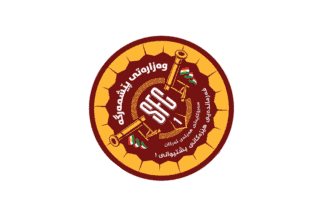 image by Daniel Rentería, 14 April 2026
Based on
https://www.dvidshub.net located by Esteban Rivera,, 14 April 2026
Picture caption reads: "IRAQ 01.13.2025 Photo by Master Sgt. Raymond Boyington Combined Joint Task Force - Operation Inherent Resolve Peshmerga Lt. Gen. Sihad Barzani, 1st Support Forces Command Headquarters (1SFC HQ) commander, poses with Coalition advisors for a group photo during a key leader engagement in northern Iraq, Jan. 14, 2025. Coalition advisors assessed the progress of sustainment and training initiatives as well as proposed unification of subordinate units for better command and control at the Peshmerga 1SFC HQ. These developments and engagements enable partner forces to better conduct unilateral operations against ISIS. (U.S. Army photo by Master Sgt. Ray Boyington)"
Esteban Rivera, 14 April 2026
.gif) image by Daniel Rentería, 14 April 2026
image by Daniel Rentería, 14 April 2026
Based on
https://www.facebook.com/farmandai.Hezakani.pishtewane1 located by Esteban Rivera,, 14 April 2026
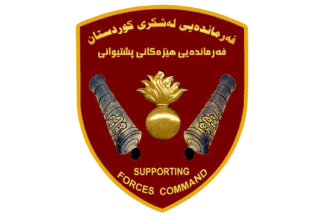 image by Daniel Rentería, 14 April 2026
Based on
https://www.facebook.com/farmandai.Hezakani.pishtewane1 located by Esteban Rivera,, 14 April 2026
.gif) image by Daniel Rentería, 14 April 2026
image by Daniel Rentería, 14 April 2026
Based on
https://www.facebook.com/qader.mohammad.77 located by Esteban Rivera, 14 April 2026
It reads: "فه
رمانده ی له شكرى كوردستان فه رمانده یی هیزه کانی پشتیوانی ۱
SUPPORTING FORCES COMMAND 1" (English: Kurdistan Army Commander SUPPORTING
FORCES COMMAND)
Esteban Rivera, 14 April 2026
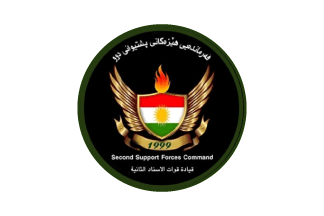 image by Daniel Rentería, 14 April 2026
Based on
https://www.facebook.com/Hezakani.pshtiwany2 located by Esteban Rivera,, 14 April 2026
.gif) image by Daniel Rentería, 14 April 2026
image by Daniel Rentería, 14 April 2026
Based on
https://www.facebook.com/Hezakani.pshtiwany2 located by Esteban Rivera, 14 April 2026
Esteban Rivera, 14 April 2026
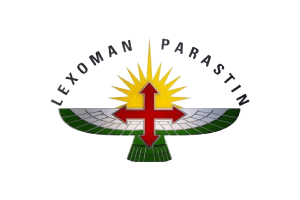 image by Daniel Rentería, 14 April 2026
Based on
https://www.facebook.com/Hezakani.pshtiwany2 located by Esteban Rivera,, 14 April 2026
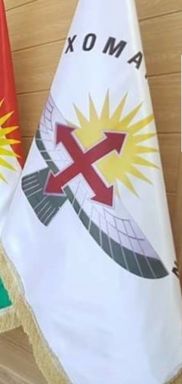
The Counter-Terrorism flag looks like it has a green border. I did a quick
search and found one in the wind with only a white background and
an indoor version of the same (but
with the more common logo style). I drew the common white background flag; for
the green border one, if it is certainly there, I'm not sure if it goes all
around or just 3 edges.
Daniel Rentería, 14 April 2026
.gif) image by Daniel Rentería, 14 April 2026
image by Daniel Rentería, 14 April 2026
Based on
https://www.youtube.com/CTGKurdistan located by Esteban Rivera, 14 April 2026
Esteban Rivera, 14 April 2026