
Last modified: 2026-01-17 by rob raeside
Keywords: signal pennant | equal speed pennant | alter course pennant | battle of jutland | equal speed charlie london |
Links: FOTW homepage |
search |
disclaimer and copyright |
write us |
mirrors
On this page:
There were five different 'alter course pennants': all bearings relative to magnetic north.
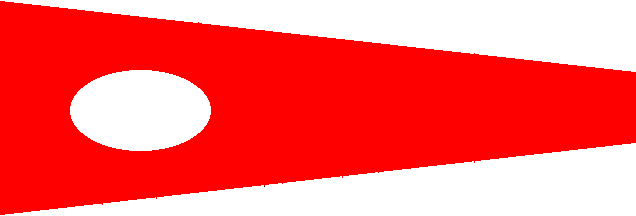 When altering course
by Compass Pendant (white oval on red pendant) Guides preserve "Relative bearings and distances" from the Guide of the fleet, and ships in column preserve "Relative bearings and distances" from their guides, thus preserving "the Order of the Fleet in Formation of Columns".
When altering course
by Compass Pendant (white oval on red pendant) Guides preserve "Relative bearings and distances" from the Guide of the fleet, and ships in column preserve "Relative bearings and distances" from their guides, thus preserving "the Order of the Fleet in Formation of Columns".
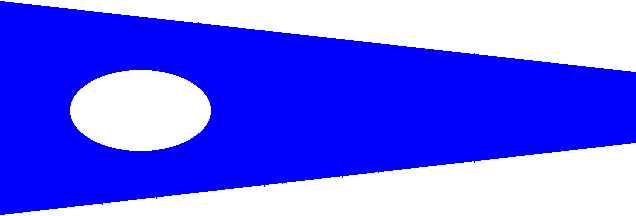 When altering course by
Blue Pendant (white oval on blue pendant) "All ships" alter course the same amount together preserving "Compass bearings and distances".
When altering course by
Blue Pendant (white oval on blue pendant) "All ships" alter course the same amount together preserving "Compass bearings and distances".
 When altering course by
Number Nine Pendant (red oval on white pendant) "Leading ships" alter course the same amount together preserving "Compass bearings and distances"; "Ships in column" preserve "Relative bearings and distances" from their leading ships.
When altering course by
Number Nine Pendant (red oval on white pendant) "Leading ships" alter course the same amount together preserving "Compass bearings and distances"; "Ships in column" preserve "Relative bearings and distances" from their leading ships.
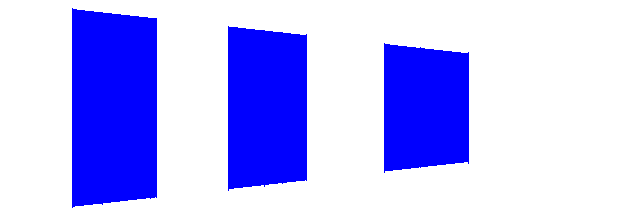 When altering course by Equal Speed Pendant (white-blue-w-b-w-b-w) to form single Line-Ahead, the column which becomes the Leading Column alters course in
succession to the point indicated, the remaining Columns alter course "Leading Ships together, the rest in succession", so as to form astern of the now Leading Column.
When altering course by Equal Speed Pendant (white-blue-w-b-w-b-w) to form single Line-Ahead, the column which becomes the Leading Column alters course in
succession to the point indicated, the remaining Columns alter course "Leading Ships together, the rest in succession", so as to form astern of the now Leading Column.
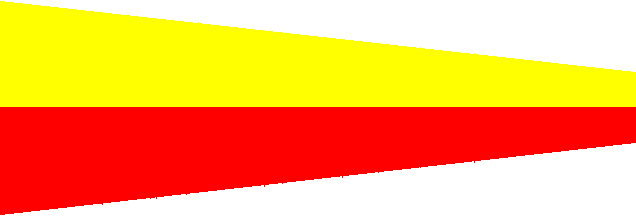 When altering course by
Oblique Pendant (yellow over red) to form Single Line-Astern, the Column which becomes the Lead Column alters course in succession to the point indicated, and increases speed to one knot less than the maximum, the remaining Columns alter course "in succession independently" course and speed being adjusted so as to form astern of the now leading column.
When altering course by
Oblique Pendant (yellow over red) to form Single Line-Astern, the Column which becomes the Lead Column alters course in succession to the point indicated, and increases speed to one knot less than the maximum, the remaining Columns alter course "in succession independently" course and speed being adjusted so as to form astern of the now leading column.
Course changes were signalled using the 128 point compass.
4 cardinal points : N, E,
S, W
4 quadrantal points : NE, SE, SW, NW
8 intermediate points : NNE,
ENE, ESE, etc
16 by points : N by E, NE by N, NE by E, etc
96 quarter
points : N 1/4 E, N 1/2 E, N 3/4 E, etc
The code for the compass table.
A. North
AA. N 1/4 E
AB. N 1/2 E
AC. N 3/4 E
AD. N by E
AE. N by
E 1/4 E
AF. N by E 1/2 E
AG. N by E 3/4 E
AH. NNE
AI. NNE 1/4 E
AJ. NNE 1/2 E
AK. NNE 3/4 E
AL. NE by N
AM. NE 3/4 N
AN. NE 1/2 N
AO. NE 1/4 N
B. North East
BA. NE 1/4 E
etc
C. East
D.
South East
E. South
F. South West
G. West
H. North West
Course or bearing in degrees.
Degrees were not numbered clockwise from due
north as a number up to 360,
but as degrees east or west from north or south.
Thus "222 degrees" was "south 42 degrees west" and signalled as :
Compass Pendant
S
4
2
W
[General Signal Book 1915. Copy in
National Archives (PRO) is ADM 186/699]
David Prothero, 1 December 2004, 18 January 2008
Equal Speed Pendant
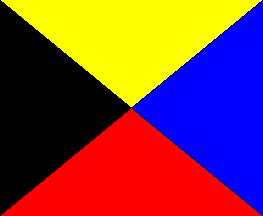 C(harlie) Pendant
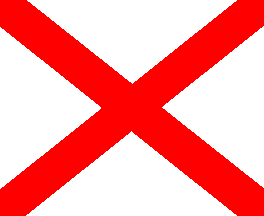 L(ondon) Pendant
Admiral Jellicoe's famous flag signal,
"Equal Speed/C(harlie)/L(ondon)" [at the
Battle of Jutland] directed his fleet to change from a column formation to a single battle line steering course Southeast by East, while maintaining the current speed. What were the components of the signal - that is, what did each of the flags signify? Was "C" the signal for the column-to-line maneuver, and "L" the course indication? Barrie Kent provides an
overall interpretation in his book "Signal!",
but does not break it down into its components.
Peter Ansoff, 1 December 2004
The equal speed pennant was (it no longer appears in the current list) part of the suite of Royal Navy signal flags, and was employed in fleet manoeuvring. When the admiral in command raised the equal speed pennant, followed by a pennant or pennants to indicate the type of manoeuver required (turn in succession to starboard etc., etc), he was giving an order for all the ships in a particular formation to act as one.
In the case of Jutland the article was probably referring to the first occasion upon which Admiral Jellicoe ordered the Grand Fleet to change from column of advance to line ahead in order to "cross the T" of the German (High Seas) Fleet - in other words, to bring all broadside guns to bear - and engage the enemy.
Christopher Southworth, 18 January 2008
Equal Speed Pennant.
"When altering course by Equal Speed Pendant to form single Line-Ahead, the
column which becomes the Leading Column alters course in succession to the point
indicated, the remaining Columns alter course 'Leading Ships together, the rest
in succession', so as to form Astern of the now Leading Column."
The letter(s) below the pennant were selected from the compass table, in which
one letter represented the major points of the compass, and two letters
represented the minor points of the compass.
Thus:
A was North
AA was North 1/4 East
AB was North 1/2 East
AC was North 3/4 East
AD was North by East
AE was North by East 1/4 East
etc..
B was North East, C was East, D was South East, etc..
David Prothero, 1 December 2004
The "Equal Speed Charlie London" signal has a somewhat iconic status in naval
history. It was hoisted by Admiral Jellicoe as a result of a bold decision which
forced the German fleet to turn away. This is an important piece of flag-related
history. This incident was significant in a larger sense because it was
(symbolically, anyway) the last time that flag signals were used as the primary
means of controlling a large formation of major warships. In later times, flags
gave way to radio and other means of communication.
Peter Ansoff, 18
January 2008